

Overview
Today, more than ever, companies of all sizes, from SMEs to Fortune 500 conglomerates, heavily rely on IT infrastructure for the continued efficiency of day-to-day business processes. Depending on the industry and the business's immediate needs, this may range from cloud services to data warehouses, cybersecurity systems, hyper-converged infrastructures, and edge computing environments.
Beyond these, another necessity enterprises must address is web development services – including system redesign, app modernization, and continuous improvement of software critical to operations. Once these essential parts are put in place, another need arises – technical support. Experienced professionals versed in the various IT fields have to be hired to administer these activities and ensure development and business processes continue undisrupted.
Because information technology demands skilled specialization, many organizations would rather hire supplementary expertise through staff augmentation firms or outsource the tasks entirely to managed services providers (MSPs). This is where understanding the difference between managed services and staff augmentation services becomes critical. Knowing the distinction between both outsourcing models in terms of their benefits and use cases helps enterprises better navigate their options when choosing an outsourcing partner.
In this article, Softellar takes an in-depth comparative view of IT staff augmentation vs managed services, delineating both concepts and providing answers to some pertinent questions.
What Are Staff Augmentation and Managed Services?
Staff augmentation and managed services are two separate business models that IT companies use to outsource the development and management of software and hardware infrastructure. Both terms might be used interchangeably in colloquial language, but their definitions highlight the distinct applications behind both outsourcing modes.
Staff Augmentation
Staff augmentation is an outsourcing strategy short-handed IT firms adopt to augment existing in-house team temporarily. In this method of employment, external professional experts are integrated into a business's internal processes to serve on development projects till they are actualized, or contract obligations are fully met.
Augmentation practices give IT companies the levity to staff up on specialized tech talents, such as hire dedicated React Native developers, for a limited duration when workforce demands are high or the internal team has a skill gap to fill.
Staff augmentation firms like Softellar serve as the third-party brokers facilitating this tractable arrangement between enterprise and personnel, and they do so by offering multiple cooperation models to satisfy organizations in varying sectors.
Depending on their staffing requirements and long-term project objectives, companies may choose traditional staff augmentation or a dedicated team model for addressing insufficiency in manpower.
While traditional augmentation is concerned with hiring technical professionals to fill specific vacant positions for a predetermined period, dedicated team augmentation focuses on putting together a professional unit consisting of development and operations experts who collaborate with the in-house team and report to internal project managers.
These models of staff augmentation services are unique in how they suggest, manage, and oversee augmented employees. But the bottom line for both models is the following: the augmentation provider assumes the responsibility of vetting and hiring the required personnel, be they software developers, analysts, designers, engineers, or DevOps professionals. Besides that, the provider also oversees onboarding and integrating the new hires into the employing company's work culture.
By using staff augmentation, enterprises free themselves from the often-steep costs that come with having tech staff on a permanent basis. These services also help put enterprises in an unencumbered position, as the augmentation provider is the body that deals with typical employer obligations such as providing benefits, training programs, performance evaluations, and other administrative burdens associated with hiring full-time employees. For the full picture of the augmentation approach, read our IT staff augmentation guide.
Managed Services
Managed services are solutions employed by enterprises to develop, support, and maintain IT infrastructure for an extended period through an external provider, usually within the scope of a service level agreement (SLA). These services are made possible by specialized institutions known as managed services providers (MSPs), and they achieve this by covering a range of functions such as troubleshooting, security management, data backup, and recovery, as well as 24/7 surveillance and support.
This method of workforce supplementation, where companies outsource entire projects or infrastructure maintenance to MSPs, is commonly utilized by companies having no internal IT team or those whose core teams are preoccupied with developing other strategic initiatives.
Managed services kicked off at the turn of the 21th century when emerging technologies like virtualization and cloud services began to take a foothold. In response to the increasing complexity of IT environments, companies began outsourcing specific IT tasks such as network management and data security to third-party providers. This allowed businesses to leverage expertise from highly qualified professionals at lower costs and with greater efficiency in business operations.
Still Unsure Which Model Fits Your Needs?
Choosing between staff augmentation and managed services can be complex. Our experts will analyze your specific requirements and help you select the optimal approach for your IT infrastructure and business goals.
Managed Services vs. Staff Augmentation: A Comparative Analysis
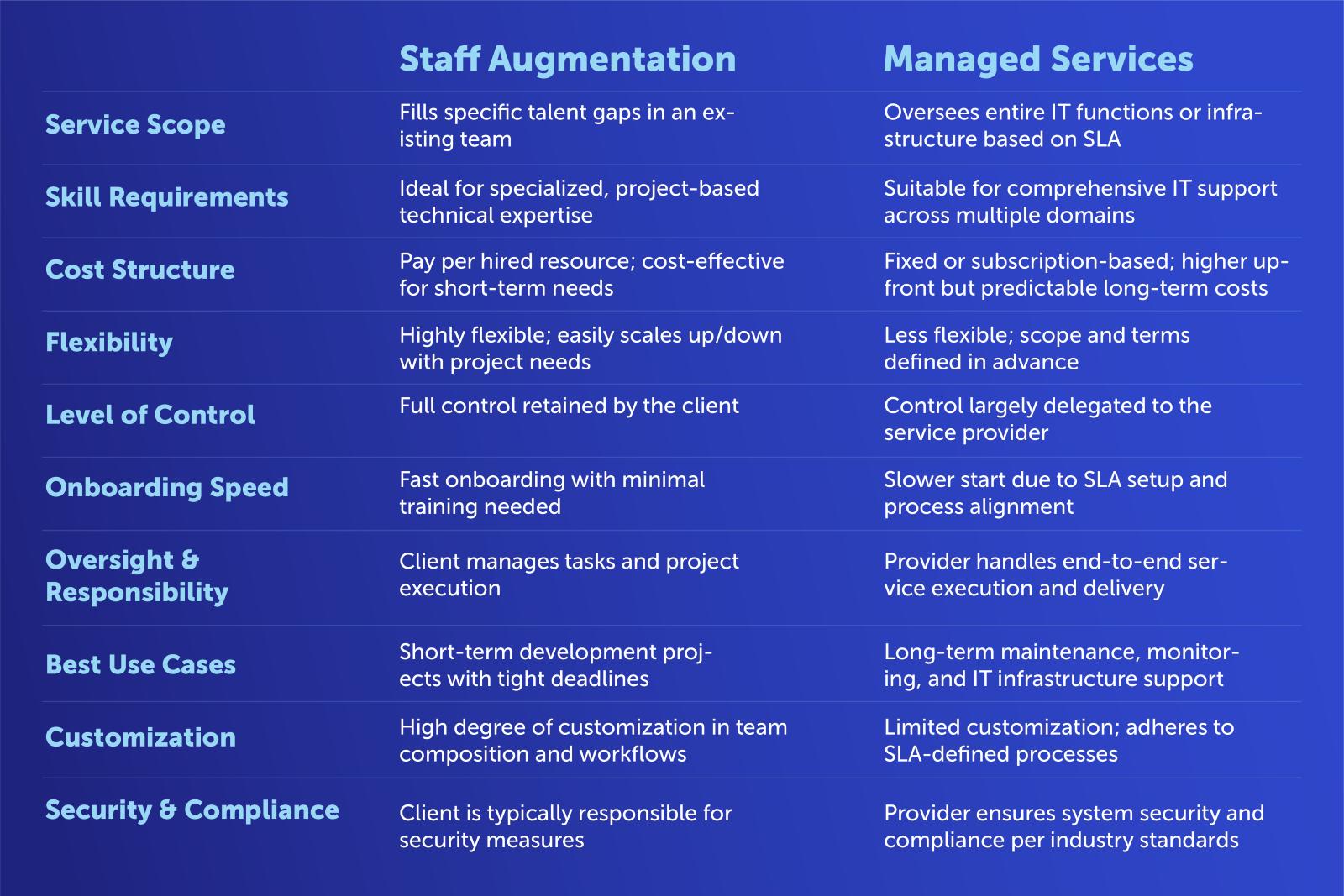
What is the difference between staff augmentation and managed services? While both outsourcing models share similarities in the type of customer needs they provision, their service descriptions differ considerably. To paint a more comprehensive picture of managed services vs staff augmentation, let's compare both models based on their costs, flexibility, and the level of control afforded to the client.
Costs
Augmenting staff temporarily can be substantially more economical than hiring managed services. This is not to say that managed services are not at all cost-efficient. But depending on the job functions that are being outsourced, it may be more financially prudent to go for one over the other.
Staff augmentation helps businesses maximize operational budgets on short-term or fixed development projects as these businesses only have to pay for the duration of the project to which the augmented team members contributed. This workforce augmentation method is especially suited for small and midsize businesses with limited budgets and temporary IT needs.
An essential component of managed services is the service level agreement. In this document, MSPs and IT client firms detail the intricacies of their business contract, covering the provider's payment structures, service responsibilities, and expected performance standards. Because managed services are inherently long-term IT solutions, they may require a more consistent investment in the form of a one-time fixed fee or recurrent subscription fees. These alternatives may seem pricier initially, but their long-term benefits to system security and business operations become more evident in the long run.
Flexibility
Compared to the traditional hiring process, staff augmentation and managed services offer flexible business models. Yet, the degrees of separation between both become obvious when the range of flexibility comes into question. Staff augmentation service providers offer a more tractable employment model that allows IT organizations to selectively scale specific IT functions and development operations as needed. With staff augmentation, new team member can quickly be incorporated into the existing team to pursue project objectives.
Managed services are not so flexible; the terms of engagement are typically predetermined before the commencement of services and can remain unchanged due to the long-standing nature of their service offerings.
Level of Control
When comparing IT-managed services vs staff augmentation, the extent to which the employing company gets involved in the project is strikingly dissimilar. In an augmentation model, clients typically retain some level of control, and they determine the project timeline, tasks to be undertaken, and the involvement level of the external technical team.
Managed services, on the other hand, present a more holistic methodology for infrastructure administration and management, where the service provider is wholly responsible for the execution and delivery of service commitments. This limited liability MSPs provide comes at a cost to IT-based and IT-dependent organizations – they have to forego a reasonable amount of oversight and trust the MSPs to maintain their IT infrastructures in optimal condition.
Advantages of Staff Augmentation
It would be inconsequential to compare IT managed services vs staff augmentation without looking at the unique and varied benefits these outsourcing models provide. The upsides to adopting staff augmentation as a service include:
Access to Specialized Technical Talent
When embarking on any software development initiative, it is not uncommon for IT companies to experience workload spikes that demand more skilled hands for the project to be executed properly. Staff augmentation services supply this in-demand talent, like .NET developers for hire, in due time and with little hassle to the companies in need. They conduct the vetting and interviewing of potential candidates and furnish you, the clients, with a venerable talent pool to choose from.
Risk Mitigation
Some technical functions are far too delicate and significant to be entrusted to in-house hires not conversant in the field. Staff augmentation addresses this potential mismatch between employees' skills and project requirements by providing external technical teams versed in various aspects of project development and delivery. This helps companies that adopt the staff augmentation model to limit the likelihood of errors in the development process, thereby boosting their chances of achieving their mission statement.
Cost Savings
Hiring full-time employees in any industry comes with various associated costs not limited to salaries, benefits, bonuses, and insurance expenses. In a world where the skills of these specialized technicians are in high demand, it will cost organizations even more considerable sums to keep these personnel on a permanent payroll.
Augmentation providers empower businesses to circumvent budget constraints that might hinder development by providing workspaces, equipment, and market compensation rates for newly augmented staff.
Increased Client Customization and Control
A particular aspect of outsourcing where staff augmentation vs managed teams doesn't compare fairly is customization. Control and customization in a managed service model only go as far as the terms stated in the SLA. With staff augmentation, the client has more freedom to decide on various project management facets, from the augmented teams hired to the resources and processes that would be utilized in actualizing the project.
Faster Onboarding and Time-to-Market
Businesses with a pressing need for tech expertise can leverage the staff augmentation model to expedite the process of recruiting, training, and integrating new tech talent. Since the external professionals already possess the skills required, they can contribute their know-how to the project's fulfilment from the get-go. This accelerated onboarding phase results in a faster time-to-market for the product or application being developed.
Advantages of Managed Services
Proactive Maintenance
Some of the most significant solutions a managed services company can provide to corporations and SMEs are pre-emptive management and ongoing maintenance of IT systems and infrastructure. To ensure critical ICT systems and infrastructure always remain operational, managed service providers typically monitor these systems round-the-clock, 24/7, providing comprehensive support. Should an operational failure occur, it is their job to implement damage control and resolve it while ensuring the impact of the event on business operations is contained.
Focus on Core Business Initiatives
Besides companies in the tech ecosystem, IT operations are typically not the core business functions of most organizations. As such, delegating this assignment to external MSPs who possess the required capacity and competence makes business sense. By employing managed services – whether for hire dedicated PHP developers or full-stack infrastructure support – organizations reduce day-to-day IT burdens, leaving room for more innovation and concentrated efforts from core internal teams.
Cost Predictability
Many businesses involve outsourcing providers in their operations for one reason – resource management. While staff augmentation services providers are notable for the cost-effectiveness of their services, managed service providers help companies manage resources better by offering a predictable pricing structure. MSPs operate on a fixed payment or subscription service model that allows businesses to better budget their financial resources to accommodate IT support fees.
Improved Security and Compliance
The managed service model of administering IT infrastructure prioritizes cybersecurity and the protection of client data above all else. Service providers are responsible for implementing robust security measures that safeguard client infrastructure against vulnerabilities. These measures may range from data encryption to malware prevention or firewall management.
Depending on the SLA, most MSPs are also contractually obligated to conduct regular system audits to ensure company infrastructure remains updated and in accord with industry standards.
Things to Consider Before Choosing an Outsourcing Model
When contemplating the staff augmentation vs managed services model, it is important to weigh both outsourcing models' pros, cons, and best-use scenarios. They both provide unique solutions to specific IT challenges faced by modern institutions. Still, the premium choice will largely depend on factors such as the scope of service, skill requirements, budget limitations, and level of oversight you require.
Service Scope
Staff augmentation brings augmented personnel to fill specific skill gaps in existing team. This makes the employment model fitting for short-term projects with flexible staffing requirements. In contrast, managed services are better suited for ongoing long-term projects that require diligent IT support and maintenance.
Skill Requirements
What kind of expertise are you looking for? This would factor significantly into how you make your decision. Specific IT endeavors such as software development, interface design, or microservices management, which require programmers and development professionals periodically, stand to benefit more from staff augmentation. Conversely, a managed service provider may better serve projects that demand a team of specialists with expertise across multiple IT disciplines.
Budget Constraints
Depending on your organization's fiscal state, cost implications can be decisive in choosing an outsourcing strategy. Team augmentation services typically come with upfront hiring costs that cover recruitment, training, and onboarding expenses. Managed services, on the other hand, involve paying a fixed retainer or recurring subscription fee. Neither payment structure is inferior, but it is essential to consider the project's lifecycle and details in SLAs to ensure you won't be incurring hidden charges.
Level of Oversight
When seeking outsourcing providers or weighing staff augmentation to managed services, it is important to establish how much control you want over your project development or infrastructure management. In a staff augmentation model, the service provider supplies the team while the client organization has the imperative to retain complete control over the direction of the project if they like. Managed services differ in their approach to client control. The MSP assumes responsibility for staffing the required expertise, managing resources, and ensuring optimal system performance in accordance with the terms of the agreed-upon SLA.
Conclusion
Choosing between staff augmentation (e.g., hire Vue.js developers for short-term needs) and managed services boils down to your project needs, internal capabilities, and strategic goals. Staff augmentation offers a flexible way to enhance your team with skilled professionals, maintaining control over your projects while filling specific talent gaps. On the other hand, managed services provide a comprehensive solution where an external provider manages entire projects or functions, offering expertise and resources that might be beyond your current scope. Both models have their unique advantages and can significantly impact your operational efficiency and project success. The key is to assess your current situation, project requirements, and long-term objectives carefully to make an informed decision that aligns with your company's growth and development strategy.