Softellar

Digital Transformation Services

Digital Transformation, Measured in Results

We rebuild the processes, systems and data a business runs on, one funded phase at a time, and agree the result to measure before work starts.

Discuss your transformation

We reply within 24 hours

Companies we have built software for

  • Multi Radiance Medical
  • Loma Lux Laboratories
  • WellVu
  • Commercial Capital Group
  • Grand Auto
  • HostMy
  • Land Base
  • Auto Tuning

Six Workstreams, One Business Result

A transformation is several projects that have to land together. Hire us for one workstream or for the whole program.

One business result

Agreed with an owner and measured before work starts

  1. 01Strategy and roadmap

    An outcome with an owner and a baseline, an inventory of systems and data, and initiatives in the order they should be funded.

    Business rules recovered from legacy binaries and interviews before an accounting suite was rebuiltRead the case study
  2. 02Process automation and integration

    Data entered once and passed between systems automatically, so people stop retyping it from one screen into another.

    80%reduction in manual processing time for an auto finance companyRead the case study
  3. 03Data and analytics

    One governed source for reporting, so decisions rest on numbers every department agrees on.

    90%of manual data workflows automated for a medical device makerRead the case study

    Delivered as

  4. 04Cloud foundation

    Infrastructure that scales with demand and a delivery pipeline that makes small, frequent releases safe.

    50,000+daily users on Azure after a travel portal moved with zero downtimeRead the case study
  5. 05Legacy modernization

    Old systems kept, moved, rebuilt or retired one at a time, while the business keeps running on them.

    Legacy systems consolidated into one unified platform for a real estate investment companyRead the case study
  6. 06Customer-facing products

    Portals, configurators and self-service apps that let customers do online what used to take a call or a visit.

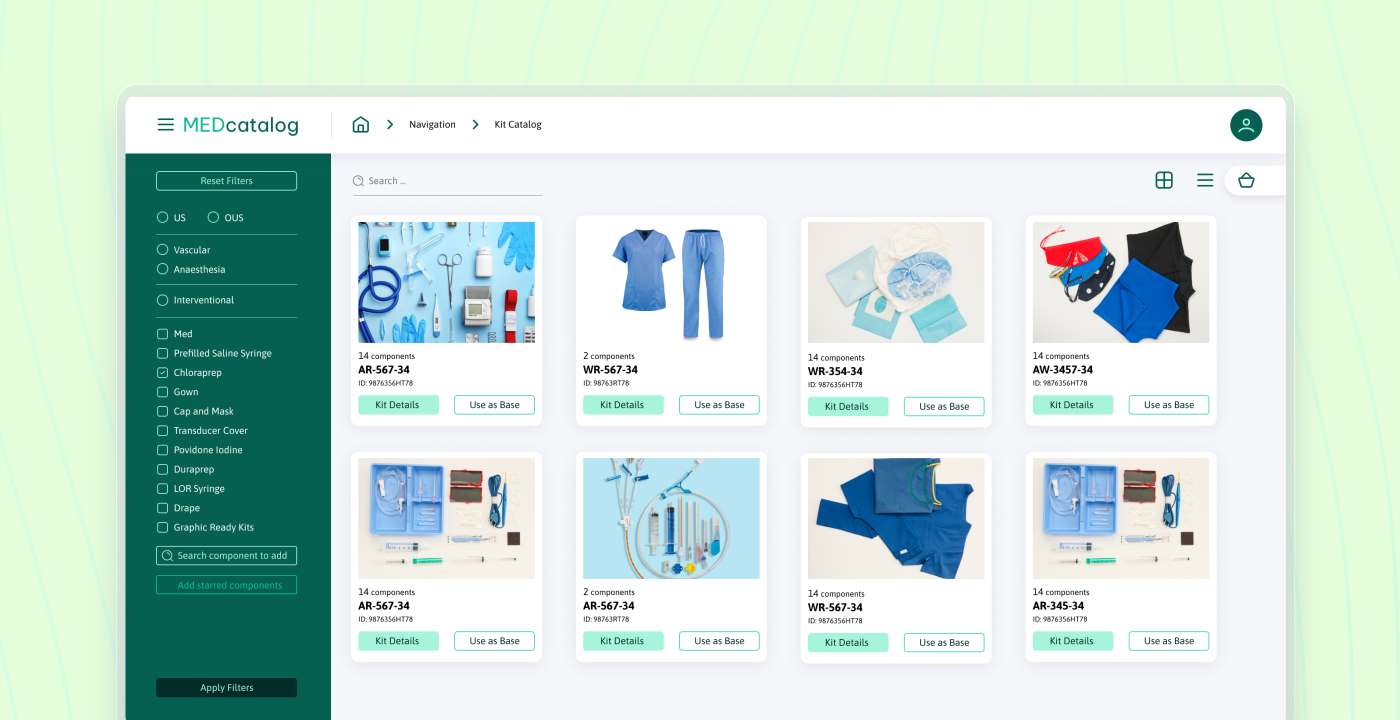
    80%reduction in kit configuration turnaround time for a medical supplies providerRead the case study

    Delivered as

One Workflow, Before and After

How a medical supplies provider designed custom kits before and after the platform we built for them, step by step.

Before

Days of manual coordination

  1. Step 1

    Assemble the kit

    Every custom kit built by hand as a physical box

  2. Step 2

    Photograph it

    Pictures taken so other teams can see the layout

  3. Step 3

    Pass it between teams

    Sent back and forth for review, with the same mistakes repeating

  4. Step 4

    Check the layout by hand

    Spacing and placement reviewed by engineers who were already overloaded

Any client change, such as a new tray layout or quantity, restarts the process from scratch

After

Under an hour

  1. Step 1

    Start from a base kit

    Chosen in the Med Catalog app, with no physical box

  2. Step 2

    Adjust it

    Components added, removed, moved or rotated, with live stock levels

  3. Step 3

    The server checks the layout

    A .NET engine applies spacing, orientation, tray and compatibility rules

  4. Step 4

    A digital sample goes to production

    Layout map, itemized list, quantities and labels in one document

A client change takes a few clicks, and admins update the layout rules without new code

Medical kits case study

Transformations We Have Delivered

Processes our clients used to run by hand, and how they run now, each with the team and timeline behind it.

United States

Auto finance: loan offers from 6 lenders without retyping

Grand Financial’s sales agents logged in to each lender’s portal, reviewed loan terms by hand and typed them into the CRM. We automated offer collection from 6 financial institutions with Azure Durable Functions and built an internal portal where agents compare offers in one place. 80% reduction in manual processing time · 5 specialists · 8 months · US client.

  • .NET
  • C#
  • Web API
  • React JS

What Clients Say After the Change

Three clients whose daily operations changed, each linked to the project behind it.

What Is Digital Transformation?

Digital transformation is changing how a company works by applying digital technology to its business processes, its products and the daily work of its people. A new order system changes little if sales, the warehouse and finance still follow the old steps, so the work covers the system, the process around it and the people who use it.

The goal

A business result, such as faster order handling or a lower cost of running systems. Not a list of new tools.

Digitization, digitalization and transformation

  1. Changes a document

    Digitization

    Information moves from paper to a digital form.

    Order handling

    Paper order forms are scanned into files.

  2. Changes a process

    Digitalization

    Digital tools run an existing process better.

    Order handling

    Customers submit orders through a web form instead of by phone.

  3. Changes how the business works

    Digital transformation

    People, systems and data work differently, end to end.

    Order handling

    Customers, warehouses and finance work from one order record, and customers see order status without calling.

Four Parts That Have to Move Together

If one part lags behind, the others stall. We lead the technology and data work and share the process work with your team.

  1. 01Strategy

    The outcome, priorities, funding, and who owns the result.

    Typical mistake
    Buying a platform with no outcome attached to it.
    Early warning sign
    Leaders describe the goal in different ways

    Led byYou

    You own the outcome and the budget. We help write the roadmap and the order of work.

  2. 02Technology and data

    Systems, integrations, data quality and security.

    Typical mistake
    Leaving data cleanup for later.
    Early warning sign
    Pilot results disagree between systems

    Led bySoftellar

    We design, build, migrate and test, with your architects reviewing the decisions.

  3. 03Processes

    How work flows across teams.

    Typical mistake
    Digitizing a broken process as it is.
    Early warning sign
    The new system exists, but people still use spreadsheets

    Led byBoth

    Your process owners decide how the work should flow. We build it into the software.

  4. 04People

    Roles, skills, habits and incentives.

    Typical mistake
    Training once, at launch.
    Early warning sign
    Support requests spike and workarounds appear

    Led byYou

    Your leaders run the change. We provide documentation and walkthrough sessions for key users.

Your people stay in charge of the change. Our delivery teams work in sprints alongside yours.

How our Scrum teams work

A Seven-Step Transformation Roadmap

Every initiative in the program follows these steps. After each one, the people who hold the budget decide what happens next.

01

Define the problem and outcome

Name the owner, write the goal and measure today’s level.

Output

A one-page outcome statement with a baseline

Checkpoint decision

Is the problem worth solving now, with a named owner behind it?

02

Assess current capabilities

Inventory systems, data, integrations, processes and skills.

Output

A map of what exists, known risks and end-of-support dates

Checkpoint decision

Do we understand the starting point well enough to plan?

03

Set priorities and sequence

Rank the work by value, risk and dependencies.

Output

An ordered list of initiatives

Checkpoint decision

Which initiative goes first, and what do we fund now?

04

Choose an approach per system

Decide to keep, move, rebuild, replace or retire each system.

Output

A decision for every system

Checkpoint decision

Are the trade-offs understood and accepted?

05

Run a pilot

Test in one location against success criteria set in advance.

Output

Pilot results compared with the baseline

Checkpoint decision

Did the pilot meet the criteria?

A pilot that misses can go back for rework

06

Scale in waves

Roll out in stages, train people and support them.

Output

A wave plan and a support model

Checkpoint decision

Is the next wave ready, or does something need fixing first?

07

Measure, review, adjust

Track the metrics and update the priorities.

  • Customers
  • Operations
  • Software delivery
  • Adoption
  • Finance

Output

A regular review

Checkpoint decision

Continue, adjust, pause or stop?

Fund One Phase at a Time

There is no honest standard price. We estimate after the inventory, you fund the first phase, and the next is decided at its checkpoint.

Phase one, funded

A defined scope with success criteria agreed in advance

It limits what you can lose on a wrong assumption and keeps the budget tied to evidence.

Checkpoint

The team shows what it learned. The decision is recorded in writing, with the budget for the next step.

  • Go on

    The evidence meets the criteria, so the next phase is funded.

  • Rework

    The evidence falls short. The team fixes a specific gap and comes back.

  • Pause

    The idea is sound, but the timing or capacity is wrong.

  • Stop

    The money and people should go elsewhere.

Next phase

Funded after the checkpoint, on the evidence from the phase before

Your own pilot gives a better estimate than any round-number timeline: how long one location took, and what slowed it down.

What drives cost and timeline

  • 01

    Scope

    How many systems and teams are involved

  • 02

    Legacy systems

    Their complexity and integrations

  • 03

    Data quality

    How much cleanup the data needs

  • 04

    Regulation

    Reporting, privacy and audit rules

  • 05

    Team model

    Your team, ours, or a mix

  • 06

    Training

    Support for users after launch

  • 07

    Parallel run

    How long old and new run side by side

Why Transformations Stall

Most stalls have causes you can see coming. We check for these signs at every checkpoint, while they are still cheap to fix.

Transformation risk register8 risks
R-01Unclear outcomeEarly warning signLeaders describe the goal in different waysWhat to doWrite a one-page outcome statement with a baseline, signed by the owner
R-02No active sponsor or ownerEarly warning signDecisions wait for weeks and nobody can say yesWhat to doName an owner with budget authority and set regular checkpoints
R-03Scope too big, launched all at onceEarly warning signNothing is delivered for monthsWhat to doSplit the program into initiatives, pilot first, then scale in waves
R-04Legacy systems and data underestimatedEarly warning signPilot results differ between systems and data surprises keep appearingWhat to doInventory early, clean data before rollout, plan migration and rollback
R-05People not preparedEarly warning signWorkarounds, spreadsheets kept “just in case” and a spike in support requestsWhat to doAnalyze the impact by role, train before go-live and support afterwards
R-06No metrics or baselineEarly warning signNobody can say whether things improvedWhat to doDefine the key metrics and record the starting level
R-07Dependence on a vendor or contract termsEarly warning signScope is hard to change and leaving is hardWhat to doCheck who owns the code and data, and what the exit and scaling terms are
R-08Security added lateEarly warning signAccess and compliance questions surface at the endWhat to doInclude security and compliance reviews from the start

Seeing One of These Signs?

Tell us where your program is stuck, and an architect will suggest what to fix before the next checkpoint.

We reply within 24 hours and can sign an NDA first.

Have files or a long brief? Use the full form

Where AI Fits, and When to Wait

AI can speed up parts of a transformation, but it depends on groundwork: consistent data, a clear task and someone who checks the results.

Where it helps today

  • Searching internal documents
  • Sorting and routing support requests
  • Helping developers write and test code
  • Forecasting demand from past data

What has to be in place first

  • Data in a consistent form
  • A defined task with an owner
  • Access and security rules
  • A way to check results, including human review

When it is not needed

  • Rules or a plain integration solve the problem
  • There is no usable data
  • Nobody is able to verify the output

Technology Behind the Change

The stack from the projects on this page, grouped by the workstream it served. Most of our work runs on .NET and Azure.

Integration and automationAuto finance offer aggregation
Data and analyticsMedical device reporting, retail analytics
  • Azure Data Factory
  • Azure Synapse
  • Azure Data Lake
  • Power BI
  • BigQuery
Cloud foundationTravel portal, real estate platform
Customer-facing productsMedical kit configurator, accounting SaaS

Is Your Organization Ready?

Check the basics before you commit money. If several are missing, spend a few weeks on them first. It is cheaper than finding out halfway through.

Transformation readiness checklist

Readiness checklist

0 of 9 in place. Tick what is already true for your organization.

Not worth it yet when

  • Nobody owns the result
  • There is no specific problem, only a wish to “update everything”
  • The current system works and is not causing damage
  • The company lacks the capacity to finish what it starts
  • People are not willing to change how they work

In those cases a smaller fix, or a delay, is the honest recommendation. We will tell you if that is where you are.

Ask for an honest assessment

US Office, European Engineering

Headquartered in Warsaw, Poland, with a client office in New York. A European engineering team that works in your hours, with a US point of contact.

Headquarters

Warsaw, Poland

Engineering and delivery, and the main contact point for clients in Europe.

Client office

New York, United States

Kickoffs, contracts and account management for North American clients.

Shared hours with North America

Clients in Europe share the full working day with the team.

8 AM to 12 PM New York time, 2 PM to 6 PM in Warsaw.

How We Work With You

Fixed price for a well-defined phase, time and materials when scope will change, invoiced in US dollars.

Not sure which model fits your program? Tell us where the business is today and the result you need, and we'll suggest how to staff the first phase. The consultation is free.

Book a free consultation

Recognized for Delivery

The Manifest's 2024 App Modernization award, next to our Clutch, TechReviewer and GoodFirms recognition.

Related reading

Read Before You Start a Program

Guides from our team on planning a transformation, deciding at checkpoints and modernizing legacy systems.

All Insights

Frequently Asked Questions

Common questions about digital transformation programs, timelines and costs.

Have a different question? Talk to our team

Which Process Would You Change First?

Describe where the business is today and the result you need.

We reply within 24 hours, and we can sign an NDA before you share details.

Talk to the people who will scope your project