Overview
Enterprises in today's IT industry face an existential dilemma that arises out of the need to constantly remain agile in competitive practices. Every now and again, novel technologies and methodologies are invented that gain subsequent widespread adoption in IT service and product delivery. For IT companies and development teams not to fall behind in the race for the next best thing, there is a pressing need to adopt these technologies as soon as possible.
Achieving this process requires substantial manpower in the form of developers, programmers, and other IT specialists that businesses might not have readily at their disposal. Here is where staff augmentation comes in – to help companies recompose and upsize their human resource personnel so they are better equipped to cater to variable project demands.
But exactly what is staff augmentation? This article provides an in-depth view, exploring its importance, implications, varied models, and much more. Let's dive in.
Defining Staff Augmentation
Staff augmentation is an outsourcing strategy employed by IT companies during software development projects to fortify in-house teams in domains where their capabilities fall short of fulfilling the demands of development.
This employment model facilitates the provision of seasoned technical personnel to organizations spanning from startups to conglomerates, exclusively for the tenure of a development project.
This adaptable business arrangement is made possible by staff augmentation service providers such as Softellar, which screen and recruit the required developers and engineers. As a result, the organization is released from any employer responsibilities with respect to employee expenditures, perks, or additional compensation.
Why Staff Augmentation Is So Popular in the IT Industry
Contract staffing is a practice that has been around for as long as the Industrial Revolution. However, the widespread use of specialized service providers in recruiting skilled workers didn't gain traction in the IT industry until the turn of the 20th century, when the Internet boom gave rise to the development of technological initiatives at a blistering pace.
In an effort to meet up with the rapid pace of innovation, IT firms started adopting staff augmentation, the new model of employment that had come to challenge the status quo. Since then, IT staff augmentation has remained relevant to the IT industry for several reasons, the primary one being its flexibility.
In a sector where project scopes change rapidly, staff augmentation has offered businesses a flexible means by which to augment their workforce with specific skill sets for determined periods without having to commit to long-term employment. Staff augmentation vendors have also significantly lifted the burden of hiring and administering full-time employees from in-house project managers. With the recent surge in remote work, companies can now get instant access to remote professionals working from halfway across the world and integrate them into their existing team.
Pros of IT Staff Augmentation
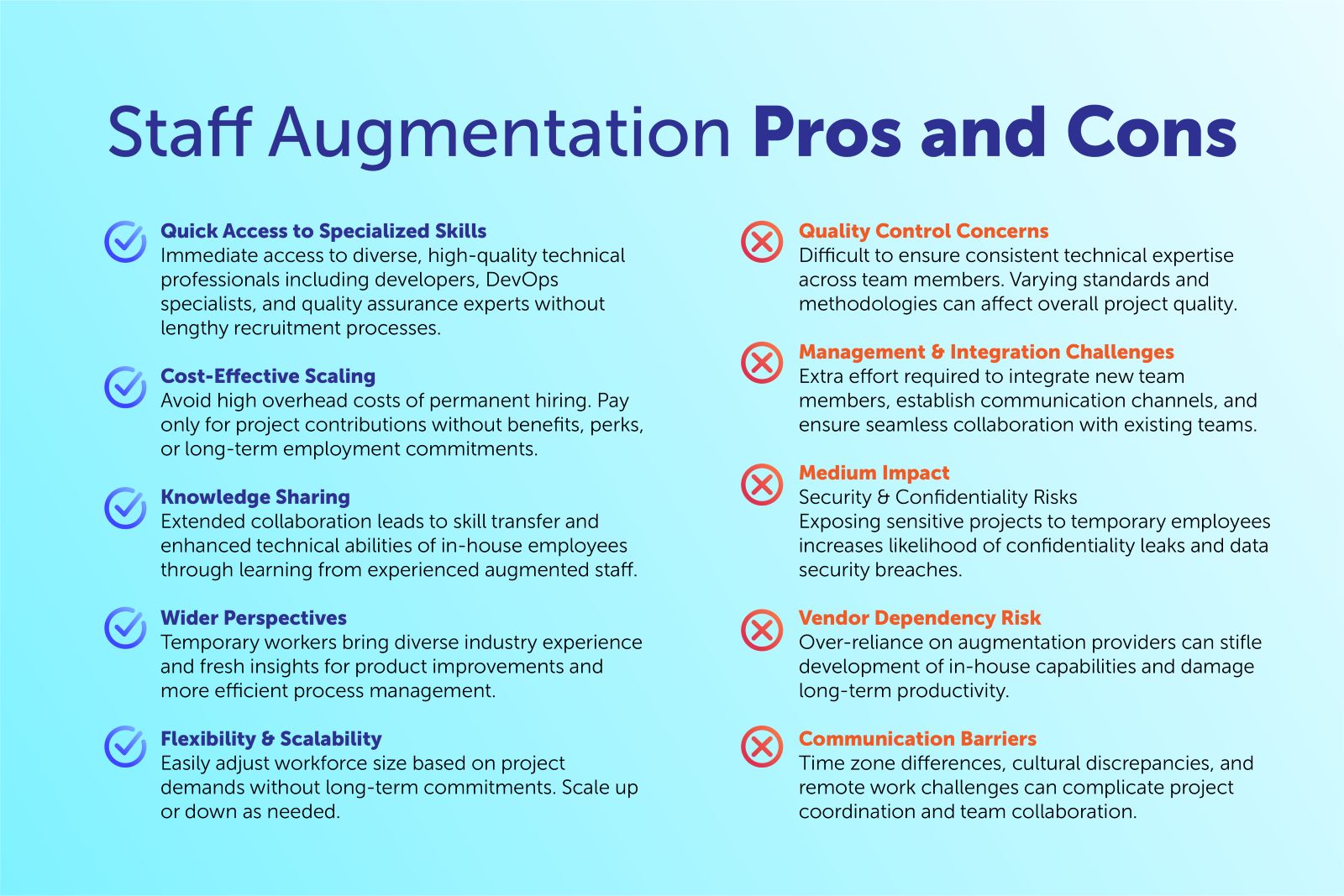
While the staff augmentation model is one of the most popular models of outsourcing used by IT enterprises, it is by far not the only one available. There are situations where augmentation is optional, and there are those where it isn't. To this end, we examine some pros and cons of this hiring model.
Quick Access to Specialized Technical Skills
One of the advantages of staff augmentation services that makes it highly attractive to project managers is the diverse and high-quality personnel available on a staff augmentation roster.
Staff augmentation company offers businesses access to a wide range of top-tier professionals in software development, including software programmers, DevOps specialists, business analysts, database analysts, and quality assurance experts. This allows businesses to easily secure commitments from these professionals without any hassle.
Cost-Effective Scaling
Companies interested in initiating a new software development project can now avoid the burden of incurring high overhead costs associated with hiring permanent staff. They only have to determine the necessary specialized skills and compensate the developers for their project contributions. This service offering facilitates a mutually beneficial arrangement where the hiring company can reduce labor expenses while the professional developer or engineer can enjoy the flexibility of working with multiple clients.
Knowledge Sharing
When internal team works closely with augmented staff on projects over an extended period, individuals from both sides are likely to learn a few trade secrets from their team members. This skill transfer has the potential to greatly enhance the technical abilities of in-house employees, even in areas where they may not have specific expertise.
Gaining A Wider Viewpoint
Temporary workers joining a development team have a wealth of knowledge gained from working on diverse projects in various industries. These experiences can provide valuable insights for suggesting product improvements or more efficient process management.
Having individuals with different perspectives can be a game-changer when development teams face new challenges during a project's development cycle.
Ready to Leverage These IT Staff Augmentation Benefits?
Transform your development capabilities with strategic staff augmentation. Our experts will help you implement the advantages outlined in this guide, from accessing specialized skills to enhancing knowledge sharing, while mitigating potential challenges.
Cons of IT Staff Augmentation
Quality Control Concerns
One of the most common staff augmentation challenges that companies have to deal with is quality assurance. Though augmented teams usually come highly rated by service providers, it can, at times, be difficult to ensure a consistent level of technical expertise across all team members. Different team members may be used to varying standards and methodologies of working, and this can affect the overall quality of project outcomes.
Management And Integration Challenges
When working on projects that demand proportional input from an outsourcing team and in-house staff, integrating and managing team members may require extra effort and resources. Project managers may have to go the extra mile to ensure new team members are up to date on project workflows and that they can seamlessly collaborate with existing team. They would also have to establish round-the-clock communication channels to ensure remote employees stay in tune with the latest project developments.
Potential For Vendor Dependency
Relying too heavily on staff augmentation solutions to provide specialised skills that are critical to business operations can lead to vendor overdependency. This overdependency stifles a company's ability to develop its own in-house capabilities and can be damaging to productivity over time.
Confidentiality And Security Risk
Working with augmented staff means having to expose your sensitive projects to the view of temporary employees. Although augmentation service level agreements typically have stipulated precautions to protect your proprietary information, as more people are brought onto a project, the likelihood of confidentiality leaks and data security breaches increases.
Types of IT Staff Augmentation
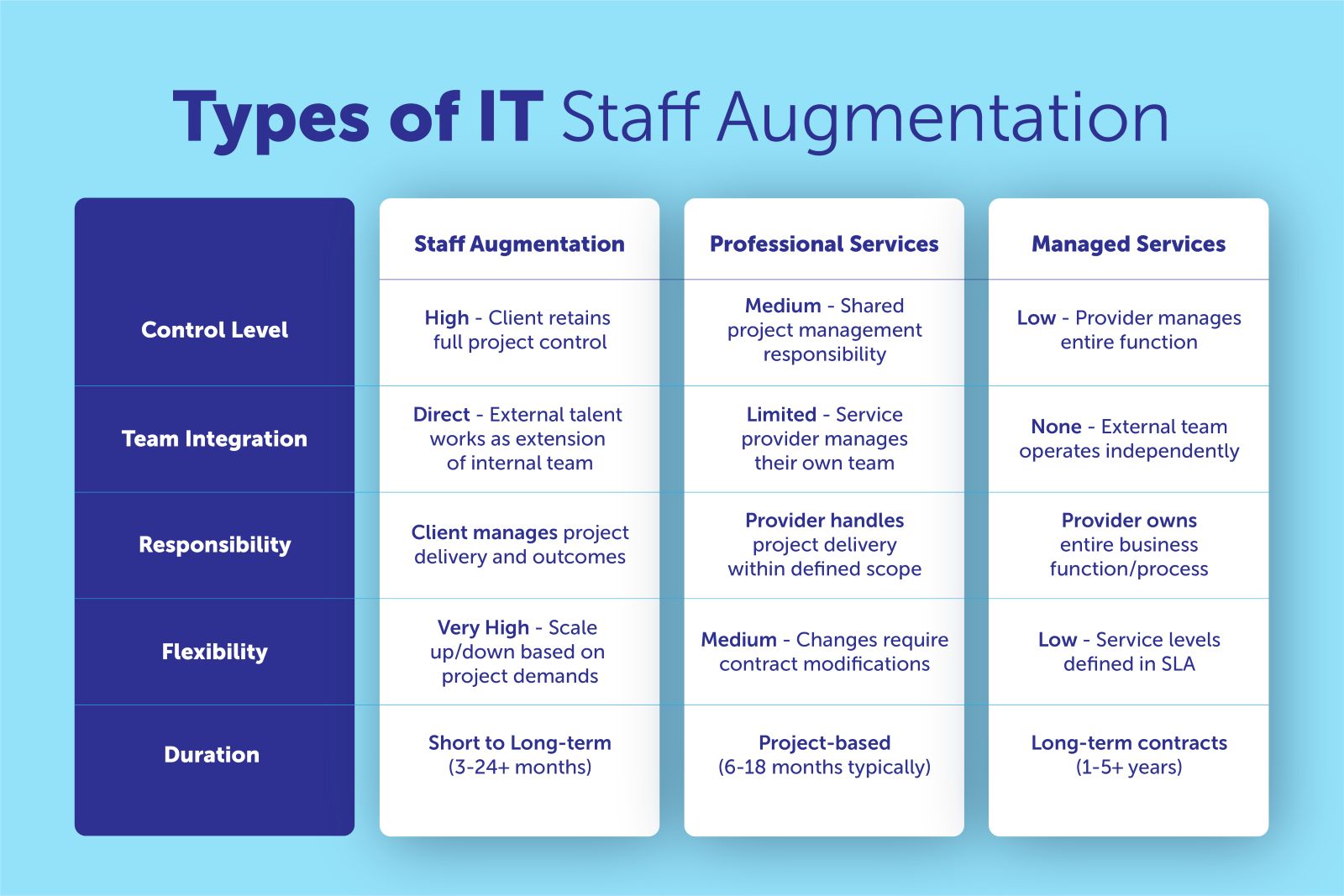
Organizations looking to implement an IT staff augmentation program need to understand the differences and overlaps between the various IT staff augmentation frameworks provided by augmentation providers. These frameworks are all suited for different types of projects with varying levels of complexity, commitment, and talent requirements. They include:
Skill Based Augmentation
Skill-based augmentation is the prevalent type of staff augmentation used in IT and other tech-intensive industries. The focus here is on hiring employees with expertise in technical areas that are not well-provisioned in-house. These specialized experts are usually brought in with the objective of addressing specific skill gaps or implementing novel technologies. For instance, say a company is looking to adopt cutting-edge technology like blockchain or AI, skill-based augmentation can be used to bring in professionals well-versed in these technologies, thereby ensuring the project is executed with the most up-to-date knowledge and expertise.
Project Based Augmentation
In this approach, companies bring augmented team into the fold to support a project with a defined timeline. These individuals may range from project managers to software developers, business analysts, or senior-level engineers, and they all come together to work on the project's success. Project-based augmentation is an agile business strategy that is suited for projects that may be too complex or resource-intensive for an internal development team to handle. Using this type of augmentation, organizations can venture into new territories without having to divert their core team members from their primary responsibilities.
Short Term vs Long Term Augmentation
The distinction between short-term and long-term augmentation reflects the temporal flexibility in different staffing strategies. Both skill-based and project-based augmentation can also be short-term or long-term. Short-term augmentation is designed to help companies fill interim vacancies or increase staff in times when workloads are at their peak.
On the other hand, long-term augmentation is intended to be more stable and continuous, providing ongoing staffing support for sustained development initiatives. This dichotomy is important as it enables enterprises to align their workforce planning and project pipelines with the most suitable augmentation strategy.
Onshore, Nearshore And Offshore Augmentation
This is a geographical categorization of staff augmentation that aims to distinguish augmentation providers based on the origin of the talent. Onshore augmentation is a type of augmentation where the augmented talent is sourced from within the same national borders as the client company. It facilitates smoother collaboration between augmented and in-house teams, as barriers such as language time zones or work culture differences are virtually non-existent. However, it comes at a steeper cost.
Nearshore augmentation strikes a balance between cost convenience and proximity; talent is hired from nearby countries with similar time zones and cultural affinities.
With offshore augmentation, talent is often sourced from lower-income countries halfway across the world. Though this offers the most cost savings advantage, it presents an integration challenge for companies as they have to navigate complexities like remote work time zone differences and cultural discrepancies.
Types of IT Staff Augmentation Services
When it comes to IT resource augmentation, be it for software development services, infrastructure management solutions, or other tech stack adoption processes. Businesses have a number of IT staff augmentation prospects to choose from. This varied service model caters to diverse objectives, business budgets, and development processes, and they are tailored to meet project demands in varying capacities.
Dedicated Teams
Dedicated teams are a staff augmentation model where a service provider puts together a dedicated team of efficient talent, such as developers, programmers, engineers, or managers, to work exclusively on a client project. These teams are usually highly skilled and collaborate as an extension of the client's IT workforce. The dedicated team approach is well suited for long-term projects that require expertise from separate technological fields for a long period.
Using this model, organizations can scale their businesses and development operations without having to compromise on quality of work or loyalty of service, as the team members are contracted exclusively to their projects.
Individual Contributors
On some projects, IT enterprises don't require more than one or two highly specialized individuals to help meet project requirements. It would, therefore, be inconsequential to gather a team for this nature of task. Individual contributors can help fill specific voids in the talent pool without having to put together an IT team. These specialized professionals are easier to integrate and onboard onto development projects, and they provide a fast solution for addressing immediate project needs.
Managed IT Services
Managed IT services are an augmentation model that is used to customize entire projects or business functions of an IT department to an outsourcing vendor known as a Managed Services Provider. These providers offer businesses a hands-off approach to staff augmentation that allows in-house teams to focus on core business activities. They take on critical operations such as software development or cybersecurity without the involvement of the client company and are responsible for managing teams and delivering desirable outcomes. This helps companies reduce operational complexity so they can focus on strategic growth.
Consultancy And Advisory Services
Beyond IT staffing, augmentation companies also offer consultant services to help IT firms identify IT needs and devise strategies to meet these needs. These services can be helpful to organizations looking to digitally transform their business model but not having the technical insight to pinpoint areas of improvement.
Reasons to Choose IT Staff Augmentation Services

One of the main reasons why IT staff augmentation is important to tech companies is the flexible and affordable staffing it provides. Beyond this, there are multiple scenarios where staff augmentation presents the optimal staffing solution.
Unique Initiatives
One of the most evident instances of staff augmentation is undertaking distinct specialised initiatives that lie beyond the organisation's primary areas of expertise. Tasks such as creating bespoke software, constructing a mobile application from the ground up, revamping cybersecurity procedures, or overseeing a machine learning pilot program may necessitate distinct skill sets on a temporary basis.
Seasonal Demands
Flexible staffing can be highly advantageous for companies operating in areas characterized by substantial seasonal variations in activity, such as retail, tourism, and accounting since it enables them to effectively address periodic demands. It may not be financially prudent to consistently maintain a larger workforce throughout the year in order to accommodate vacations, tax season, or increased travel during the summer. Augmented personnel have the ability to increase their capability as required.
Exploring New Initiatives
Whether they are investigating new offerings, entering new markets, or taking on significant business risk, augmentation enables firms to test possible development areas without making long-term commitments. In the event of a failed new product or unsuccessful expansion plans, it is possible to prevent expensive restructuring. Augmentation provides increased flexibility till the feasibility of efforts is demonstrated.
Unexpected Job Openings
Instead of rapidly recruiting replacements in response to unforeseen vacancies resulting from resignation or absence, staff augmentation can be employed as a temporary solution to address gaps. This provides firms with an opportunity to carefully evaluate the most suitable skills match, prevent the hiring of unqualified candidates, and allocate sufficient time to effectively integrate the most qualified permanent team members.
Factors to Consider When Choosing a Staff Augmentation Model
Project Scope
One of the most influential factors in selecting a staff augmentation model is the scale and division of the project. This is the primary reason why there are varied augmentation models: to address distinct business requirements across specialties. Although SMEs working on short-term initiatives may benefit from the typical augmentation approach, established IT companies working on large-scale projects may get greater value from a dedicated team.
Ease Of Integration
Onboarding and integration are critical facets of the IT staff augmentation process. Therefore, it is important to scrutinize the capacity of augmented professionals to fully integrate and collaborate with in-house development team. Employees joining projects newly should be thoroughly vetted to ensure they have the requisite skills to excel in their designated positions.
Budget
Cost is another important consideration when choosing an augmentation model. Traditional employment models are usually costlier than staff augmentation, yet staffing agencies price their services differently. Before committing to an augmentation model, one should compare the overall expenses as they relate to the cost of hiring full-time staff.
Technical Requirements
The proficiency of the personnel needed to fill a skill gap is a factor that affects both the choice of augmentation model and the optimal staffing agency. This is because while some firms focus on recruiting personnel for junior tech positions, others may deal in providing access to senior developers and engineers.
How Staff Augmentation Compares to Other Models of Outsourcing
When talking about outsourcing as a business practice, the IT staff augmentation meaning often gets lost in translation when mentioned in the light of other popular outsourcing models. This section delineates the details between the lines.
Staff Augmentation vs Professional Services
When comparing staff augmentation vs professional services, it is important to remember these services' core essence.
Professional services is a comprehensive model of outsourcing where companies delegate the entire project management responsibilities for complex, long-term tasks to a professional service provider.
Staff augmentation, on the other hand, provides a medium for IT firms to supplement their workforce with external expertise based on project demands. Unlike professional service providers, staff augmentation firms do not take on the full responsibilities of managing and delivering a project; they're more focused on managing their own teams and the input they bring to an ongoing project.
Staff Augmentation vs Consultancy Services
Consultancy services provide businesses with expert guidance and advice on how to Implement business strategies and solve specific business problems. IT consultants delve into a business' model of operation and assess various departments to pinpoint areas of improvement and implementable strategies through which to achieve them.
When comparing staff augmentation vs consulting, it's important to note that, though some staff augmentation firms might offer a degree of consultancy in the initial stages of engagement, this is not their specialty. Consultants are not involved in the execution of day-to-day business tasks; augmented staff are.
Staff Augmentation vs Managed Services
Managed services is an outsourcing model where enterprises entrust business functions like IT support or payroll to an external provider. The difference between managed services and staff augmentation is that, unlike staff augmentation – where the client company retains control of augmented teams and project direction – with managed services, the client foregoes a substantial level of control in exchange for valuable time to focus on core business strategies.
Staff Augmentation vs Individual Contractors
Individual contractors are technically adept professionals who operate independently and offer their skills to IT firms on a project or contract basis. They present businesses an opportunity through which to address short-term project needs and in-house team shortages without having to go through a third-party provider.
This outsourcing model shares some similarities with staff augmentation in terms of flexibility and focus on specific Skills. However, it lacks the oversight and cohesive integration with team members that staff augmentation provides. Additionally, with this model, the client company still has to retain all administrative duties like payroll and implementation of project management tools; this is something that is handled by service providers in the staff augmentation model.
Steps of IT Staff Augmentation Process
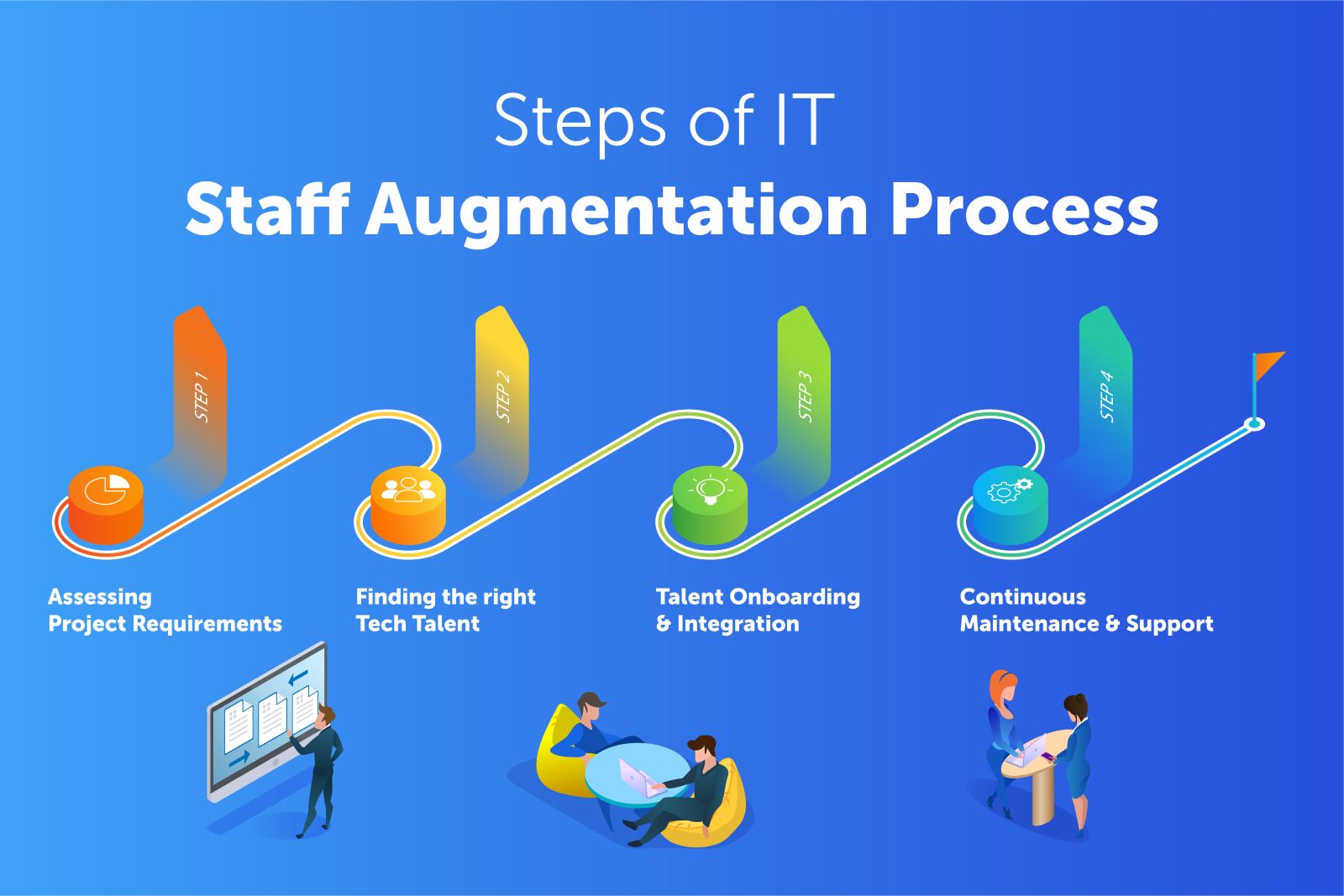
When IT firms approach augmentation providers for staffing solutions to facilitate in-house team expansion, a lot of the IT staff augmentation responsibilities, like conducting interviews and reviewing CVs, fall on the augmentation provider. Augmentation firms like Softellar employ a meticulous process to ensure they don't err in fulfilling these responsibilities. Though staff augmentation processes may differ among providers, they follow a pattern that goes similar to the following:
Step 1: Assessing Project Requirements
In the very first stages of a staff augmentation project, an augmentation provider would typically consult with your team leads to evaluate the scope of your project and identify areas that would need reinforcements with extra human resources. This will help give the service provider and incoming tech talents an unambiguous vision of your project objectives and the milestones they must achieve.
Step 2: Finding The Right Tech Talent
Here is where the augmentation provider goes about the task of compiling candidates and interviewing them to find the most suitable individuals for the project at hand. They then submit this list of recommended candidates, as well as attached CVs and portfolios, to the client company for further assessment.
Step 3: Talent Onboarding & Integration
If the client organization is satisfied with the recommended individuals and believes they can help meet their project objectives, the staffing agency goes on to onboard the augmented talent on the project's details. Depending on the structure of the organization, this onboarding phase can as well be handled by in-house project managers. Onboarding is such a pivotal aspect of the augmentation process because it ensures all project members get the memo and participate at the same tempo.
Step 4: Continuous Maintenance & Support
The best staff augmentation firms don't stop at onboarding – they understand that new team members may need some time to acclimatize to the current work environment; hence, they maintain open communication lines with augmented staff and continue to provide support in the form of project tools, counsel, and administrative assistance throughout the life cycle of the project.
Tips for Effective IT Staff Augmentation
We've discussed the benefits, downsides, models, and processes involved in staff augmentation. Still, with this information, there are some staff augmentation best practices IT firms must implement to find the right model and ensure it works for them. Whether or not you follow the latest IT staff augmentation trends, this information will prove itself useful.
Define The Project's Requirements
Before embarking on staff augmentation, you should have a holistic picture of the elements you need to actualize your project objectives. More than just the technical skills, you should have a precise notion of the project's duration, the level of expertise needed, and the tools that will be used. This forestalls any ambiguity that might cause project delays once the augmentation process is underway.
Select a Reputable Agency
Choosing the right partner is crucial to the success of any staff augmentation endeavor. When selecting a staff augmentation company, be sure to look into their recruitment process, support services, and compliance with labor laws so as not to suffer any legal repercussions. Another important consideration in this regard is the track record and longevity of the augmentation provider in your specific domain or industry. They should have a clean performance record and access to a wide talent pool that can allow you to upscale your IT teams when workloads are hectic.
Ensure Teams are Well-Integrated
Upon conclusion of a meticulous augmentation process, you should ensure augmented teams are well-embraced and quickly updated on your company's work culture so they can hit the ground running. If you are working with remote developers or engineers, try to set up communication channels and organize team activities that foster collaboration and a sense of belonging.
Maintain Flexibility and Scalability
The two main advantages of augmentation as opposed to traditional hiring practices are that it is cost-effective and easily scalable. To ensure you get the best of both these benefits you should assess your project's demands at every stage of development and try to adjust your IT team accordingly. This might involve scaling down redundant roles or adding new skill sets as your project evolves.
Conclusion
In the IT industry, finding reputable talents that can fit into specific roles at any given time can at times be a daunting endeavor. The fact that IT projects often require employees to work in the interim can further exacerbate the hiring process. Staff augmentation presents an invaluable solution to these challenges by sourcing IT talent and onboarding and managing them on behalf of resource-strapped companies. Augmentation providers like Softellar simplify the process of hiring new staff, saving IT enterprises valuable investments and giving them increased control over their project outcomes.