

Supervised vs. Unsupervised Learning: Key Differences & Examples
In one meeting, a product owner asks two questions. First: "Which of our customers are about to leave?" A few minutes later: "What kinds of customers do we actually have?" Both sound like "let's use machine learning," but they are different problems, and they call for different approaches.
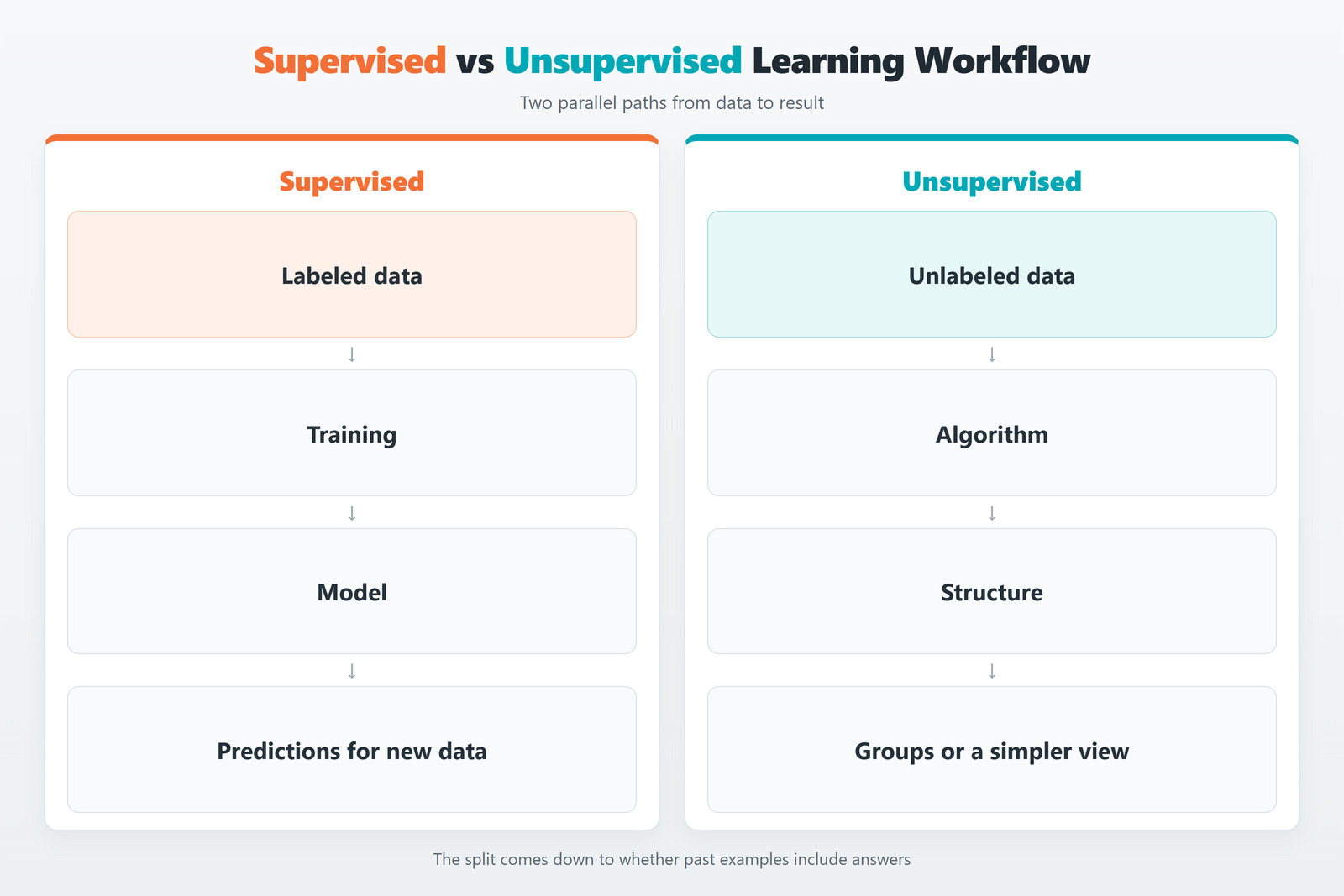
Supervised learning trains a model on examples with known answers, so that it can predict the answer for new data. Unsupervised learning looks for structure in data that has no answers attached.
This guide explains the difference, shows examples and working Python code with real output, covers how to tell whether a model is any good, and ends with a way to choose between the approaches, including what to do when labeled data is expensive.
Supervised vs. Unsupervised Learning in Machine Learning, in One Minute
Machine learning means building models that identify patterns in data instead of following rules someone wrote by hand. Most machine learning models fall into two families, and the choice between them comes down to one question: do you have the answers for past examples?
Each example in your data is described by input features: a customer's plan, country, and days since last login. In supervised learning, every example also carries a label, sometimes called the target. That's the answer you want the model to predict, such as "left" or "stayed." Unsupervised learning works with the features alone.
Think of flashcards. With the answers on the back, you can practice until you get new cards right. That's supervised. With a pile of unlabeled photos and no instructions, all you can do is sort them into piles of things that look alike. That's unsupervised. Everything else in this guide follows from that difference: what you get back, how you check it, and what it costs.
What Is Supervised Learning?
Supervised learning is a way of training a model on labeled training data: a set of examples in which every piece of input data comes with its output, the correct answer. Each of these input-output pairs shows the model what a right answer looks like. The model's job is to learn the relationship between the input features and the corresponding target labels well enough to predict the correct output labels for examples it has never seen.
Supervised learning handles two kinds of problems, classification tasks and regression tasks, and which one you have depends on the kind of answer you want. Classification predicts a category: whether an email is spam, whether a customer will leave, whether a photo shows a defective part. Regression predicts a number: the price of an apartment, next month's demand, the minutes a delivery will take. Logistic regression, despite its name, is a classification method, because it predicts the probability of a class. Spam filters and models that flag suspicious areas on medical scans are classic classification tasks, though in medicine the model supports a doctor's decision instead of replacing it.
The Supervised Learning Process
Model training follows nearly the same sequence every time:
- Collect examples with known outcomes, for instance customers from the past two years and whether each one left.
- Split them into a training set and a test set. The model learns from the first, and the second is kept aside to check it honestly.
- Train the model, which means adjusting its parameters until its predictions on the training set get close to the labels.
- Evaluate it on the test set. If it does well on training data and badly on test data, it has memorized the examples instead of learning the underlying patterns. That's overfitting.
- Use it on new data, and keep checking that it still works as the data changes.
Common Supervised Learning Algorithms
Hundreds of supervised learning algorithms exist, but a short list covers most real work. Linear and logistic regression are simple, fast, and easy to explain, which is why classic regression analysis is still a common first step. Decision trees split the data with a sequence of yes-or-no questions, and random forests and gradient boosting combine many trees; both often perform very well on tables of business data. Support vector machines separate classes with a boundary and remain useful on smaller datasets. Neural networks handle images, audio, and text, where hand-picked features are hard to define. None of them is simply the best. Which one works depends on your data and on what a mistake costs.
Supervised learning models are only as good as their labels and their data. If the labels are wrong or inconsistent, the model learns the mistakes. If the data it was trained on doesn't look like the data it will see in production, accuracy drops, sometimes without anyone noticing. We come back to both problems below.
What Is Unsupervised Learning?
Unsupervised learning works with data that has no labels. There are no example answers to learn from, so the algorithm has to work without prior knowledge of the right result. It relies on the assumptions built into the method, such as what counts as similar and how many groups to look for, to find underlying structure: groups of similar data points, a simpler way to represent the data, or items that don't fit. In other words, it tries to discover hidden patterns that nobody described in advance. It is most useful when you don't yet know which question to ask, which is why it often comes first in exploratory data analysis.
"Unsupervised" doesn't mean "without people," though. Nobody labels the data, but somebody has to interpret the result. Unsupervised learning models give you "cluster 3," not "customers who only buy during sales." Naming and checking the groups is human work.
Common Unsupervised Learning Algorithms
Unsupervised learning algorithms fall into three families that cover most uses. Clustering is about grouping similar data points, and clustering algorithms come in several types. K-means clustering is the best known: you choose the number of clusters, and because it relies on distances, features measured on very different scales (orders per month and total spend, say) have to be rescaled first. Hierarchical clustering creates a tree of nested groups and doesn't need the number of clusters upfront, but it gets expensive on large datasets. DBSCAN looks for dense regions, doesn't need the number of clusters, and marks points in sparse areas as noise. Customer segmentation is the standard application of all three clustering methods.
Dimensionality reduction techniques compress many features into a few. Principal component analysis (PCA) finds new axes that keep as much of the variation in the data as possible, which helps with speed, noise, and plotting a hundred-column table on a flat chart. Methods such as t-SNE and UMAP are mostly used for visualization.
Association rule learning finds items that occur together, like products often bought in the same basket. Apriori is the classic algorithm behind "frequently bought together" suggestions.
Anomaly Detection
Anomaly detection looks for cases that don't fit the usual pattern: a payment far from a customer's habits, a server whose response time suddenly jumps, a login from an unexpected place. In many tasks anomalies are rare and nobody has labeled them, so the problem is often approached without labels. The model learns what normal looks like and flags whatever is far from it. Isolation forest is a common choice.
One caveat matters. If you do have labeled examples of the cases you care about, such as confirmed fraud, the task becomes supervised, and in practice teams often combine both. And flags from unsupervised methods usually need a person or a rule to check them, because unusual is not the same as bad.
Key Differences Between Supervised and Unsupervised Learning
| Metric | Supervised learning | Unsupervised learning |
|---|---|---|
| What you feed it | Features and labels | Features only |
| What you want back | A prediction for new cases | Structure: groups, a simpler view, outliers |
| Typical tasks | Classification, regression | Clustering, dimensionality reduction, association rules, anomaly detection |
| What "correct" means | The label is the reference | There is no reference answer; usefulness is judged |
| How you check it | Compare predictions with known answers | Internal measures, stability, expert review, value to a later step |
| Where human effort goes | Collecting and labeling data | Interpreting and validating results |
| Typical failure | Overfitting, poor or inconsistent labels, data that drifts away from the training set | Neat-looking clusters that mean nothing, arbitrary choices such as the number of groups |
| A good fit when | You have history with outcomes and a clear target | You're exploring, or have no labels and no cheap way to get them |
Two of these differences are easy to miss. The first is how you know the model worked. A supervised model has an answer key: you hold back some labeled examples and compare the predictions with the truth. An unsupervised model has none. Whether the customer groups it found are "right" is not something the data can tell you. You judge them by whether they are stable, whether they differ in ways that matter, and whether anyone can act on them.
The second is where the work goes. Supervised projects spend it upfront, on collecting and labeling examples. Unsupervised projects skip that step and spend the effort afterwards, on interpretation.
This is also why "which one is more accurate?" is the wrong question. The two approaches answer different questions, and accuracy against known labels isn't even defined for most unsupervised tasks. A better question is which learning method fits the question you're asking. Supervised learning excels when the target is clear, and unsupervised learning excels when you're still working out what to ask.
Examples: One Product, Two Different Questions
The clearest way to see the difference is to ask two questions about the same data.
Customer Segmentation or Churn Prediction?
Take the meeting from the start of this article. Predicting churn is a supervised task. You need a history of customers, each labeled with whether they left, and the model learns which behavior tended to come before leaving. Customer segmentation is an unsupervised task. You give the algorithm each customer's behavior, such as visits, orders, spend, and features used, and ask it to put similar customers together.
Neither is better. One predicts and the other explains, and they work well together: segments often show which groups deserve a churn model of their own, and a segment label can itself become an input for a prediction.
The same pairing appears in most products:
| Area | Supervised question | Unsupervised question |
|---|---|---|
| Subscription product | Which customers are likely to leave next month? | What groups of customers behave alike? |
| Payments | Is this transaction one of the known fraud types? | Which transactions look unusual for this customer? |
| Customer support | Which category and priority does this ticket belong to? | What topics keep appearing in tickets nobody has categorized? |
| Documents | Which value on this invoice is the total? | Which new invoice layouts have started to appear? |
| Monitoring | Will this service fail soon, judging by past incidents? | Which metrics are behaving unusually right now? |
These are illustrative scenarios, not results from a particular project.
Document processing shows the split well. Models that extract fields from invoices are trained on invoices where people marked the correct values, which makes them supervised. Grouping incoming invoices by layout, with no labels at all, can reveal that a new supplier format has appeared before extraction quality starts to slip. We describe the first case in our article on how invoice recognition works in practice. Credit scoring is the textbook supervised case, since years of loan outcomes train a model to score new applications. And a retailer that wants to understand its shoppers without a predefined target is doing unsupervised work.
Supervised and Unsupervised Learning in Python
Two short experiments make the difference concrete. Both use scikit-learn on synthetic data, so the numbers show how the methods behave, not what you would get on real customers. We ran them with Python 3.12.3 and scikit-learn 1.8.0, with fixed random seeds, and the output below is exactly what the code printed. The two examples are independent scripts. To reproduce the output, install the same version with pip install scikit-learn==1.8.0.
Model Training in Python: A Supervised Example
We generate 10,000 synthetic customers, of whom roughly 5% leave, and split them into a training set and a test set. The label says whether each customer left.
from sklearn.datasets import make_classification
from sklearn.dummy import DummyClassifier
from sklearn.linear_model import LogisticRegression
from sklearn.metrics import accuracy_score, f1_score, precision_score, recall_score
from sklearn.model_selection import train_test_split

# Synthetic customers: roughly 5% leave (label 1).
customerFeatures, churnedLabels = make_classification(
    n_samples=10_000,
    n_features=8,
    n_informative=5,
    weights=[0.95, 0.05],
    random_state=42,
)
trainFeatures, testFeatures, trainLabels, testLabels = train_test_split(
    customerFeatures,
    churnedLabels,
    test_size=0.25,
    stratify=churnedLabels,
    random_state=42,
)
Then we train two models: a baseline that answers "stays" for everyone, and a logistic regression. We compare them on the test set.
baselineClassifier = DummyClassifier(strategy="most_frequent").fit(
    trainFeatures, trainLabels
)
logisticModel = LogisticRegression(max_iter=1000).fit(trainFeatures, trainLabels)

print(f"share of customers who left in the test set: {testLabels.mean():.3f}")
for modelName, classifier in [
    ("always 'stays'", baselineClassifier),
    ("logistic regression", logisticModel),
]:
    predictions = classifier.predict(testFeatures)
    print(
        f"{modelName:20} accuracy={accuracy_score(testLabels, predictions):.3f}  "
        f"precision={precision_score(testLabels, predictions, zero_division=0):.3f}  "
        f"recall={recall_score(testLabels, predictions):.3f}  "
        f"f1={f1_score(testLabels, predictions):.3f}"
    )
Output:
share of customers who left in the test set: 0.055
always 'stays'       accuracy=0.945  precision=0.000  recall=0.000  f1=0.000
logistic regression  accuracy=0.948  precision=0.706  recall=0.088  f1=0.156
The baseline is wrong only for the 5.5% of customers who leave, so its accuracy is 94.5% without ever finding a single leaver. The logistic regression reaches 94.8%, which looks like a small improvement. The other columns tell a different story. Precision, the share of flagged customers who really leave, is 71%. Recall, the share of leavers the model actually catches, is only 8.8%. For a retention team, that model misses more than nine out of ten of the customers it was built to find.
Clustering Customers Without Labels
Now the unsupervised case. We generate 600 synthetic customers in four hidden groups, and then pretend we don't know that. K-means has to be told how many clusters to look for, so we try every number from 2 to 8 and score each result with the silhouette score, which compares how close each customer is to its own cluster against the nearest other one. It runs from -1 to 1, and higher means better-separated clusters, as the scikit-learn documentation explains.
from sklearn.cluster import KMeans
from sklearn.datasets import make_blobs
from sklearn.metrics import adjusted_rand_score, silhouette_score
from sklearn.preprocessing import StandardScaler

# Synthetic customers in four hidden groups. We pretend we do not know that.
customerFeatures, hiddenGroups = make_blobs(
    n_samples=600,
    centers=4,
    cluster_std=1.3,
    random_state=42,
)
scaledFeatures = StandardScaler().fit_transform(customerFeatures)

for clusterCount in range(2, 9):
    clusterAssignments = KMeans(
        n_clusters=clusterCount,
        n_init=10,
        random_state=42,
    ).fit_predict(scaledFeatures)
    silhouette = silhouette_score(scaledFeatures, clusterAssignments)
    print(f"k={clusterCount}  silhouette={silhouette:.3f}")

bestClusterAssignments = KMeans(
    n_clusters=4,
    n_init=10,
    random_state=42,
).fit_predict(scaledFeatures)
agreement = adjusted_rand_score(hiddenGroups, bestClusterAssignments)
print(f"agreement with the hidden groups (ARI), k=4: {agreement:.3f}")
Output:
k=2  silhouette=0.538
k=3  silhouette=0.708
k=4  silhouette=0.732
k=5  silhouette=0.623
k=6  silhouette=0.527
k=7  silhouette=0.402
k=8  silhouette=0.330
agreement with the hidden groups (ARI), k=4: 0.996
The score peaks at four clusters, which matches how the data was built. But three clusters score almost as well (0.71 against 0.73), a reminder that the number is a hint, not a verdict. The last line compares the clusters with the hidden groups, and that check is only possible because the data is synthetic. With real customers nobody holds the answer key, and you would have to decide whether the segments mean something, which is the subject of the next section.
How to Tell Whether a Model Works
A model that runs without errors says nothing about whether it is useful. Model evaluation and model performance checks work differently for the two approaches, so it helps to take them one at a time.
Checking a Supervised Model
Never judge a model on the data it was trained on. Keep a test set aside, as in the example above, or use cross-validation, which repeats the split several times to show how much the result varies. And always compare with a simple baseline. The "always stays" model is a baseline, and a real model has to beat something like it to matter.
Then choose metrics that match the cost of mistakes:
| Metric | The question it answers | Watch out for |
|---|---|---|
| Accuracy | What share of all predictions are right? | Misleading when one class is rare, as the example showed |
| Precision | Of the cases the model flagged, how many were right? | Can look excellent while recall is tiny |
| Recall | Of all real cases, how many did the model find? | Can be inflated by flagging almost everything |
| F1 | One number that balances precision and recall | Hides which of the two is weak |
| ROC AUC | How well does the model rank cases, whatever threshold you pick? | Says nothing about how a chosen threshold behaves |
| MAE, RMSE (regression) | How large is the typical error, in the units of the target? | RMSE punishes large errors more than MAE does |
In our churn example, a single setting changes the picture. Telling the model that the rare class matters more takes one argument. This snippet continues the supervised script above:
balancedModel = LogisticRegression(
    max_iter=1000,
    class_weight="balanced",
).fit(trainFeatures, trainLabels)
predictions = balancedModel.predict(testFeatures)
print(
    f"accuracy={accuracy_score(testLabels, predictions):.3f}  "
    f"precision={precision_score(testLabels, predictions):.3f}  "
    f"recall={recall_score(testLabels, predictions):.3f}  "
    f"f1={f1_score(testLabels, predictions):.3f}"
)
Output:
accuracy=0.751 precision=0.139 recall=0.679 f1=0.230Accuracy fell from 94.8% to 75.1%, yet the model became far more useful for finding leavers: recall rose from 8.8% to 67.9%. The price is precision, which dropped to 13.9%, so most flagged customers are false alarms. Which version is better is not a statistical question. It depends on what each mistake costs. A retention email sent to someone who wasn't leaving costs little, and a lost customer costs a lot. If the offer is a large discount, the balance shifts.
Checking an Unsupervised Model
Without an answer key, you collect several kinds of weaker evidence. Internal scores such as the silhouette score measure how well separated the groups are, but as the example showed, a high score doesn't mean the groups are meaningful. The elbow method, which plots the clustering error against the number of clusters and looks for a bend, is a heuristic, and often there is no clear bend.
Stability is a better test: do you get similar groups on a different sample of customers, or with a different random seed? Then comes usefulness. Do the segments differ in behavior that matters, such as conversion or support load, and could the business act differently for each? Finally, check the value to the next step: does adding the segment as an input improve a supervised model, or a business metric? A clustering that passes none of these tests is a picture, not a finding.
How to Choose: Five Questions and Typical Situations
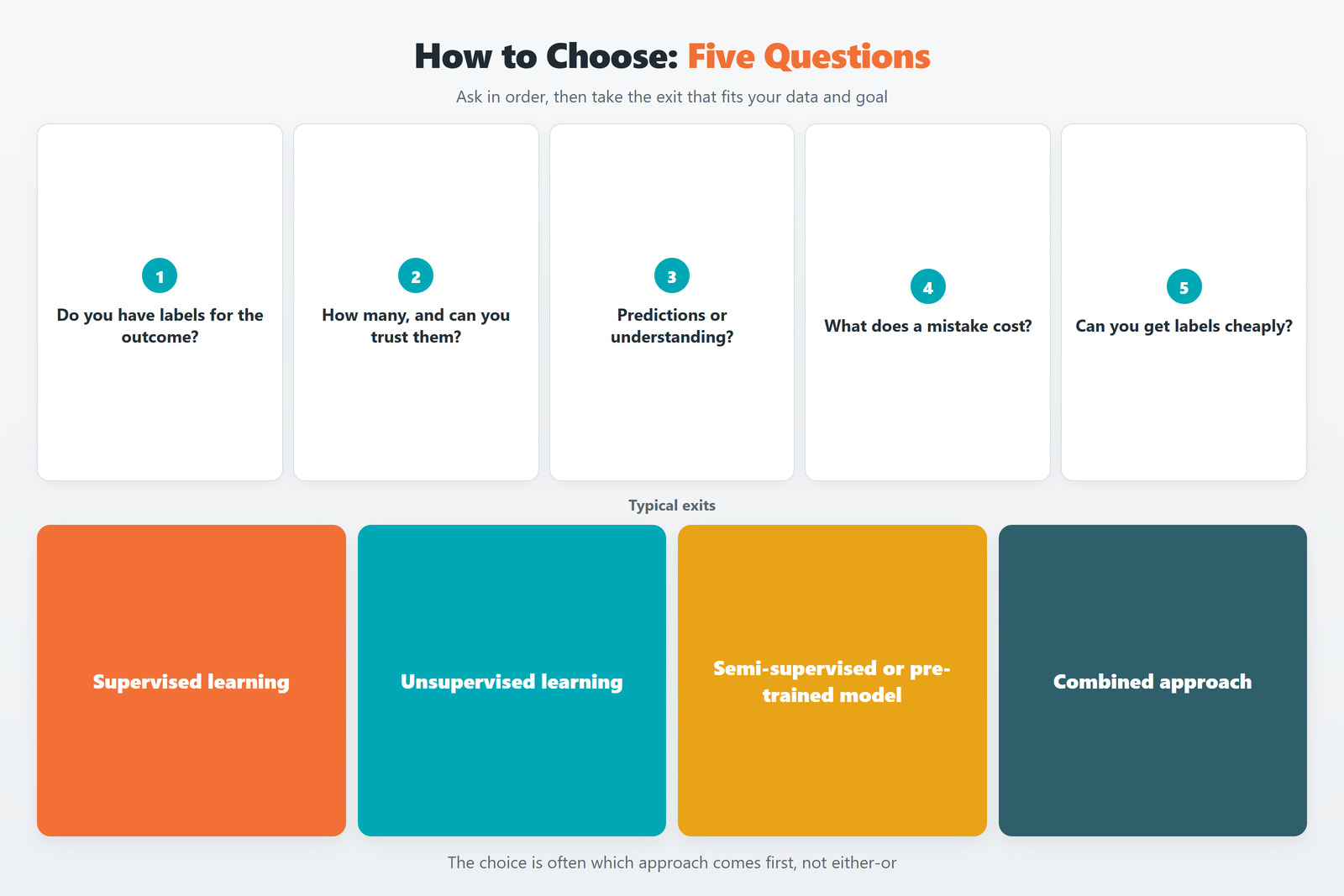
Choosing between the approaches is rarely about the choice of machine learning algorithms. Five questions, asked in this order, settle most cases:
- Do you have labels for past examples, and do they cover the outcome you want to predict?
- How many are there, and can you trust them? How many labels you need depends on the task and the model. A small, reliable set is usually enough to build a first model and see whether the problem is solvable and how quickly quality grows as you add labels. Thousands of inconsistent labels can be worse.
- What do you need at the end: predictions for new cases, or an understanding of the data?
- What does a mistake cost, and does anyone have to explain the decision?
- Can you get labels cheaply, or start from a pre-trained model?
Here is how the answers play out in typical situations:
| Situation | Approach | Why |
|---|---|---|
| We have years of loan outcomes and want to score new applications | Supervised classification | The outcome is known and the target is clear |
| We don't know what kinds of users we have | Unsupervised clustering | There is no target, only a wish to understand the data |
| We have 200 labeled documents and 50,000 unlabeled ones | Semi-supervised learning, or a pre-trained model with a small labeled set | Few labels, plenty of unlabeled data |
| We want to spot unusual behavior but have no examples of it | Unsupervised anomaly detection, with human review | There are no labels, and the cases are rare |
| Labels are expensive or arrive late | Active learning, weak supervision, or a pre-trained model | They reduce the amount of labeling needed |
| A regulator wants to know why each decision was made | A simple, inspectable supervised model, with human review | Explainability and an audit trail matter more than the last point of accuracy |
The two approaches also work in sequence. Many projects begin with unsupervised exploration to uncover hidden patterns and decide what is worth predicting. Once the target is defined, people label examples and train a supervised model for predictive analysis, and segments found earlier can become inputs to it. The choice is often not either-or but which one comes first. The next section covers what to do when labels are the bottleneck.
Not sure whether you have enough labeled data, or which approach fits?
Send us a short description of the data you have and the question you want answered, and our engineers will tell you where to start.
When Labels Are Expensive: Semi-Supervised, Self-Supervised, and Pre-Trained Models
The biggest practical limit of supervised learning is not the algorithm but the labels. Someone has to decide the right answer for every example, which takes time and often expertise. A radiologist marking tumors on scans is expensive, and even tagging tens of thousands of support tickets adds up. Labels also go stale when your product, customers, or fraudsters change. Quality matters as much as quantity: two people can label the same example differently, and a model trained on inconsistent labels learns the inconsistency. Before a large labeling effort, have two people label the same few hundred examples and compare. If they often disagree, the problem is the definition, not the model.
Semi-Supervised Learning
There are several ways to get more out of fewer labels. Start with the labels already hiding in your existing data: agents categorize tickets, users mark emails as spam, purchases confirm interest. They are the cheapest labels you will get.
Semi-supervised learning combines a small labeled set with a much larger unlabeled one. In self-training, the most common approach, a model is trained on the labeled examples, labels the rest, keeps only the predictions it is confident about, and is retrained. scikit-learn offers a ready-made implementation, SelfTrainingClassifier. The approach makes sense when labels are scarce, unlabeled data is plentiful, and similar examples can be expected to share labels. Its risk is that a biased labeled set teaches biased guesses, which the model then feeds back to itself.
Two more options reduce the labeling effort. In active learning, the model asks a person to label the examples it is least sure about, so each label teaches more. Weak supervision writes rules, such as "a ticket mentioning a refund is probably billing," to produce noisy labels at scale, and a model trained on many imperfect labels can still beat one trained on a handful of perfect ones.
Self-Supervised Learning and Pre-Trained Models
Self-supervised learning creates its own labels from the data: hide part of the input and ask the model to predict it. A language model trained to predict the next token (roughly, the next word or word fragment) needs no human labeling, because the text already contains the right one. This is how large language models are pre-trained on huge amounts of text, and similar ideas are used for images. It is not the same as unsupervised learning, which looks for structure. Self-supervised learning solves a prediction task whose answers come from the data itself.
The practical consequence is large. In natural language processing and computer vision, which deal with unstructured data and complex datasets, many teams now start from a pre-trained model (this is transfer learning), turn each text or image into an embedding (a list of numbers that captures its meaning), and use ordinary tools on top. A classifier trained on a small labeled set is supervised, and clustering the embeddings is unsupervised. Classic methods haven't gone away. They sit on top of much better inputs.
Related Terms: Reinforcement Learning and Deep Learning
Two terms often appear next to this split but don't belong to it. Reinforcement learning is a separate paradigm in which an agent learns by acting and receiving rewards or penalties, as in game-playing systems or some robotics. It has neither labeled examples nor hidden structure to discover. Deep learning describes an architecture, neural networks with many layers, and not a way of learning: such a network can be trained with labels, with self-supervision, or with rewards. When a system is said to use deep learning, the useful question is how it was trained.
A practical rule before any big labeling project: label a small batch (200 examples is a reasonable start), train a first model, and see how it does. The result is a rough guide to whether more labels are worth the cost and how quality grows as you add them. How many you will need depends on the task and the model.
Common Mistakes
Most failures in machine learning projects come from the process around the model, not the algorithm. These are the ones that show up again and again.
Data leakage is the most expensive. It happens when information that wouldn't be available at prediction time ends up in the training data. A churn model that uses a "cancellation reason" field is a classic case, because that field only exists after the customer has left. Splitting time-ordered data at random is another, since the model gets to peek at the future. The result is excellent test scores and a model that falls apart in production. Ask of every input: would we know this at the moment we need the prediction? And when the data has a timeline, split by time.
Choosing the number of clusters by habit is the clustering equivalent. Four segments because the slide has room for four, or the unscaled feature with the biggest numbers quietly deciding the groups, produces tidy charts and misleading segments. Rescale the features, try several values, and look at stability.
Clusters get treated as facts. Once a group is named "bargain hunters," the name starts to feel like a discovery, and strategy gets built on it. Check that the group really behaves differently before you name it.
Training data that doesn't match production causes quieter damage. A model trained on last year's customers meets this year's, in a new market or after a pricing change, and its accuracy slips without any error message. Track the inputs and the results over time, and plan to retrain.
Treating deployment as the finish line is a related mistake. A model in production needs monitoring, a plan for retraining, a fallback for when it is unavailable or unsure, and a person who reviews decisions that affect customers. These are engineering tasks, and they often take more effort than building the first model.
Ignoring the labels you already have is a surprisingly common mistake. A team with years of outcomes in its database runs clustering because it sounds more advanced, when a supervised model would answer the question directly.
Skipping basic data checks is less glamorous and just as costly. Missing values, duplicated rows, and inconsistent units quietly damage any model, supervised or not, and no algorithm fixes them for you. Look at the data before you blame the model.
And reaching for a complex model first. A neural network that nobody can explain, built before anyone tried logistic regression, leaves you without a baseline to judge it against. Start simple, and add complexity only where the simple model is demonstrably not enough.
The Bottom Line
The choice between supervised and unsupervised learning is decided by your data and your question, not by fashion. Start with a simple model and a baseline, and judge the result by whether it is useful, not only by a score.
Turning a model into part of a product is as much engineering as data science: data pipelines, monitoring, retraining, and human review where decisions affect people. If you'd like to talk through your own data and goals, get in touch.