United States
Invoice recognition SaaS on Azure AI
Outcomes
- Invoice processing up to 80% faster
- Over 60% fewer manual correction requests
- Accurate extraction across 50+ invoice templates
- .NET
- React
- Azure Cognitive Services
- Azure Service Bus


Generative AI Development
We build generative AI products on .NET and Azure, from the first MVP to the release your users run. The model is one layer, and we build the screens, data, controls and operations around it.
We reply within 24 hours
 Multi Radiance Medical
 Loma Lux Laboratories
 WellVu
 Commercial Capital Group
 Grand Auto
 HostMy
 Land Base
 Auto Tuning
What three of our MVPs shipped first and what waited for later phases. Only one put the model in its first release.
Shipped in the MVP
Came in later phases
The model was the product, so it shipped in the MVP.
Read the case studyShipped in the MVP
Came in later phases
The MVP shipped with a manual underwriting desk. The model came two phases later.
Read the case studyShipped in the MVP
Came in later phases
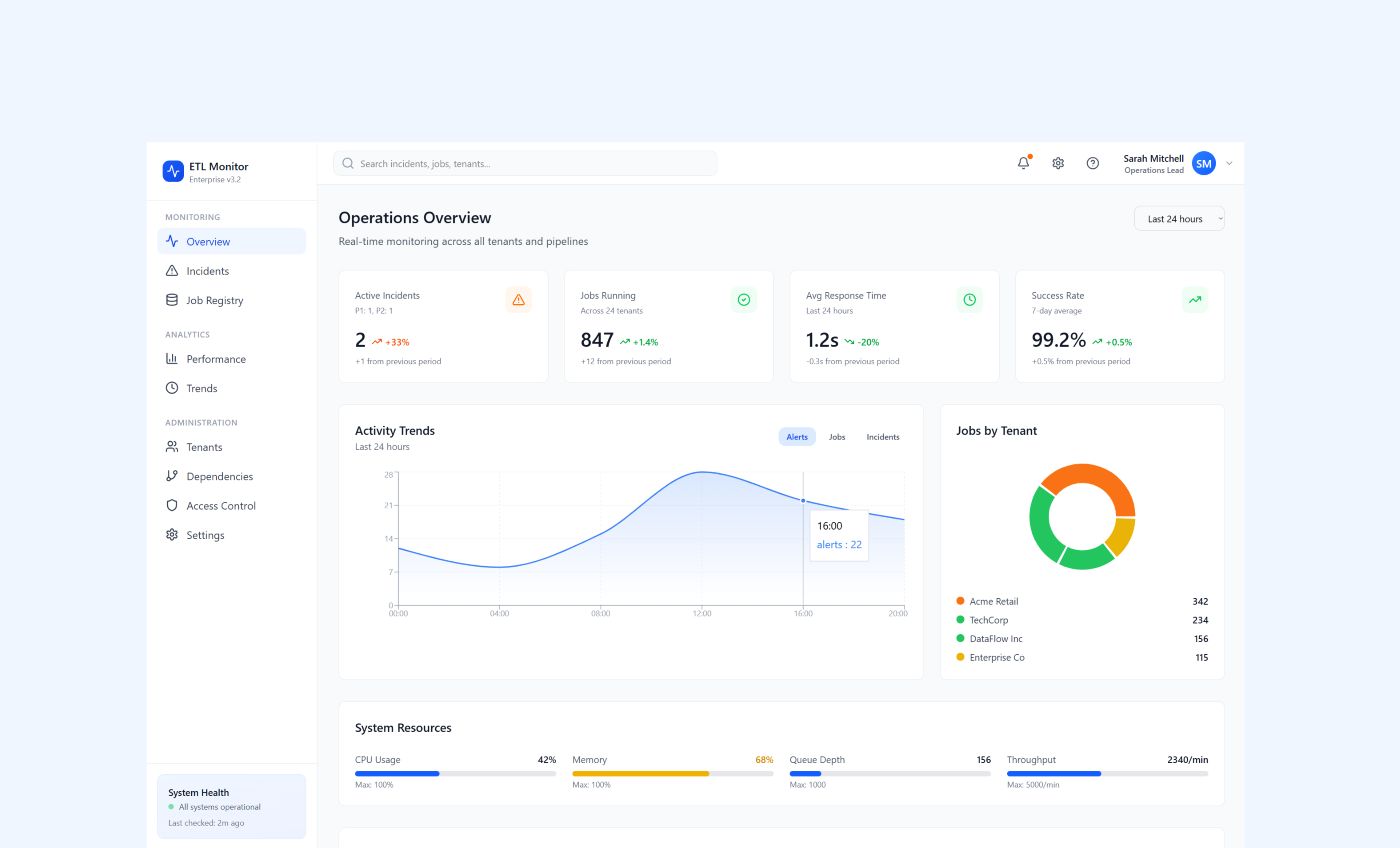
The MVP made alerts worth trusting first. The model came in the last phase.
Read the case studyNot sure your MVP needs a model? Four questions on our AI page show whether the first release needs a model, or a rule will do.
Take the fit checkAn invoice recognition SaaS, a lending platform and an ETL monitoring platform, then the data and automation work around them.
United States
Outcomes
Three AI products we built, drawn as the same six layers, from the model down to running it in production.
Azure Cognitive Services and OCR, with a model per client
Azure OpenAI and Azure AI Document Intelligence
Azure OpenAI in the client’s own tenant
Azure Service Bus between the services
A .NET gateway with schema-bound outputs
Temporal workflows, RabbitMQ and an AI gateway
.NET microservices on Azure Service Fabric
ASP.NET Core and Entity Framework Core
.NET APIs and workers
React and TypeScript review screens
Angular and TypeScript
Next.js and TypeScript admin UI
Storage isolated per tenant
Azure SQL, Blob Storage, Entra ID and Key Vault
PostgreSQL and Valkey
Audit logs and data flow tracing
Application Insights, OpenTelemetry and GitHub Actions
Terraform, Azure Container Apps and GitHub Actions
An enterprise app, medical image processing and a daily operations pipeline, each quote linked to its project.
They took the time to understand our business needs and provided a cloud native solution with microservice architecture that exceeded our expectations.
Eugene Baronetsky
Managing Director, Commercial Capital Group LLC
The team was very responsive, communicated effectively, and were always available to address any questions or concerns we had.
Josh Robertson
VP of Sales, WellVu
The solution they provided was not only efficient and accurate, but also integrated seamlessly with our existing internal system.
Boris Godes(LinkedIn profile, opens in a new tab)
President, Grand Financial Inc
Building a product around a generative model: software that drafts, summarizes, extracts or proposes, and the screens, services, data and controls that decide what happens next. We take it from the first MVP to the release your users run, on .NET and Azure.
The goal
A first release real users work in, and a product that keeps working when the model changes.
Three ways to put a model to work, from the least effort to the most. We start at the lowest step that does the job.
Step 1, Prompt
For drafting and summaries from data the product already holds.
Structured outputs make the model follow a JSON SchemaWhere we used it
Lender summaries from a private OpenAI gateway with schema-bound outputs
Step 2, Ground
For answers that must come from your records and documents.
Grounding responses in your proprietary contentWhere we used it
Prompts built only from incident fields and slices of the dependency graph
Step 3, Train
For fixed document layouts that a general model misreads.
Five examples of the same form type to get startedWhere we used it
Models trained on each client’s invoice samples
The path a request takes through the .NET gateways we built for the lending and ETL platforms, from the product to the model and back.
Loan submissions never wait on the model. In the ETL platform, the workflow decides when to call it, which contract version to use and when to skip it.
Only listed fields go in: incident fields, slices of the dependency graph and redacted log fragments, or hashed identifiers instead of full documents.
The gateway rejects payloads that run too long, contain path-like tokens or match secret patterns, before the request leaves the network.
Azure OpenAI runs in the client’s own tenant behind private endpoints, with network rules that deny traffic to unapproved hosts.
Token limits cap the call. The answer is validated against a versioned JSON schema and parsed back into domain objects before the product sees it.
When the model fails, a circuit breaker serves static help and logs an AI unavailable event. Term changes need human approval, and code fixes arrive as normal pull requests.
Want the gateway designed before the first prompt? Software architecture covers where the model sits in your system and what it may touch.
Software architectureTell us what it does today and who should use it next. We will say what the MVP needs around the model, and what can wait.
We reply within 24 hours and can sign an NDA first.
The work a security review, an investor or the on-call engineer asks about, from the lending and ETL builds.
Phase 1 of 4
Threat modeling for the bureau and bank integrations, done in discovery before the MVP.
Phase 1 of 4
Azure landing zone choices and cost guardrails, agreed in the same discovery phase.
Phase 4 of 4
Admins see and control which model version the product runs.
In production
A clear record of who changed routing, severity or automation policy.
Phase 3 of 4
Load tests on peak submission windows, in the phase that brought more lenders on board.
Phase 4 of 4
Runbooks for whoever is on call, shipped with the remediation work.
The real teams behind three AI products, one seat per person. The highlighted seats did the model work.
5 people, 8 months
6 people, 11 months
7 people, 14 months
Need the seats, not the whole build? Hire a dedicated team for the product, or add engineers to the team you have.
Headquartered in Warsaw, Poland, with a client office in New York. A European engineering team that works in your hours, with a US point of contact.
Headquarters
Engineering and delivery, and the main contact point for clients in Europe.
Client office
Kickoffs, contracts and account management for North American clients.
Clients in Europe share the full working day with the team.
8 AM to 12 PM New York time, 2 PM to 6 PM in Warsaw.
Independent rankings for the team behind our AI products, each next to the service it relates to.

Top Software Developers 2026
TechReviewer

Champion, Fall 2024
Clutch

Global Leader, Fall 2024
Clutch

Best Company to Work With
GoodFirms

App Modernization 2024
The Manifest
Top Software Developers 2024
TopDevelopers

Top Healthcare Software 2025
SuperbCompanies

ReactJS Winner 2025
TechBehemoths
Related reading
Guides from our team on supervised and unsupervised learning, sprint zero and project estimation.
30 min readAudio version available
Supervised vs unsupervised learning explained: key differences, real examples, working Python code, how to measure results, and how to choose

5 min readAudio version available
Sprint Zero determines whether Agile projects succeed or fail. This guide reveals how successful teams use Sprint Zero for predictable delivery.
6 min readAudio version available
Project estimation separates successful managers from those facing delays. This guide reveals proven techniques for delivering projects on time and budget.
Questions founders and product teams ask before an AI MVP, and once it has to face real users.
Have a different question? Talk to our team
Tell us the work it takes on, who uses it and the systems it touches.
We reply within 24 hours, and we can sign an NDA before you share details.
Talk to the people who will scope your project