


Your next release is three months away. The roadmap needs a senior backend engineer with payments experience, and nobody on the team has it. Hiring a permanent employee would mean posting a job, running several rounds of interviews, waiting out a notice period, and onboarding. By the time that person writes production code, the release date has passed.
This is the situation staff augmentation is built for. The staff augmentation process is the sequence of steps that takes you from "we're missing a skill" to an external engineer working inside your existing team, and eventually to a clean handover when the engagement ends.
This guide walks through that process the way it actually runs: eight steps, who is responsible for each, what goes into the contract, how long things usually take, and what the first 30 days should look like. If you're still deciding whether the model fits you at all, our complete guide to IT staff augmentation covers that in more depth.
What Is the Staff Augmentation Process?
Staff augmentation refers to adding external professionals to your in-house team for a defined period. They work on your tasks, in your tools, under the direction of your project managers. They are not your employees, though. The staff augmentation company employs or contracts them and, depending on the country and the contract, takes care of their pay, taxes, benefits, and related compliance. You pay the provider.
That split is the most important thing to understand about the model, and it shapes every step of the process: you manage the work, and the provider handles the agreed employment and administrative responsibilities.
In practice, the process runs through eight steps:
- Define the need and the skill gaps.
- Choose a staff augmentation partner.
- Shortlist candidates.
- Interview and select.
- Sign the contract.
- Onboard the new team member.
- Manage day to day and track performance.
- Scale, replace, or offboard.
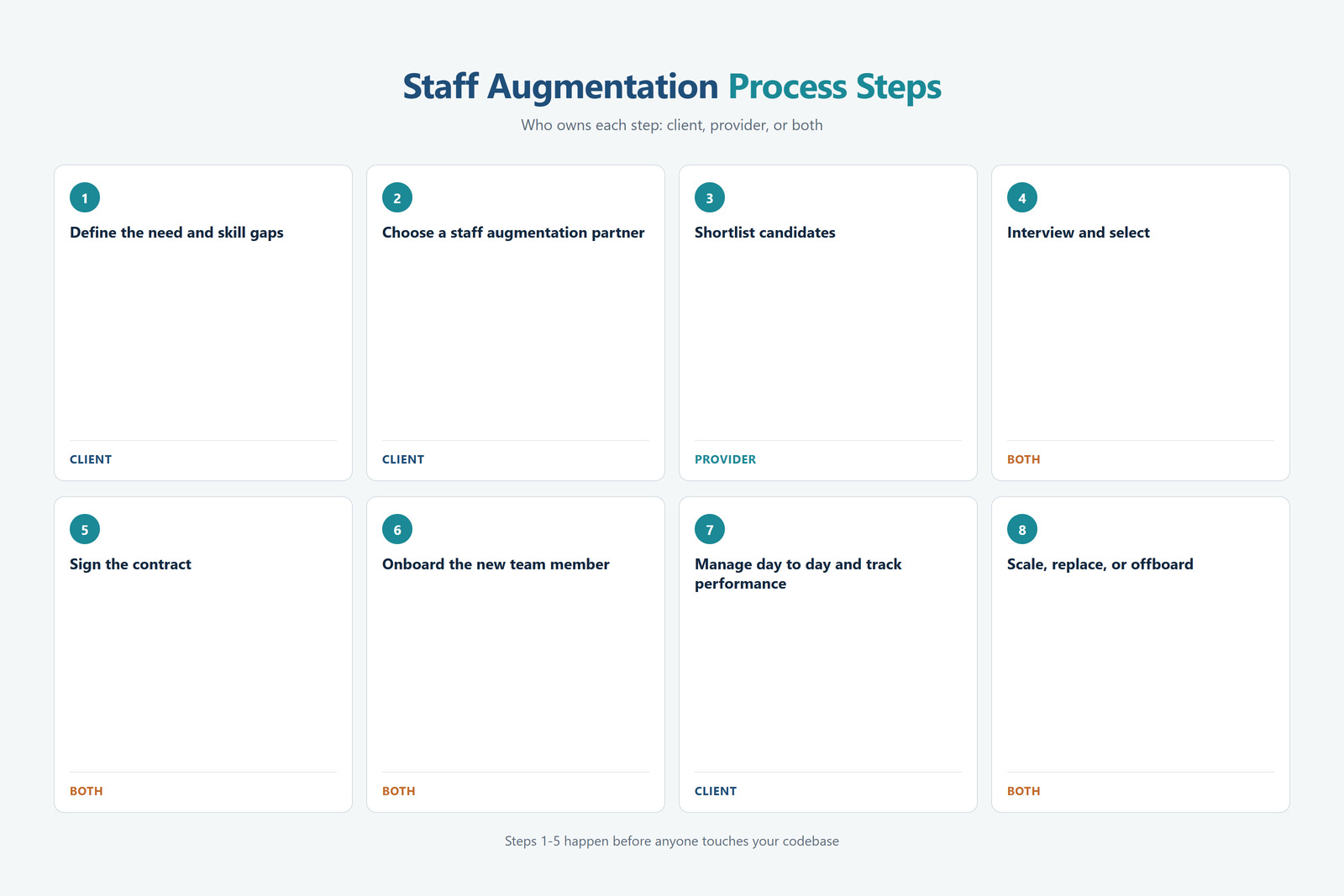
Steps one to five happen before anyone touches your codebase. They're also where most problems start, which is why we spend the most time on them below.
Staff Augmentation vs. In-House Team, Managed Services, and Independent Contractors
Staff augmentation is often lumped in with outsourcing, and some people call it an outsourcing strategy. The difference that matters is control. With staff augmentation, the work stays inside your team and your processes. With most other external models, someone else runs it.
| Metric | Hiring an in-house team | Staff augmentation | Managed services | Independent contractors | Project outsourcing |
|---|---|---|---|---|---|
| Who directs day-to-day work | You | You | The provider, against agreed service levels | You | The vendor |
| Who is accountable for the result | You | You | The provider | You | The vendor |
| How you pay | Salary and benefits | Hourly or monthly rate per person | Fixed fee per service | Contractor's rate, paid directly | Fixed price or time and materials per project |
| Who handles payroll, taxes, compliance | You | The provider | The provider | You and the contractor | The vendor |
| Who replaces someone who leaves | You | The provider | The provider | You, by finding someone new | The vendor |
| Best for | Core, permanent roles | Skill gaps and extra capacity inside your team | Ongoing functions you want run for you, such as infrastructure support | Small, well-defined tasks | A self-contained product or project you'd rather hand off entirely |
Independent contractors look similar to staff augmentation on the surface: one person, working on your tasks. The difference shows up when things go wrong. If a freelancer disappears, you start sourcing again from zero. If an augmented engineer leaves, the provider finds a replacement, and the vetting, contract, and compliance are already in place.
There's one more model worth knowing: a dedicated team, where a provider assembles a whole cross-functional team around your product. We cover it separately in our guide to the dedicated team model.
Types of Staff Augmentation
Engagements differ mainly in length and in how specialized the role is, and that mostly changes how long steps three and four take. Short-term augmentation covers a sprint, a release crunch, or a specific task; long-term augmentation runs for a year or more on long-term projects. Commodity-based augmentation adds capacity for well-defined work that many candidates can do, while skill-based augmentation targets a specific capability, such as test automation or data analysts for a reporting project.
Highly Skilled Augmentation for Complex Projects
Rare roles, such as a solution architect for a cloud migration or a security specialist before an audit, take longer to fill and cost more, but give you specialized expertise you might not be able to hire at all. Location matters as well: onshore, nearshore, and offshore engineers differ in rates and in how much their working hours overlap with yours. If you're weighing the first option, see our guide to onshore team augmentation.
The IT Staff Augmentation Process, Step by Step
For each step below, you'll find what happens, who owns it, and the mistake that most often slows it down.
1. Define the Need and the Skill Gaps
Owner: you. Typical time: usually about 1 day, depending on how quickly your team can agree the brief.
Everything downstream depends on this step, and it's the one teams rush most. "We need a senior developer" produces a pile of mismatched profiles. A short written brief produces a shortlist you can actually choose from.
A good brief fits on half a page:
- Role: Senior backend engineer
- Stack: .NET 8, PostgreSQL, Azure; payments experience a strong plus
- Seniority: 6+ years, comfortable owning a service end to end
- Duration: 6 months, possible extension
- Time zone: at least 4 hours overlap with CET
- First 30 days: take over the refunds service, fix open bugs, ship the partial-refund feature
The last line matters more than people expect. Describing what the person should achieve in their first month tells the provider far more than a list of technologies. If you're looking for engineers for a specific stack, our software developers page lists the skills we typically cover.
Common mistake: confusing a skill gap with a capacity gap. If the team knows the stack but is overloaded, you need a solid mid-level engineer who can pick up tasks quickly, not a rare specialist.
2. Choose a Staff Augmentation Partner
Owner: you. Typical time: a few days to a few weeks, depending on how many providers you compare.
Rate is one criterion, not the deciding one. These questions tell you much more about how the engagement will go:
- Have they placed engineers in your industry and your stack before? Ask for examples.
- How do they vet candidates, and who on their side does the technical interview?
- How large and how relevant is their talent pool for this role?
- What happens if an engineer doesn't work out, or leaves mid-project?
- Who is your point of contact on their side, and how often will you hear from them?
- What security and data protection practices do they follow?
Cultural fit matters too. A provider whose engineers are used to working inside client teams, joining standups and taking direction, will integrate faster than one used to delivering fixed projects on its own.
Common mistake: choosing the cheapest rate and discovering that vetting was thin. Replacing a weak hire costs weeks.
3. Shortlist Candidates from a Global Talent Pool
Owner: the provider. Typical time: 1-3 days.
The staff augmentation provider searches its bench and network, runs its own technical screening, and checks communication and English. Working with a global talent pool widens the choice, especially for rare skills, but it also means thinking about time zones and how much overlap your team actually needs.
You should receive a shortlist of profiles, not a stack of CVs, with notes on why each person fits the brief and the results of the provider's own assessment.
Common mistake: asking for ten candidates "to have options." A few well-matched profiles, often around three, are faster to evaluate and usually lead to a better choice than a long list.
4. Interview and Select
Owner: you, with the provider coordinating. Typical time: usually a couple of days to two weeks, depending on your interview availability.
Even if the provider has vetted everyone, run your own interview. Usually one technical conversation with an engineer from your team and one short call about how the person works with others is enough. Keep it to one or two rounds, and give feedback within a day or two. Good engineers rarely stay available for long.
Common mistake: copying the full multi-round process you use for permanent hires. For most roles it slows things down without adding much, since the provider has already done the screening. Regulated or business-critical projects are the exception: there, extra checks such as background screening or a security interview are worth the time.
5. Sign the Contract
Owner: both. Typical time: usually a couple of days to two weeks, depending on how quickly both sides can review and sign.
Many staff augmentation contracts consist of a master services agreement plus a short order or statement of work for each engineer. Make sure they cover:
- Pricing and billing. Usually time and materials: an hourly or monthly rate per person, invoiced monthly.
- Duration, extension, and notice. How long the engagement runs, how to extend it, and how much notice either side gives to end it.
- Trial period and replacement. What happens if the engineer isn't the right fit in the first weeks, and how quickly a replacement is provided.
- Intellectual property. The contract should assign intellectual property rights in the code and other work product to you, and state when that transfer takes place.
- Confidentiality and data access. NDA terms, what data the engineer can access, and how it's protected, including GDPR if personal data is involved.
- Employment and compliance. Which employment, tax, and benefits obligations the provider takes on for the engineer. This depends on the country and the legal model, so spell it out.
- Conversion. Whether you can later hire the engineer directly, and on what terms.
At Softellar, engagements include a trial period, a replacement guarantee if the engineer is not the right fit, and clear notice terms for ending or changing the engagement. The exact lengths and conditions are set in the master agreement and the order for each engineer.
Common mistake: treating the contract as paperwork and skipping the replacement and offboarding terms. Those are exactly the clauses you need when something changes.
6. Onboard the Augmented Team Member
Owner: you, with support from the provider. Typical time: the first one to two weeks.
Treat the new engineer like a new employee, not a vendor. Prepare access to the repository, environments, ticket tracker, chat, and documentation before day one. Assign a mentor from your team who will answer questions in the first weeks. On the provider side, an account manager stays in touch with both you and the engineer to catch problems early.
We cover what the first month should look like in detail below.
Common mistake: waiting for access requests to go through IT after the engineer has started. Every day spent waiting for credentials is a paid day with no output.
7. Manage Day to Day and Track Performance
Owner: you. Typical time: the whole engagement.
The augmented engineer works like anyone else on your team: same standups, same sprint planning, same code review, same project management tools. Your team lead sets priorities and reviews the work. The provider doesn't assign tasks; it supports the engineer and checks in with you regularly.
Agree on a few simple indicators up front, such as tasks delivered per sprint, review feedback, and how quickly blockers are raised, and talk about them every couple of weeks rather than waiting for a quarterly review.
Common mistake: keeping the external engineer out of planning and design discussions. People who don't know why something is being built make worse decisions about how to build it.
8. Scale, Replace, or Offboard
Owner: both. Typical time: the agreed notice period.
Engagements change. You may need to add two more engineers for a launch, reduce the team after it, replace someone, or end the engagement at project completion. A good provider makes each of these routine.
Offboarding deserves its own plan. Before the engineer leaves, make sure the knowledge they built stays with you: documentation updated, open work handed over, a walkthrough with whoever takes over. Then revoke access to every system on their last day. Institutional knowledge that lives only in one external engineer's head is the biggest long-term risk of the model, and it's entirely avoidable.
Have a role to fill?
Send us a short brief like the one in step one, and we'll come back with matching profiles.
IT Staff Augmentation Services: Who Does What
Most friction in staff augmentation comes from unclear boundaries. The client assumes the provider will manage performance; the provider assumes the client will. Writing the split down early saves a lot of awkward conversations later.
| Step | You (the client company) | The provider | Together |
|---|---|---|---|
| 1. Define the need | Write the brief, set budget and timeline | Help refine the brief, flag unrealistic requirements | - |
| 2. Choose a partner | Evaluate providers, check references | Share process, examples, and terms | - |
| 3. Shortlist candidates | - | Source, screen, and present profiles | - |
| 4. Interview and select | Interview, decide | Schedule interviews, collect feedback | - |
| 5. Contract | Review terms, sign | Prepare agreements, handle the engineer's employment contract | Agree on rates, notice, replacement, IP |
| 6. Onboarding | Prepare access, assign a mentor, set first tasks | Prepare the engineer, provide equipment if agreed | First-week check-in |
| 7. Daily work | Set priorities, review work, run ceremonies | Pay the engineer, handle HR matters, stay in touch | Regular feedback |
| 8. Scale or offboard | Decide on changes, own knowledge transfer | Find additions or replacements, close out the engineer's contract | Plan the handover |
Depending on the contract and the country, the provider typically takes on the engineer's pay, taxes and benefits, cover during vacations and absences, equipment if agreed, and replacing someone who leaves. In the standard staff augmentation model, deciding what gets built, setting priorities, and reviewing the code stay with you. Some hybrid arrangements let the provider take part in technical leadership or code review, but that should be agreed explicitly. If you want someone else to own these areas entirely, managed services or a dedicated team will usually fit better.
If you'd like to see how this split works with us, our IT staff augmentation services page covers the roles we provide.
How Long Does the Staff Augmentation Process Take?
The honest answer is that it depends less on the provider than on the role and on how quickly decisions get made on your side.
| Stage | Typical duration |
|---|---|
| From brief to first profiles | 24-48 hours |
| Client interviews and decision | 1 day to 1-2 weeks, depending on the number of candidates and your availability |
| Contract signing | usually 1-2 weeks |
| From decision to first working day | usually the next day after the contract is signed |
| Total, common roles | usually 1-3 weeks |
| Total, rare or highly specialized roles | usually 1-2 months |
Three things speed the process up more than anything else. A clear written brief, so the first shortlist is the right one. Fast feedback on candidates, ideally within a day or two. And access prepared before the start date, so the first week is spent working rather than waiting.
The same three things, missing, are what usually slow it down. Vague requirements lead to a second and third round of profiles. Interview slots that take a week to schedule lose candidates to other offers. And contracts that sit in legal review for weeks can push the start date further than everything else combined.
Compared with traditional hiring, the main saving isn't only the speed of finding someone. It's that there's usually no long notice period to wait out, and no need to run the whole hiring process again if the person doesn't work out.
The First 30 Days with Augmented Staff
The first month sets the tone for whether an augmented engineer becomes a real part of the team or stays a contractor working off to the side. In complex systems, full ramp-up takes longer than 30 days; the point of the first month is to make sure things are heading in the right direction. It doesn't take much effort to get it right, but it does take a plan.
| When | The engineer | Your team | The provider |
|---|---|---|---|
| Day 1 | Gets access, sets up the environment, meets the team, picks up a small first task | Mentor walks through the codebase and how the team works | Confirms the start went smoothly |
| Week 1 | Joins every standup and planning session, opens a first pull request, asks a lot of questions | Reviews the first work quickly, explains context behind decisions | Short check-in with both sides |
| Weeks 2-4 | Takes regular sprint tasks with growing independence, starts contributing in reviews and discussions | Gives the first structured feedback around the end of week two | Collects feedback, flags concerns early, adjusts if needed |
| Day 30 | Works at the pace of the team on their own area | Decides whether expectations are met | Agrees on next steps with you: continue, adjust, or replace |
The small first task on day one is deliberate. Fixing a minor bug or updating a test checks that the environment, access, and deployment pipeline work, and it gives the engineer an early win. Starting with a large feature usually means a week of setup problems disguised as a slow start.
The feedback at the end of week two is just as important. It's early enough to correct a mismatch in expectations, about code style, communication, or working hours, before it turns into frustration on either side. If the fit isn't right, this is also the point where a replacement costs the least.
Finally, include the engineer in the parts of team life that aren't strictly work: retrospectives, demos, the team chat. People who feel part of the team care about the result in a way that people treated as outside help rarely do.
Benefits of Staff Augmentation and the Trade-Offs
The benefits of staff augmentation are well known: quick access to specialized skills, a team you can scale up and down without long-term commitments, and none of the recruitment overhead of hiring full-time employees, while you keep control over priorities and quality.
The trade-offs get less attention. The rate is often higher than what an equivalent full-time employee costs per hour, although that depends on location, specialization, and the full cost of hiring. Your managers still have to direct the work, so the model adds capacity, not management. External engineers start without knowledge of your company culture and internal processes. And unless it's documented, what they learn leaves with them.
That makes staff augmentation a good fit for skill gaps, temporary capacity, and projects with a clear end, and a poor substitute for building your own team in the long run. Our complete guide to IT staff augmentation goes deeper into when the model fits.
How to Leverage Staff Augmentation Without the Common Mistakes
The obvious mistakes, like a vague brief or skipping your own interview, are covered in the steps above. The problems below are less obvious. They rarely show up in the first week; they tend to appear a few months into an engagement.
The first is adding more external engineers than your leads can absorb. Each new person needs context, reviews, and decisions. How many newcomers one lead can absorb depends on the team and the codebase, but adding several at once often turns the lead into a bottleneck. If you need to grow quickly, add people in waves and check that review times and lead workload stay reasonable before the next wave.
The second is expecting the provider to manage delivery. Staff augmentation gives you people, not an owner for the outcome. If what you actually want is someone else to plan the work, run the team, and be accountable for results, a dedicated team or managed services will fit better. Mixing the two expectations leads to gaps where everyone assumes someone else is responsible.
The third is access sprawl. Over months, external engineers collect access to repositories, cloud consoles, databases, and third-party tools, often more than the current task needs. Give the least access that works, use individual accounts rather than shared ones, review access every quarter, and make sure the offboarding checklist covers every system, not just the obvious ones.
The fourth is a single point of knowledge. It happens quietly: one augmented engineer becomes the only person who really understands a service. Pair them with an internal engineer on that area, rotate code reviews, and write down important decisions while they're being made rather than at the end.
The fifth is trusting time zone overlap on paper. "Four hours of overlap" can shrink to one in practice once meetings, lunch breaks, and focus time are accounted for. Agree on core hours when the whole team is reachable, and on what can be handled asynchronously.
And finally, letting a long engagement drift. An arrangement that made sense for a six-month push can quietly run for three years. Every few months, ask whether staff augmentation is still the right model, or whether it's time to hire the role permanently, move to a dedicated team, or wind the engagement down. That review is most of what a staff augmentation strategy needs.
How Augmentation Services Are Priced
Staff augmentation is usually billed on a time and materials basis: an hourly or monthly rate per engineer, invoiced monthly, as set out in the contract from step five. Fixed prices are rare, because you, not the provider, control what the engineer works on. The staff augmentation cost for a role depends mostly on the stack and specialization, seniority, location, the length of the engagement, and requirements such as time zone overlap or security clearance.
The rate typically covers the engineer's pay and related employment costs, recruitment and vetting, administration, and the provider's margin. Whether equipment, software licenses, travel, or replacement are included depends on the contract, so check it. When you compare the rate with an in-house hire, compare full costs on both sides: recruitment fees, benefits, equipment, and the time a role stays vacant all belong in the calculation.
The Bottom Line
The staff augmentation process itself is simple. What makes it work is agreeing on the boundaries before the engineer starts: you direct the work, the provider handles the agreed employment and administrative side, and both sides know how changes, replacements, and the end of the engagement will be handled. Start with a clear brief, interview for fit as well as skills, and plan the first 30 days. The rest tends to follow.


