


Overview
Companies that are looking to develop new IT initiatives in today's technological landscape have multiple options to choose from when it comes to sourcing expert development talent. Of these options, staff augmentation stands out for its scalability and the flexible avenue it provides for businesses to quickly access tech expertise.
When IT firms approach staff augmentation providers for specialized expertise, the augmentation provider assesses the scope of the project at hand to determine the most viable means of augmenting staff. For the service provider, the alternatives here are three-pronged: nearshore, offshore, and onshore outsourcing.
This article will focus on onshore staff augmentation and the many beneficial avenues it offers businesses that are developing novel IT projects.
What Is Onshore Staff Augmentation?
Onshore augmentation is an outsourcing model where IT development teams are hired from within the same country as an IT company's headquarters to supplement an existing workforce. Compared to other avenues for sourcing tech talent, nearshore augmentation is arguably the fastest, as it allows outsourcing companies to find employees closest to them – employees who understand the cultural differences and the demands of the client company firsthand.
Benefits of Onshore Staff Augmentation

Closer Proximity And Better Communication
Augmented onshore teams are often located within the same geographical area and time zone as the client company. This close proximity helps limit delays in feedback and decision-making that plague longer-distance collaboration. When IT firms employ onshore augmentation, communication across all teams is more effective as remote and in-house employees work during synchronized business hours. This ensures teams maintain a synergistic flow when collaborating on web development (e.g. React Native staff augmentation), app development projects (e.g. Java staff augmentation) or resolving software issues with .NET augmented specialists.
Cultural Compatibility
In a technical environment such as software development, instructions, guidelines, and project reports need to be communicated to team members in unambiguous terms. In this regard, cultural compatibility becomes invaluable, as it facilitates a work environment devoid of communication challenges.
When individuals working on a project come from similar cultural backgrounds, there's an increased chance of them interpreting and reacting to unique situations through a unified lens. This shared perspective creates a fluid workflow process that can impact the efficiency and speed of making time-sensitive decisions.
Compatibility among augmented teams also helps employers mitigate any potential project or personal conflicts that may arise due to ineffective communication. Being that there are not many major differences between staff in terms of language, humor, work ethics, and location, employers can resolve hostile situations more preemptively.
Better Quality Control
Compared to other augmentation modes like offshore outsourcing and hybrid outsourcing (onshore/offshore model), onshore staff argumentation gives IT project managers more control over a project's quality and direction. Whether you're developing a product for commercial or enterprise use, web or mobile, the close physical presence of supervisory staff in an onshore setting can facilitate more concentrated engagement from team members. Besides this, the interaction dynamics in an onshore team support the implementation of agile methodologies in a way that offshore or strictly remote settings cannot match.
Legal And Regulatory Compliance
When IT firms employ offshore team for onshore development efforts, they have to put in extra efforts to ensure their practices are in line with local and international tax and labor laws. Hiring local talent from onshore services mitigates these complexities because companies are only obligated to work within the legal frameworks of the development territory.
The advantages of these to project management are manifold, but they're perhaps most evident on the human resources side of things, where managing teams is accompanied by administrative duties like payroll processing and employee benefits disbursement and statutory obligations like withholding tax.
Cohesive Team-Building
Onshore teams working on-site encounter each other face-to-face on a regular basis. Studies have shown that this can increase the likelihood of teams developing an effective working relationship that enables seamless collaboration. The shared cultural context of onshore staffers further contributes to this collaborative spirit.
Ready to Leverage These Onshore Augmentation Benefits?
Transform your project delivery with strategic onshore staff augmentation. Our experts will help you implement these proven benefits, from better communication to quality control, ensuring your projects succeed.
When to Leverage Nearshore Staff Augmentation
Onshore augmentation is preferred by development teams and augmentation companies for a variety of reasons, including effective communication, cost efficiency, confidentiality, and project agility. Here we look at some situations where outsourcing presents itself as the ideal service solution.
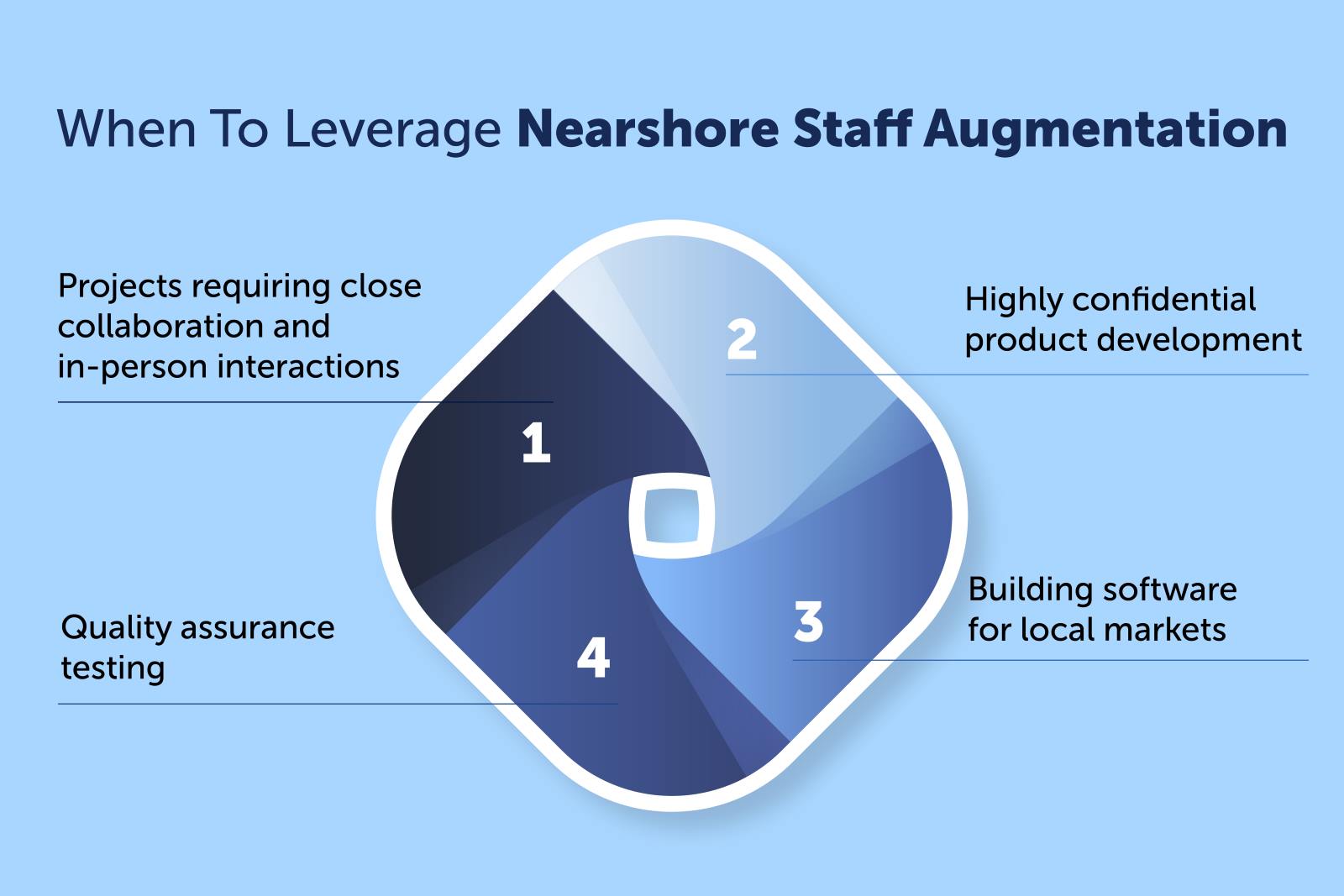
Projects requiring close collaboration and in-person interactions
Some software initiatives can be executed to satisfaction with remote team work as the primary engagement model; others demand regular in-person interactions between outsourced team and in-house staff. In order to actualize projects in the latter category, IT teams must adopt and outsource services.
Highly confidential product development
Onshore team augmentation offers organizations greater security when developing IT products that demand confidentiality. The location of teams within the same jurisdiction limits the likelihood of security breaches and cyber vulnerabilities that may affect project integrity.
Building software for local markets
Developers who reside in close proximity and understand local compliance laws and market dynamics are essential for developing applications primarily used in the same region as the development company. This expertise helps enterprises limit the risk of incurring legal penalties or missing out on emerging preferences in the domestic market.
Quality assurance testing
Companies that adopt a hardware/software co-design process often require software teams that can work in tandem with engineers to continuously test software and hardware compatibility. While these software teams may work remotely without issue, having them onshore and in the same location as the hardware developer can prompt innovative solutions for mitigating device issues.
Conclusion
Onshore staff augmentation offers numerous advantages for companies seeking to improve the efficiency of their project operations. By leveraging onshore staffing, organizations can build a culturally compatible and regulation-compliant workplace that works cohesively. While it may not be as cheap as the nearshore or offshore alternatives, the trade-off is justified by the speed of integration of augmented workers and the ease of collaboration that it affords development teams.


