

Overview
In contemporary IT business environments, organizations encounter the daily challenge of navigating shifting technological demands to stay ahead of the competition in areas such as strategic project planning, user base expansion, and operational efficiency. As businesses grow and the complexity of their IT project requirements evolve, the need for more sophisticated software development projects, website development services, and network infrastructures to support these technological demands becomes increasingly apparent.
These necessities present an investment challenge that companies in IT must successfully traverse to stay in business and remain profitable; do they hire more employees to develop and manage these processes and infrastructure, or do they choose the outsourcing route?
For many enterprises, this choice is dictated by reasons not limited to finances, project timelines, and technical expertise requirements. Yet, the prevalent strategy most modern IT firms employ is outsourcing. The rationale behind this choice is not far-fetched-outsourcing offers multiple benefits in terms of reduced employment costs, greater technical expertise, and a limited need for continual oversight.
When choosing an outsourcing model, businesses are faced with multiple options, among which the most prevalent are staff augmentation and managed consulting. In this article, we dive into both service models, considering their unique dissimilarities and applications.
Staff Augmentation Model: What Is It?
Staff augmentation is a strategy adopted by businesses where external expertise is hired to supplement an internal workforce on an as-needed basis. Staff augmentation as a service is provided by specialized staff augmentation firms that have access to a global talent pool and tap into it to furnish businesses in need with specialized expertise in specific IT roles. This model of outsourcing is employed to a greater degree by organizations looking to overcome workload spikes, skill deficits, or personnel shortages for a defined period. It provides businesses with a scalable and cost-effective employment model that circumvents the long-term commitment and overhead typically associated with hiring employees full-time.
Among the essential features of staff augmentation services that make them such an attractive option for businesses in need of IT personnel is the vast spectrum of skills they provide in various domains. These specialized skills help companies embark on complex IT projects with confidence without having to worry about the rigorous processes of advertising, interviewing, and onboarding required to hire IT talent permanently. Earlier we discussed in detail what is IT staff augmentation and how it works.
Definition of Managed Consulting
Managed consulting is a practice implemented by organizations to procure specialized professional services with the aim of optimizing processes, devising novel business strategies, or boosting profitability. These services are provided by consultants who bring their own proprietary methodologies and frameworks to help companies assess processes, identify inefficiencies, or transition from one business model to another. The professional services provided by managed consultants may cover different industrial sectors, from management, to finance, marketing, human resources, and technology. What's more, these services are usually provided on a per-project basis until the stated objectives are actualized.
Consulting services take a more collaborative approach to outsourcing than staff augmentation. Consulting agencies don't help companies source talent; rather, they are the talent. Companies undergoing significant changes in business or looking to gain competitive market advantage engage consulting agencies who then tap into the experience and insights of their well-versed, in-house consultants to strategize a course of action for optimizing operations and driving sustainable growth. This collaborative partnership bears dividends for the employing company as it helps them target performance improvement with the guidance of seasoned professionals who have decades of experience and a wealth of resources that may not be available in-house.
Need Help Choosing Between These Models?
Deciding between staff augmentation and consulting can be challenging. Our experts will analyze your project requirements and help you select the optimal approach for your business objectives and team structure.
Advantages of Staff Augmentation
Flexibility and Scalability
Staff augmentation offers organizations unparalleled flexibility in workforce management. Augmentation providers such as Softellar cater to the ebb and flow of clients' project demands as they change with evolving market conditions. With staff augmentation, businesses are empowered to scale their workforce dynamically without having to bother about the constraints associated with traditional hiring processes. This adaptability is crucial in IT, whether you're looking to hire Java developers for enterprise solutions or scaling down a team post-launch.
Access to Specialized Skills
Staff augmentation providers help enterprises drive innovation and maintain a competitive edge by sourcing the right talents for specific projects. Because they have direct access to a global talent pool of individuals with skills in niche product areas, they can orient augmented staff and onboard them quickly, accelerating project timelines and reducing the learning curve associated with using novel technologies. For example, companies looking to hire React Native developers can leverage staff augmentation to find the right experts efficiently.
Cost Efficiency
Opting for the augmentation approach helps businesses allocate resources efficiently. Companies only have to pay staff for the duration of their contribution to project efforts. Typical costs associated with hiring permanent employees, such as office space, wages, benefits, and training expenses, are circumvented, and these cost savings can be reinvested into other business departments.
Advantages of Consulting
Expert Insights
One of the major benefits project-based consulting services offer businesses is industry-specific expertise. The work of consultants with various types of organizations across various sectors gives them a broad perspective that allows them to identify best practices and suggest innovative solutions that internal team might overlook. This outsider perspective is invaluable for driving sustainable growth as it informs business and project managers of the strategies their competitors are implementing that they might not be cognizant of.
Operational Speed and Efficiency
Consulting services typically operate in the upper echelons of the outsourcing market, catering to conglomerate and multinational companies. As such, speedy implementation of strategies and methodologies is expected of them. Consultants pride themselves in rapidly diagnosing problems and formulating strategies for solving them. They adopt agile practices to help organizations fast-track innovation and transformation within often-tight project timelines.
Knowledge Transfer
Knowledge transfer is one lasting benefit of project-based consulting that often goes unnoticed. By collaborating with client staff on certain project aspects, consulting team helps build the internal capabilities of in-house team significantly. Their competencies in varied business domains rub off on internal staff, enhancing their proficiency and innovative acumen inadvertently.
Key Differences Between Staff Augmentation and Consulting
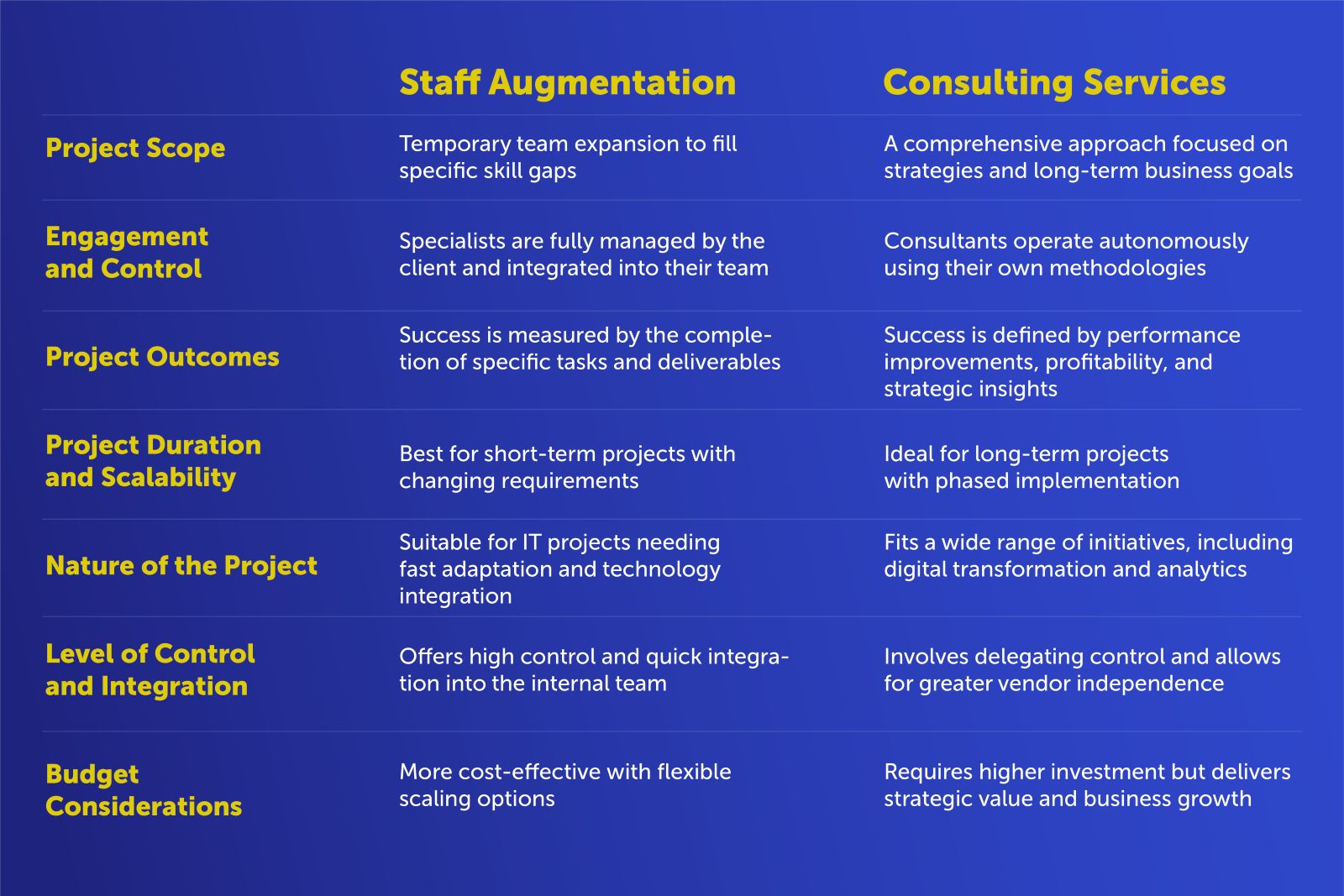
For enterprises looking to choose an optimal employment model for their project needs, understanding the main difference between staff augmentation and consulting is very essential. Here, we highlight some major aspects of both models that differ considerably.
Project Scope
Staff augmentation is a tactical approach that enterprises employ to enhance the capacity of their workforce temporarily. The primary focus of augmentation services is to help supplement skill gaps by sourcing specific skill sets and integrating them into an existing in-house team. Consulting, on the other hand, is aimed at delivering quality strategies and actionable plans to help businesses achieve long-term development objectives. Consulting services tackle projects more holistically. Throughout the IT project's life cycle, they take on the full responsibility of optimizing operations and recommending areas for improvement.
Engagement and Control
In an augmentation model, the staff augmentation company integrates augmented staff with a client's development team and these teams are directly managed and supervised by the client. It is an employment model that allows businesses to fully control staff augmentation personnel and the direction of their project. Contrastingly, consulting services take a more hands-on approach when engaging with clients. Though they may work closely with client teams, they maintain a level of autonomy that allows them to lead projects while implementing their proven methodologies.
Project Outcomes
The outcome of a staff augmentation project is often measured by tangible deliverables. Once augmented staff have completed their task, be that software delivery, quality assurance, or other endeavours, their collaboration is deemed successful. In consulting, however, the outcomes that represent a project's success are more abstract (think enhanced performance, operational efficiency, and improved profitability). Deliverables here often come in the form of insights, reports, and recommendations on business processes.
Staff Augmentation vs. Consulting Services: Which Is Better?
When organizations embark on specific projects and look to buttress their workforce capabilities, making the choice between staff augmentation vs consulting becomes inevitable. However, deciding between the two workforce supplementation models is not a matter of which is better but rather which is better suited for the organization and project at hand. Consider the following factors:
Project Duration and Scalability Requirements
Naturally, a project's duration has a significant influence on a workforce's flexibility needs. Short-term projects with fluctuating demands and defined timelines are well served by staff augmentation services because they provide technical expertise that is rapidly scalable. Although consulting engagements may vary in duration, they often involve comprehensive analysis and implementation phases that span long periods. This makes them ideally appropriate for projects that demand iterative development and phased rollouts.
Nature of the Project
In most industries, staff augmentation is typically applied to IT projects when the need for rapid innovation necessitates a workforce that can easily adapt to new tools or methodologies. Consulting services are also utilized in IT endeavors such as cybersecurity. However, they cover a broader range of products in different sectors. This makes them suitable for devising transformation strategies that help corporations arrive at insights and solutions.
Level of Control and Integration
The level of control you would like to have over your project's direction is also a significant determinant to consider when picking between either outsourcing model. If what's important to you is maintaining control over project management and execution, staff augmentation can prove the optimal choice. The model facilitates quick integration and onboarding of external staff to be supervised by your designated team leads.
Alternatively, if you would like to bring fresh perspectives onto your project without having to handle the day-to-day execution of ideas, consulting services might just be right for you. They provide a more partnership-driven service that emphasizes independence and freedom to implement certain initiatives on your behalf.
Budget Considerations
You need to consider how much you have available to spend. Because staff augmentation allows you to directly control expenditure by scaling staff as you please, it can be a more cost-effective option. On the other hand, hiring a consulting firm can demand an investment of a higher initial sum because of the long-term nature of consulting contracts. This is, however, justified by the process improvements, revenue growth, and strategic value consultants provide.
Conclusion
While augmentation providers and managed consultants may not thread the exact same line, in the broadest sense, some of their responsibilities do overlap. Yet, both staff augmentation and consulting present unique advantages to enterprises looking to outsource specific business functions.