

Overview
In the present digital climate, dedicated software teams are indispensable to any company looking to innovate or fashion bespoke software solutions, be it Node.js or Java dedicated team development and so on. Whether you want to build an application for a business-specific purpose, maintain a platform with multiple integrated features over a long period, or simply provision your enterprise infrastructure, dedicated development teams are your go-to solution.
Yet, if there's one thing that's constant in the hyper-competitive tech landscape of today, it is that impactful innovation doesn't just manifest because you hire dedicated development teams. Regardless of who constitutes them, these teams require efficient management to work as a unit and function at their best.
More than just leadership competence, the skills needed to manage such teams involve diplomacy, an understanding of human interpersonal relationships, and deep technical insight. This piece explores the subject deeper, touching on common challenges faced in dedicated team management and tips on how to surmount them to create a project with a unified vision and long-lasting impact.
Why Must You Manage Dedicated Teams the Right Way?
Dedicated software development teams are focused and goal-oriented groups by their very nature. But even the most driven and skilled teams can fall short of their potential without proper guidance. For this reason, the role of a project manager or anyone who manages a dedicated software development team goes beyond supervision.
They need to be equally embedded in the software development process as the software developers and IT technicians on the team. This creates a more collaborative environment where everyone is working in tandem and accountable for their project assignments.
Without proper team management, development lapses may arise due to miscommunication of goals and expectations, leading to delayed timelines, missed opportunities, and wasted resources. Conversely, with efficient management in place, you can position your team to stay on course, quickly adapt, and deliver consistent value.
The Challenges of Managing a Dedicated Software Team
Dedicated teams can be fully self-governing bodies. No doubt about that. Restraint is even recommended when managing such a team, as micromanagement can also affect the team's morale and productivity. But regardless of how responsible your team is or how laissez-faire your management style is, challenges are bound to rear their head sometimes. Let's take a look at these challenges and how to tackle them.
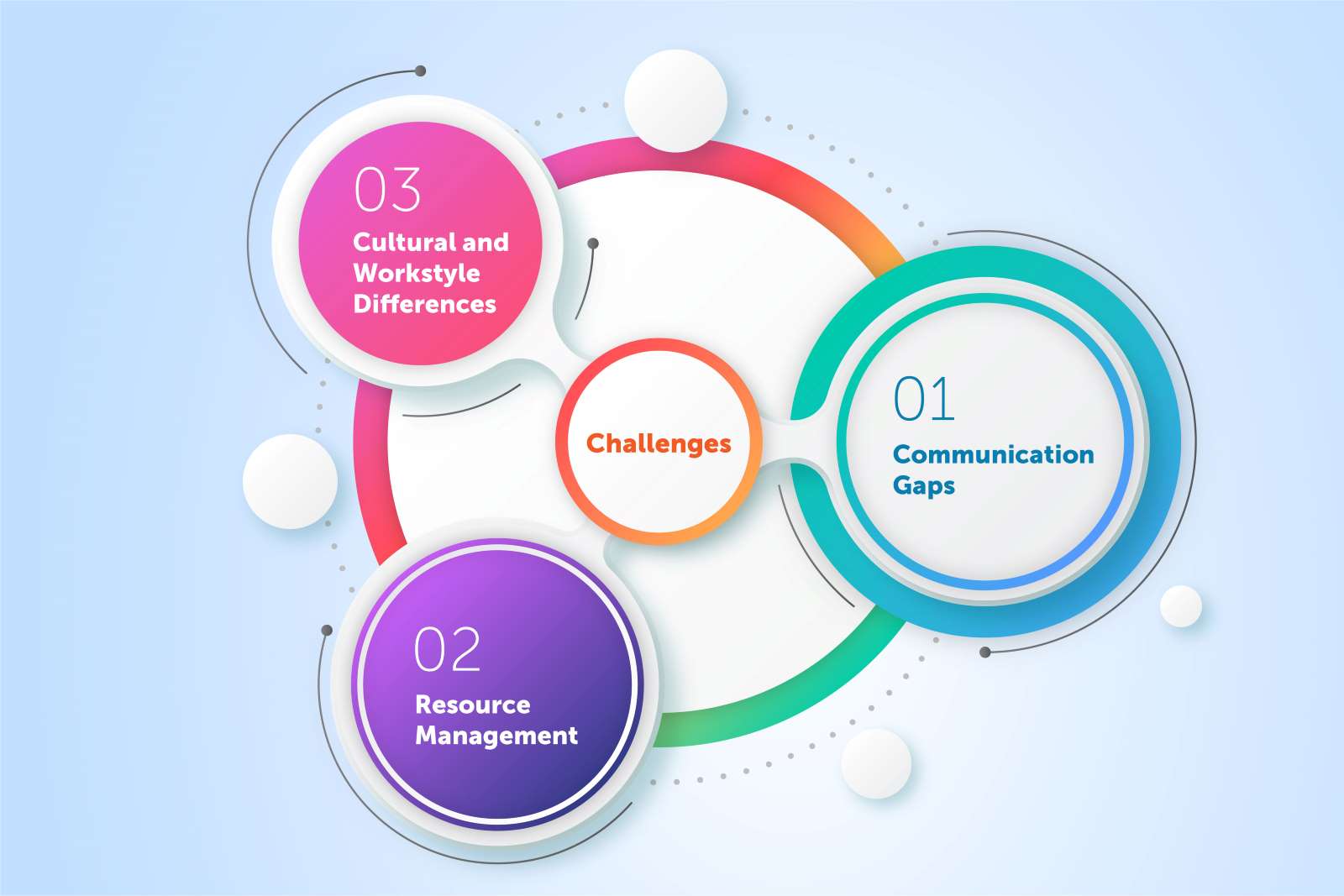
Communication Gaps
When you work with dedicated teams that cut across time zones, communication gaps are inevitable. Sometimes, a staff member might miss an update, or there might be a time lag that delays the communication of requirements. This, in turn, may cause the remote employee to continue on a development course already abandoned by the entire team.
By the time you get to reach them – resources have been spent, and time has been wasted. The solution here is to pick a communication channel such as Slack, Microsoft Teams, or Zoom and stick to it, making sure you establish immutable meeting times for daily standups. This way, every member of the team will always be on the same page.
Coping with Cultural and Workstyle Differences
Diverse teams offer innovative perspectives but can also be at odds over different ways of doing things or manners of communication. For example, one person may like their independence when working, whereas another may like to be more collaborative. This you address by bringing your team together with team-building exercises. Start off with open discussions about individual preferences and align expectations. Celebrate your diverse team with some recognition initiatives so that the cultural differences improve and do not hamper your progress.
Effectively Managing Resources
Software development dedicated teams often have an imbalance in their workload, where some may feel overwhelmed while others are underutilized. The inefficiency engendered this way can be a precursor to burnout or stagnation. Begin with implementing project management tools like Jira or Asana to visualize capacity and adjust workloads on the go. Second, conduct biweekly reviews, balancing tasks and eliminating bottlenecks. Lastly, a feedback-rich environment should be created in which team members can share their concerns about workload before things get out of hand.
Need Help Overcoming Team Management Challenges?
Get expert guidance on addressing communication gaps, cultural differences, and resource management issues in your dedicated software teams. Our consultants can help you implement effective solutions.
Best Practices for Managing Dedicated Teams
You need to know how to manage a dedicated development team properly to get the best out of your software development team. Here are some tried and true techniques you can adapt to realize this effect:

1. Defines Roles with Precision And Context
Clearly state every team member's role and obligations with respect to the architecture of the project to help eliminate uncertainty. Mark who is Responsible, Accountable, Consulted, and Informed using RACI matrix tools. This framework guarantees that every member of the dedicated software team recognizes their own role in the evolution process and reduces redundancies. Reviewing these tasks as project requirements change increases alignment and flexibility.
2. Develop a Communication Strategy
Communication is as important as code on complex projects. Besides Slack channels and stand-ups, tools like Confluence are provided for documentation of progress. Regular technical sync-up keeps the backend developers, frontend engineers, and QA testers on the same page concerning dependencies and integrations. Discuss problems well in advance to avoid delays and foster honest dialogues during sprint retrospectives.
3. Set Achievable Benchmarks
Break down big ambitions into smaller deliverables. Suppose the team works on developing a SaaS platform; then divide the workload into user authentication, dashboard development, and features reporting. Each of these tasks should have its schedule and success milestones. Use any framework that helps quantify team effort and progress measurement. Agile story points are one such framework.
4. Streamline Onboarding Procedures
For a new team member, the first thirty days are very critical in defining their path forward. Share with them processes, educate them on project objectives, and offer them mentoring from seasoned colleagues already part of your in-house team. A structured but friendly onboarding guarantees that even the newest hire adds value from the start. Build trust with your dedicated software developers early, and the rest will follow naturally.
5. Encourage an Agile Mindset
Agile is a mindset you and your team have to absorb if your processes are to be flexible and always improving; it is not just a method of project management. Urge the software developers on your staff to see feedback loops as possibilities rather than obstacles. When roadmaps change, they will, lead the team toward adaptable answers. The real strength of Agile is its capacity to build resilience and enable teams to flourish even when working under uncertain conditions.
6. Build Psychological Safety for High-Performing Teams
Besides the hard skills, performing teams rely on intuition and confidence to thrive. Create an environment that will make the dedicated software developers comfortable expressing different opinions in code reviews or architectural discussions. Conduct periodic anonymous surveys or leverage tools like Officevibe to understand team morale. Celebrate successes and failures as learning moments to reinforce a culture where innovation is more critical than the fear of making mistakes.
7. Modify Management Approaches to Suit Team Requirements
No two individuals work the same. The same goes for dedicated teams. Review often to find out whether your development team responds better under self-management or from a directive approach. A team implementing a new feature might require a more hands-on technical lead than, say, a maintenance team just fine-tuning infrastructure. This ability to adapt flexibly results in stronger team cohesion and ensures developers can achieve objectives without micromanagement.
8. Maintain a Mindful Workload Balance
When team members are overloaded, burnout is certain to take place. At the same time, keeping individuals on your team idle for too long can cause disengagement. Because of this, workloads should be carefully monitored and tasks reassigned wherever necessary to strike a balance. Your dedicated software development team members should be comfortable discussing their concerns relative to workload. Why? Well-rounded teams are more productive and consistently deliver outstanding results.
9. Employ Advanced Systems For Task Management
Modern tools are the backbone of effective project management. For instance, Jira provides the ability to create sprint boards that themselves are part of higher-level epics, whereas GitHub Projects combines version control with task tracking. The integration of automated reporting, such as that available from Datadog, enables the team to continuously review performance and technical metrics like code coverage. A well-chosen technology stack makes it easier to manage end-to-end so that nothing falls between the cracks.
10. Value Wellness and Sustainability
Sustained productivity requires balance. Encourage true downtime by setting boundaries around "on-call" hours. Integrate wellness check-ins during stand-ups to assess burnout risk. Offering benefits such as virtual yoga sessions or mental health resources signals your commitment to long-term well-being. A well-rested and motivated team does more than deliver on-time code; they deliver value with purpose.
Tools for Managing a Dedicated Software Team
The contemporary dedicated development team model is heavily reliant on existing and emerging technologies for collaboration, communication, and task coordination. Without these tools, managing an agile team is next to impossible. They fulfill many of the functions that make dedicated software teams so exceptional at delivering results that are aligned with your objectives.
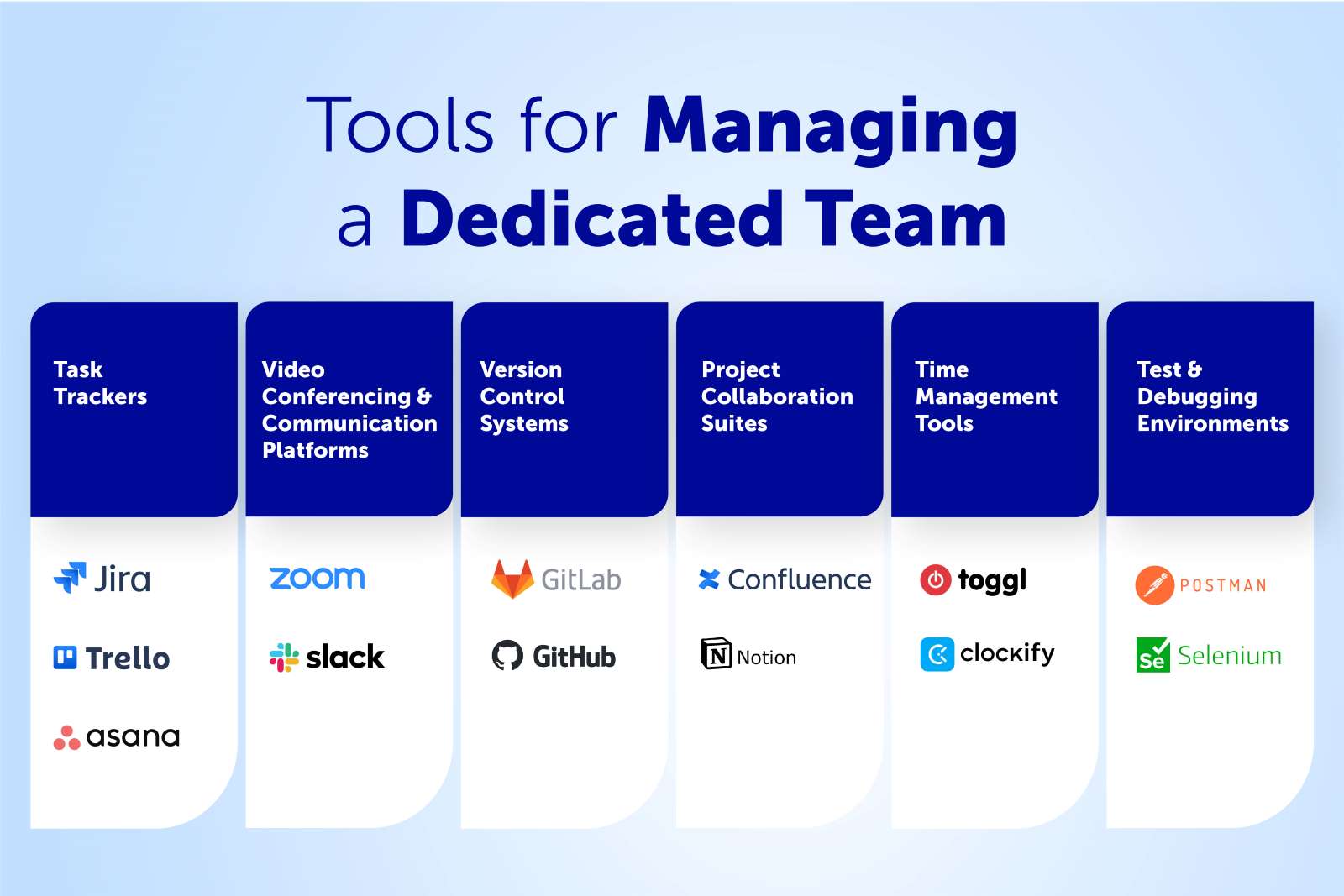
1. Task Trackers: Jira, Trello, Asana
Task trackers ensure that every assignment is visible, prioritized, and aligned with the objectives of the project. Jira is fairly famous in Agile teams for its backlog management and sprint planning features. Trello keeps visual workflows on Kanban boards and simplifies them, and Asana nails task organization and cross-functional collaboration. This set of tools centralizes the tasks, making them very clear and accessible.
2. Video Conferencing and Communication Platforms: Zoom and Slack
For a dedicated development team located in different regions, communication tools are the only avenue for collaboration. Zoom does an outstanding job when it comes to video conferencing for team meetings, retrospectives, or presentations. Slack, on the other hand, enables instant communication via organized channels, file-sharing, and integrations with other tools. All this together minimizes the barrier of distant communication.
3. Version Control Systems: GitHub and GitLab
Version control plays a very important role in the software development process. GitHub and GitLab allow developers to handle code repositories by tracking changes and creating pull requests and merge reviews. These can also be integrated with CI/CD pipelines to automate testing and deployment, hence fastening development cycles.
4. Project Collaboration Suites: Confluence and Notion
Centralized knowledge bases such as Confluence and Notion will go a long way in keeping documentation and collaboration running smoothly. These Software-as-a-service (SaaS) products enable the creation, storage, and sharing of everything from API documentation to meeting notes between dedicated team members.
5. Time Management Tools: Clockify and Toggl
Time-tracking project assignments keeps development right on schedule and within budget. Clockify and Toggl provide really user-friendly time-tracking options from which insights about productivity and resource utilization can be derived. These tools help highlight inefficiencies and thus enable better planning and execution.
6. Test and Debugging Environments: Selenium and Postman
When it comes time for quality assurance in software development, tools like Selenium are perfect for automating browser testing and ensuring app functionality across devices. Postman makes API testing quite simple by allowing a developer to simulate requests, debug responses, and make sure integrations work as expected. These tools increase the reliability of software before deployment.
Conclusion
Management in a dedicated team involves finding an excellent balance between strategic planning and efficient communication while being flexible. Minimizing the most common pitfalls, following best practices, and using only those tools that serve a purpose – all these set a stage that is very conducive to the team's success and performance. Good management doesn't just deliver software projects but is one that fosters innovation, collaboration, and continuous growth. With all we've discussed here implemented to the latter, even highly complex initiatives can be attained with dedicated software development teams.