
Overview
Long was the time when software development was an endeavor undertaken by big companies with big budgets. In today's digitally focused world, businesses of all sizes and with varying levels of resources are embarking on development initiatives to further their growth and sustainability.
When developing these projects, business owners and executives must decide on their approach to actualize them. There are multiple options, but the models expressly favored by digital and non-digital enterprises are the dedicated and extended team models.
Though similar in some aspects, the distinction between these two modes of hiring software teams goes beyond their phraseology alone. Each offers distinct benefits tailored to different project needs and organizational goals. A choice between either could significantly impact your project's efficiency, speed, and overall success.
As the tech landscape continues to boom in areas like AI, IoT, cloud computing, and cybersecurity, the demand for dedicated extended teams looks to continue its meteoric rise. According to data from Statista, the entire market for IT outsourcing (dedicated and further) accentuates the importance of both development methods in creating software applications.
The following sections explore the dedicated and extended team development models regarding their importance, benefits, drawbacks, and business viability. We also look at how these models differ and some use cases where they can best be applied.

Img source – tubik.arts
What Is the Dedicated Software Team Model?
The basic premise behind the dedicated software team model is to hire a remote team of professionals from a third-party outsourcing company. The development company assembles a competent team on your behalf that comprises all specializations needed to bring your project to life. This holistic team then works exclusively on developing your software project in line with your business goals and company recommendations, hence the term – "dedicated."
What Is the Extended Team Model?
The extended team model is also known as staff or team augmentation. It bears similarity to the dedicated team model in that you source developers from another firm. Yet, it differs from it because these extended development teams only work temporarily on your project, typically to fill skill gaps and boost capacity for time-specific projects.
Understanding the Dedicated Team Model
The dedicated team model goes beyond a mere approach to outsourcing – it is a collaboration characterized by close integration between the client and a group of IT professionals chosen specifically for them. These software development teams become more than just people who work on your project; they become representatives of your organization and completely share its ideas and aspirations. Right from the start, they are fixated on completing your project successfully, and every line of code written or design made reflects this commitment.
The dedicated development team model is all about concentration and involvement. Unlike other software development methodologies where developers may be involved in several concurrent projects, dedicated teams focus on your project alone. This ensures consistency, high standards, and alignment that can hardly be achieved when using other less integrated strategies. They will be your team in every sense imaginable; they imbibe your corporate culture, follow your workflows, and are motivated by company objectives just as if they were located at your premises.
Some of the key advantages of the dedicated team model are as follows:
- Unrivaled Expertise: Imagine a team with all its members being specialists ideally suited to your project's requirements. That is exactly how a dedicated team for hire works. Whether you need a top software developer, a UX designer, a data analyst, or a tenacious project manager, this model ensures that your project is tackled by experts who bring skill and passion.
- Seamless Collaboration: Dedicated software development teams don't work for you; they work with you. This model establishes everyday interaction and collaboration, which results in synergy and cohesive output. The team is engaged in your planning sessions, brainstorming meetings, and decision-making processes, so they're always in line with you.
- Dynamic Scalability: One of the most important benefits of a dedicated team is the ability to scale dynamically. As your project changes, so can your team. Need new team members to accommodate a larger workload when working on a back-end for web applications with a dedicated Node.js team? Not a problem. Want to downscale after an important milestone? It's simple. This scalability ensures that your resources align with your current needs, saving you from needless expenses while pursuing efficiency.
For all the benefits a dedicated development team structure gives you, some drawbacks could be worth it, but you need to consider them carefully before settling on this model. They include:
- More Expensive: Unlimited commitment comes with a price. The dedicated team model is more expensive because you are paying out salaries, benefits, and quite probably even infrastructure for a development team who, from now on, will work on your project alone. This is a large investment but usually well worth it for long-term engagements.
- Dependence Risks: The strength of a relationship with a dedicated team is a two-edged sword. One positive side is that it will ensure deep collaboration and commitment. The other could be that overdependence might leave one vulnerable if a key team member departs or in case of disruption in the partnership. Sometimes, this reliance can be a risk for a small, dedicated group.
- Onboarding Time: Integrating any new team with your existing ways of working does take time. From onboarding to getting them up to speed with your project specifics, progress may slow down. This upfront investment of your time could be a drawback in a case where quick results are needed.
Does Your Business Need This Type Of Model?
The model of a dedicated development team is not designed for all companies – it's made to suit those working on complex software development projects that need ongoing attention and precise execution over the long term. If your project requires concentration and active cooperation between different parties, and you're ready to spend money on a group that will feel part and parcel of your organization, then this could be just right. Nonetheless, one should consider if having a team fully immersed in your vision outweighs its disadvantages in terms of cost or possible overreliance.
Understanding the Extended Team Model
The extended team model, also known as staff augmentation, can scale your in-house team with external expertise in a way that is both flexible and responsive to change. It becomes more advantageous to use this model when projects require certain skills or additional capacity for only a short time. Instead of making permanent appointments, the extended team model permits you to bring in the right talents whenever necessary without interrupting continuity by smoothly embedding external professionals within existing workflows.
The crux of the extended development team model lies in its flexibility and accuracy. It is meant to support your in-house teams by filling skill gaps or adding more manpower. Unlike dedicated development teams that work exclusively on one project, these units work hand in hand with the client's in-house team, providing them with necessary assistance at different points of their activities. If you face tight deadlines and skill shortages or want to extend dedicated software development teams for short-term reasons, consider using this system, as it offers a quick fix without any strings attached.
Extended Software Team Model Advantages
- Cost-Effective Scalability: The biggest advantage of the extended team model is the cost-effectiveness. You only pay for the required talent when required, avoiding overheads of full-time hire. This model lets you scale up or ramp down your team quickly in response to project demands so that you can always have the right resources at the right time.
- Specialized Skills: The extended team model opens up access to an extensive global talent pool, giving you access to experts who might not be available locally. It is particularly useful for projects that require very niche skills or cutting-edge technologies, which can sometimes be quite difficult to find in-house.
- Smooth Integration: An extended software development team is formed to integrate seamlessly with your internal team. They work hand in hand with your existing team, following your processes and imbibing your workflows, which keeps disruption to a minimum and accelerates project timelines. The model fits just perfectly for businesses intended to raise the bar without the hassles of managing entirely separate resources.
Disadvantages Of Extended Teams
- Potential Communication Challenges: While extended development teams are meant to integrate seamlessly, they might sometimes face problems in communication, particularly if outsourced remotely or in different time zones. It takes a well-thought-out communication strategy and regular check-ins to make sure the extended team is on the same page as your in-house development team.
- Limited Long-Term Commitment: The temporary nature of extended teams cuts both ways. As much as it provides flexibility, it may also mean a lack of continuity and long-term commitment to the project. This could be a problem if your project requires sustained effort over a long period because you may find yourself re-onboarding new team members just about the time the old ones roll off.
- Risk of Dependency on External Providers: Heavy dependency on development team extension may create a risk if the external provider develops problems, such as resource shortage or priority changes. Contingency planning should be considered to minimize potential disruptions to your project's success.
Is The Extended Model Right For Your Business?
Businesses that need flexibility and specialized skills but do not want to hire full-time employees can use the extended team model. This is especially useful for projects that are temporary or during periods of rapid expansion when certain areas may be outside the scope of knowledge possessed by their own employees. However, if your project requires long-term commitment and consistent performance over time, then you should think twice about whether or not using the team extension approach aligns with what you want out of them.
The Differences Between Dedicated and Extended Teams
| Feature | Dedicated Teams | Extended Team |
|---|---|---|
| Applications | Perfect for long-term projects that require a crew that is totally committed. | Ideal for momentarily boosting the capabilities of the current team or for particular initiatives. |
| Popularity | Businesses looking for total control over resources and procedures frequently select this option. | Favored by companies looking to add specialized talents to their current workforce. |
| Cost-efficiency | Cost-effective for extended projects because the entire team is committed. | Economical for quick projects or instances where specialized knowledge is required. |
| Communication | You should communicate with the team directly and on a regular basis. | Because of the integration with the current team, communication could be more complex. |
| Flexibility | Restricted flexibility because the group is working on a single project exclusively. | High adaptability and capacity to swiftly modify resources as necessary. |
| Security | High security. You are in charge of the team's adherence to security guidelines and procedures. | Moderate security. You can control some security procedures, but the team provider also has to worry about security. |
| Infrastructure | Usually supplied by the employer or outsourcing business. | The core and extended teams may share infrastructure. |
Ready to Choose Your Team Model?
Get expert guidance on whether a dedicated or extended team is right for your project. Our consultants can help you make the best decision for your business needs.
When to Hire a Dedicated Development Team
The choice between a dedicated development team and an extended development team depends a lot on the project specifics and context. Below are some practical scenarios when each model is more applicable:
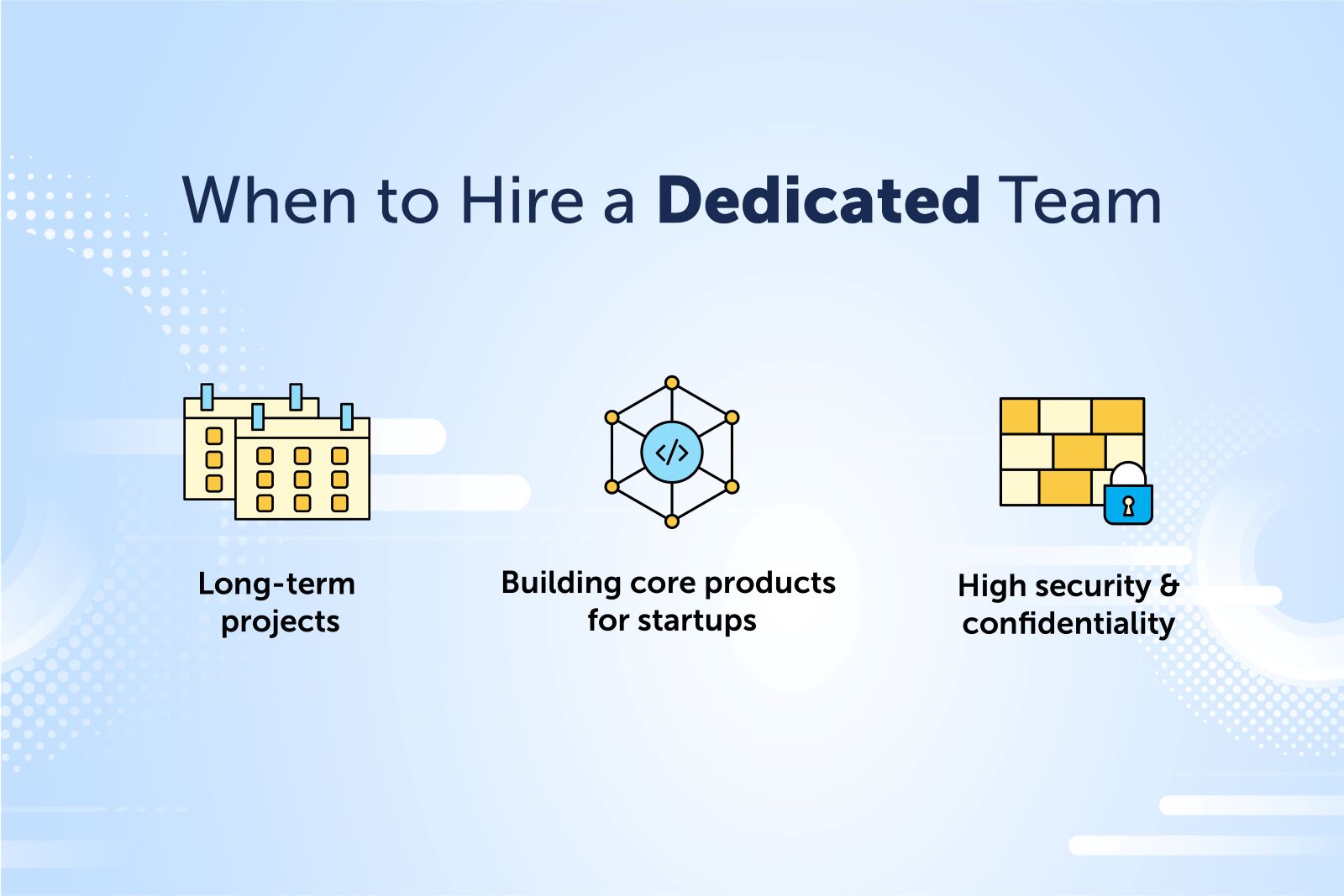
Large, Long-term Projects
If you are interested in embarking on a complex, large-scale project (e.g., utilizing dedicated Vue.js team services), consider hiring dedicated development teams. Such projects require continuous support and improvement over a long period. Creating a custom enterprise software solution with multiple modules that need to be integrated over time would benefit from having a team that can deeply understand your business and stay engaged throughout. This guarantees that the same group of experts consistently works on the same project, so there's better flow and a more polished output.
Projects Requiring High Security and Confidentiality
In sectors such as finance, healthcare or defense where security is key, dedicated teams offer necessary control and reliability. With the team being solely devoted to your project, you can impose strict security measures and ensure that the handling of sensitive data is done appropriately, reducing chances for unfortunate events like hacking due to having different clients' projects managed by one team.
Startups Building Core Products
When building their core product, startups tend to opt for a dedicated team since it enables them to work closely with the developers. The exclusive unit will be fully integrated into the startup's culture and will shape the product from there with an understanding of what the founders want to achieve. This coherence is necessary for launching disruptive innovation.
When to Hire an Extended Development Team
Covering Temporary Skill Gaps
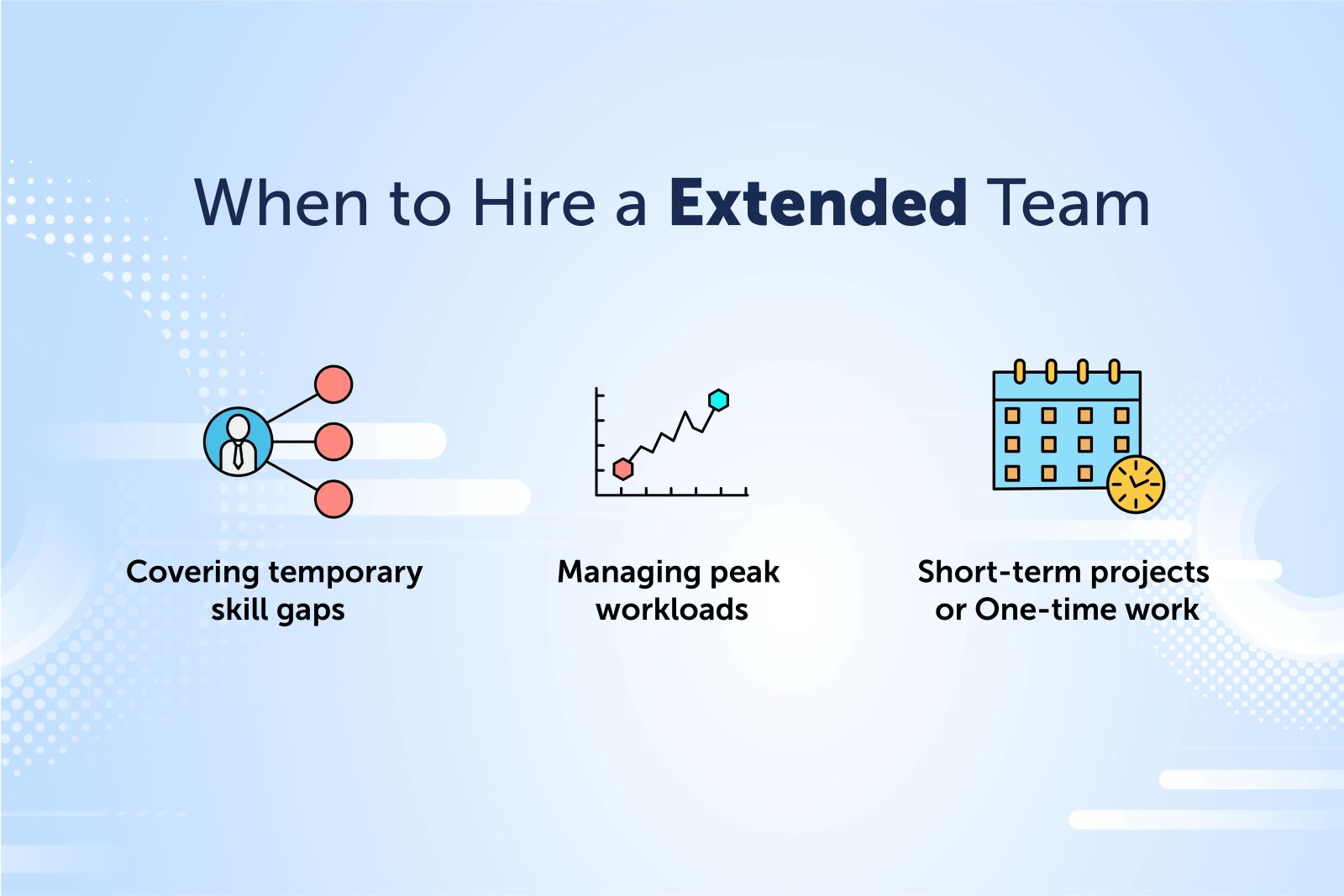
Suppose your in-house team is capable but needs more experience in a certain technology for a particular project. In this case, bringing specialists on board for a short time through development team extension can be beneficial. For example, if your team needs a data scientist for a machine learning project that will last a few weeks, adding a data expert from outside seems logical.
Managing Peak Workloads
For any software development project to succeed, the staffing provider and During high-demand periods, such as launching new products or meeting critical deadlines, the workload may overwhelm your current staff. Bringing in extra help on a short-term basis through extended development teams can help manage this situation without the need to hire full-time employees. This approach requires minimal resource investment and is useful for seasonal projects where accelerating development timelines are needed. managers must have a certain level of rapport. With this, it can be easier to find common ground when disagreements arise.
Short-Term Projects or One-Time Tasks
For projects with a clear end date or one-time development needs, extended teams provide the perfect solution. You get the expertise you need without the long-term commitment, making it ideal for seasonal projects, proof-of-concept development, or specific feature implementations.
What Are the Other Options?
Beyond dedicated and extended teams, there are other outsourcing models to consider:
- Project-Based Outsourcing: Complete project delivery where the vendor handles everything from start to finish.
- Managed Services: Ongoing IT services managed by external providers with defined service levels.
- Hybrid Models: Combining different approaches to create custom solutions for complex needs.
Conclusion
If you wish for your software development projects to succeed, you can't afford to select an outsourcing model that doesn't fit a tee. The decision should reflect your project's peculiarities and business goals, whether it be a dedicated development team for close cooperation over extended periods, the extended model to augment talents across functions, or even exploring options such as project-based outsourcing or managed service providers. In any case, there are pros and cons for each of these models that make it necessary to thoroughly assess what exactly you require before settling on one.
At Softellar, we don't just build software – we build solutions that transform businesses. Partner with Softellar today, and let's turn your biggest ideas into your greatest achievements.