


Overview
Most companies don't set out to hire an offshore dedicated development team. They set out to ship a product, run into a wall of local salaries or a six-month hiring pipeline, and end up here instead. That's a perfectly good reason to be here, honestly.
An offshore dedicated development team is a group of developers, QA engineers, and usually a delivery lead, based in another country, working full-time and exclusively for one client rather than being shared across a vendor's project list. Not a rotating cast of contractors. Not a call center reading from a script. A real team, integrated into your workflow, that happens to sit a few time zones away.
Quick summary if you're short on time: offshore dedicated teams typically cut development costs by 30 - 60% depending on region, take 2 - 6 weeks to assemble rather than the months of local hiring, and work best when you need sustained capacity rather than a one-off deliverable. The rest of this guide covers team structure, real 2026 rate benchmarks, how to pick a provider, the legal basics nobody wants to think about until it's too late, and where AI actually fits into offshore development right now.

Img source - Pixelz
What Is a Dedicated Offshore Team?
A dedicated offshore team is exactly what it sounds like once you strip away the marketing language: an offshore development company assembles a set of specialists who work only on your project, under your direction, for as long as the engagement runs. The provider handles recruitment, payroll, and office space. You handle the product. Some vendors call the same setup an offshore software development team, others just say offshore team or offshore dedicated team. Nobody's enforcing consistency here, so don't assume the label on a pricing page tells you much on its own.
This is different from traditional outsourcing, where a vendor takes a fixed spec and disappears until delivery. It's also different from a freelance marketplace, where you're rolling the dice on someone's availability next month. A dedicated offshore team is closer to hiring in-house staff, minus the part where you have to actually be in the same building, or the same country, or sometimes the same week of the calendar depending on time zones.
Offshore Dedicated Development Team vs Offshore Development Center
People sometimes conflate the two, and they're not quite the same thing. An offshore development center (ODC) is typically a more permanent operation built around your company: dedicated infrastructure, local operations, sometimes a legal entity or a branded office presence. Depending on the model, a vendor may set up and run much of that on your behalf, so "you set it up yourself" isn't always accurate either. A dedicated offshore team, by contrast, is primarily a people-and-delivery arrangement. No entity, no lease, no local registration. You're renting the team, not building an operation around it. Which one fits depends on how permanent and how large your offshore presence needs to become, not on a specific headcount number, since nobody in the industry agrees on where that line sits.
Offshore vs Nearshore vs Onshore: Where the Real Line Is
Before picking a region or a provider, it's worth being clear-eyed about which of these three you actually want, because the trade-offs aren't just about price.
| Model | Location | Time-zone overlap | Relative cost | Best fit |
|---|---|---|---|---|
| Onshore | Same country | Highest | Highest | Maximum real-time collaboration |
| Nearshore | Nearby country or region | High | Medium | Balance of collaboration and cost |
| Offshore | Distant market | Lower | Lowest to low | Maximum talent and cost leverage |
Offshore isn't automatically the right call just because it's cheaper on paper. If your product needs six hours of live, synchronous collaboration every single day, a somewhat pricier nearshore team can easily end up with a lower total delivery cost once you count the meetings that get rescheduled, the decisions that wait twelve hours for an answer, and the plain frustration of never quite overlapping. Offshore wins when the work is well-specified enough that a team can move independently for long stretches between syncs. Nearshore wins when it can't.
How an Offshore Development Team Actually Works
The mechanics are straightforward, even if the terminology around them isn't always consistent (more on that later). You define what you need. The offshore development company sources candidates from its own bench, or runs a fresh search if the skill is niche enough. You interview the shortlist. The team gets built, onboarded into your tools and your processes, and starts working under your priorities from day one.
The provider stays involved behind the scenes: contracts, local compliance, replacing anyone who leaves. You stay involved in front: sprint planning, code review, deciding what ships next. That division doesn't change much whether the team is three people or thirty.
Who's Actually on the Team
- Developers - the backbone of the setup. Frontend, backend, sometimes full-stack, sized to whatever the project actually needs.
- QA engineers - because offshore doesn't mean unsupervised, and quality assurance is where corners get cut when people skip this role to save money. Don't skip it.
- A project manager or delivery lead - your main point of contact, responsible for keeping the sprint on track and surfacing problems before they become expensive ones.
- Specialized roles as needed - DevOps, UI/UX, security, or AI/ML specialists, added when the project actually calls for them rather than bundled in by default.
A few developers and a QA engineer might cover an early-stage product. A mature platform with legacy systems and multiple integrations might need fifteen people and a dedicated architect. Team size should match project scope, not a vendor's standard package.
Dedicated Offshore Team vs Other Models: A Quick Decision Framework
The market uses "dedicated team," "staff augmentation," "offshore development center," and "outsourcing" almost interchangeably, and that's part of why comparing providers is so confusing. Different vendors use the same word for different setups. So instead of arguing definitions, here's the practical version.
| Your situation | Best fit |
|---|---|
| You need a handful of specialists inside a strong existing internal team | Staff augmentation |
| You need a full, stable team running your product for 6+ months with evolving scope | Offshore dedicated team |
| You need a large, permanent offshore operation with dedicated infrastructure or local presence | Offshore development center |
| The work is small, well-defined, and has a fixed end date | Project-based outsourcing |
| You need permanent, in-building capability and can wait to build it | Local in-house hiring |
Worth saying plainly: none of these labels are policed by anyone. When a provider pitches you a "dedicated team," ask how it actually operates, not what it's called on the pricing page.
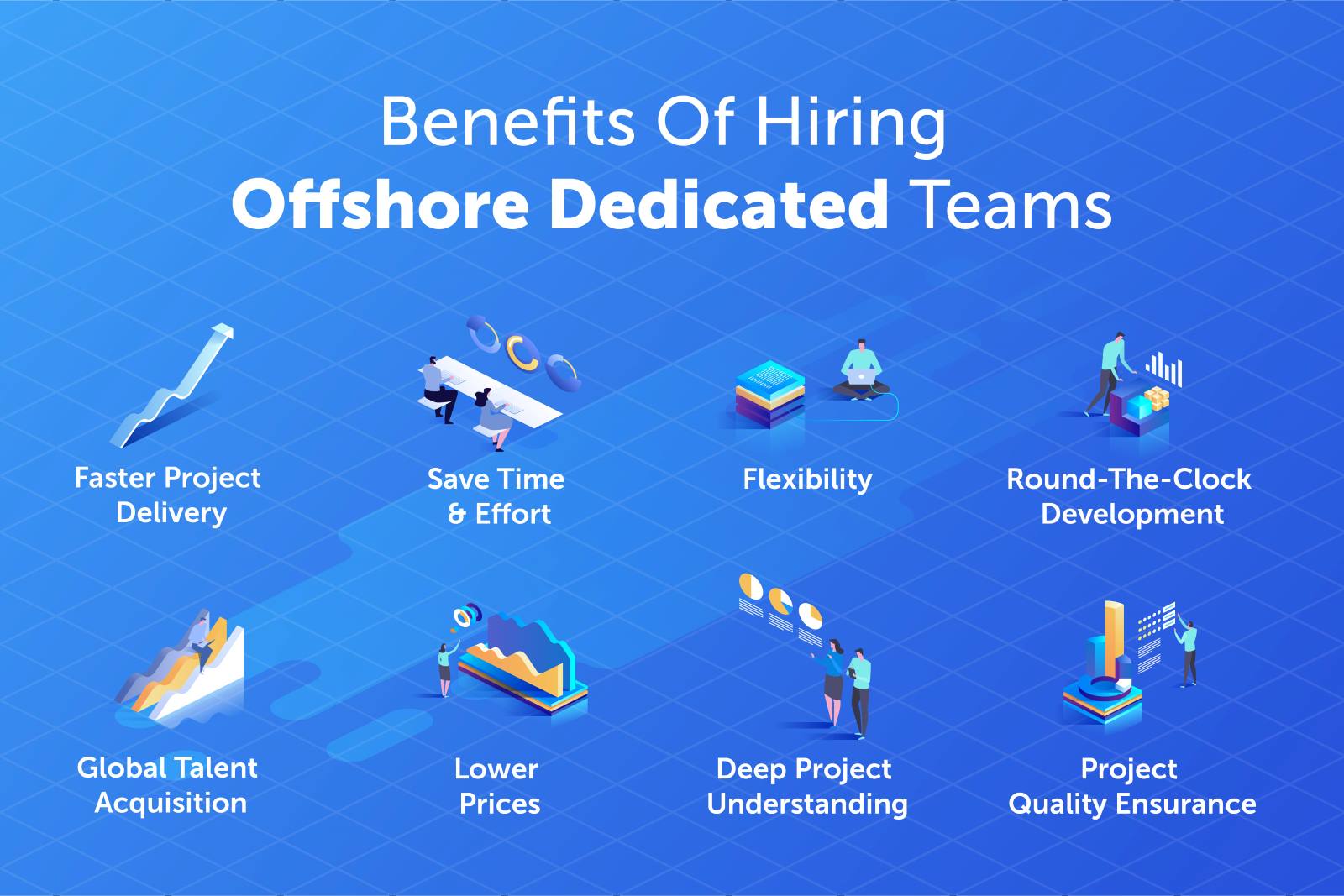
Key Benefits of an Offshore Dedicated Team
Technical Expertise Without the Local Search
Hiring locally for a specific stack, or for AI, cloud, or cybersecurity specialization, can mean months of searching in a market where five other companies are chasing the same short list of candidates. An offshore development partner already has that technical expertise sitting on the bench. You're tapping into a global talent pool that, across all regions combined, runs into the tens of millions of software developers, not the few thousand active job-seekers in your city this quarter.
Cost Efficiency, Without the Hand-Waving
Cost efficiency is usually the first question, so we'll skip the vague gesture at "savings" and point you straight to the numbers. Short version: most companies land somewhere in the 30 - 60% cost reduction range compared to local hiring, mostly because you're not paying local salary premiums, recruitment fees, benefits, or the office overhead that comes with an in-house seat. The full region-by-region breakdown, with the same metrics applied consistently across four regions, is a few sections down so you can actually compare apples to apples instead of one region's absolute rate against another region's percentage discount.
Speed and Scalability
Assembling an offshore dedicated team from an established provider's bench usually takes 2 to 6 weeks. Local hiring for the same roles often takes two to three times that, sometimes longer for niche skills. And once the team exists, you can scale it up ahead of a launch or scale it down once things settle, without the layoffs-and-rehiring cycle that comes with in-house staff.
Round-the-Clock Progress
Time zone differences get treated as a downside almost everywhere in this industry, and sometimes they are one. But they cut both ways. A team eight or ten hours ahead of you can be working while you sleep, which means genuine around-the-clock progress on a big backlog, not just a communication headache waiting to happen. Whether that works for you depends on how much real-time overlap the work actually requires.
Institutional Knowledge That Sticks Around
A dedicated offshore team works exclusively for you, which means the same people are still there in month eight, month twelve, month twenty. That's worth more than it sounds. Freelancers rotate. Institutional knowledge walks out the door with them. A stable offshore team keeps that knowledge in-house, so to speak, even though "in-house" is doing some geographic stretching in that sentence.
Less HR Overhead, More Focus on Core Business
The offshore development company handles recruitment, payroll, benefits administration, and local compliance. That frees your internal team, and frankly your own attention, to focus on core business goals instead of running a second HR department for people in another country.
Ready to Scale Your Development?
Get access to skilled offshore developers who can accelerate your projects and enhance your team. Our flexible, high-quality solutions are tailored to your specific needs.
The Trade-offs, Honestly
No setup is without friction, and offshore dedicated teams have a longer list of it than most guides admit. Here's what actually bites people, beyond the usual "communication can be tricky" line.
Communication and cultural fit. Takes more deliberate effort than working with people down the hall. Rarely a dealbreaker, but it needs real attention in the first month, not a one-time onboarding email.
Security and access. Someone has to decide how offshore developers get production access, credentials, and customer data, and "the same way everyone else does" isn't a policy. Set this up deliberately: scoped access, proper offboarding when someone rotates off the team, logging that actually gets reviewed.
Attrition, even on a "dedicated" team. Ask the provider directly what happens when someone quits. A real dedicated-team setup replaces people without losing your context; a loosely managed one just sends you a new resume and calls it handled.
Hidden management overhead. This is the one nobody puts in the pitch deck. Savings of $20 an hour disappear fast if your own lead is now spending fifteen extra hours a week coordinating, translating context, and chasing status updates. Budget for that time. It's real and it's yours, not the vendor's.
Vendor lock-in and knowledge transfer. If the team building deep product knowledge all sits with one vendor, ask upfront how documentation and handover would work if you ever needed to switch providers. Nobody likes thinking about this at the start of a relationship. That's exactly when to think about it.
Misrepresented seniority. "Senior developer" means wildly different things across vendors. Some verify it rigorously. Some stretch the label to close a deal. Ask for actual work samples or a technical interview, not just a title on a rate card.
Timezone economics. The real cost of a distant time zone usually isn't the inconvenience, it's the delay. A decision that would take five minutes in the same room can take a full day when it has to wait for the next overlap window. On a fast-moving project, that adds up to real weeks lost, not just mild annoyance.
Get all of this wrong at once and offshore savings can quietly evaporate into coordination cost. Get it right and none of it is a big deal. It just needs to be planned for instead of assumed away.
What Offshore Software Development Actually Costs in 2026
Treat the numbers below as current market signals, not a guaranteed quote. Rates shift by provider, project complexity, and how tight the talent pool is for a given skill in a given year, and published vendor benchmarks disagree with each other more than any single blog post likes to admit. We're using the same four metrics across all four regions on purpose, so you're comparing like with like instead of stacking one region's absolute rate against another region's percentage discount.
| Region | Typical mid/senior rate | US time-zone overlap | English proficiency | Talent strengths | Main trade-off |
|---|---|---|---|---|---|
| Central & Eastern Europe | Roughly $35 - $100+/hr, commonly $50 - 65 for solid mid-to-senior | Partial - workable with US East Coast mornings, easier with EU clients | Generally strong | Deep enterprise and fintech engineering benches | Higher cost than Asia; limited overlap with US West Coast |
| Latin America | Roughly $35 - $80/hr, commonly around $50 for near-senior | High - same or adjacent time zones to most of the US | Good to strong in major tech hubs | Real-time collaboration, growing fintech and e-commerce talent | Smaller talent pool than Asia or Eastern Europe; rates climbing as demand grows |
| India & South Asia | Often the steepest discount, roughly 60 - 70% below equivalent US cost | Low - typically 10+ hours from US East Coast | Generally strong business English | Enormous talent pool, deep enterprise IT and data engineering bench | Least real-time overlap with the US; vendor quality varies widely, so vetting matters more here than elsewhere |
| Southeast Asia (Philippines and neighbors) | Commonly cited in the $20 - $40/hr range | Moderate - reasonable overlap with US West Coast evening hours | Very strong, long history of US business ties | Strong client-facing and support culture, growing software bench | Senior, highly specialized engineering roles still thinner than in India or Eastern Europe |
A few things move any of these numbers in either direction: how senior and specialized the role is, whether the stack is common or scarce, how much live overlap you actually need, and how long the engagement runs, since longer commitments occasionally unlock better rates. None of this replaces getting real quotes from two or three providers before you commit. Rate cards on vendor websites are a starting point, not the final word.
Choosing the Right Offshore Development Company
This decision matters more than almost anything else in this guide, because a strong process with a weak partner still produces a weak result.
Ask for client references, and actually call them, not just skim the logos on a case studies page. Ask how the provider vets developers technically, and what happens if someone leaves mid-project. Ask directly about IP protection and data security practices, especially if your product touches sensitive data. And pay attention to communication during the sales process itself. If getting a straight answer feels like pulling teeth before you've signed anything, it won't get easier after.
Regional reputation is a reasonable starting filter, not a substitute for due diligence on the specific company. A great region full of skilled software engineers still has weak vendors mixed in with strong ones.
Intellectual Property and Legal Basics
A short, non-exhaustive checklist to work through with legal counsel before signing anything. None of it is exciting. All of it is cheaper to sort out now than after something goes wrong.
| Item | What to confirm |
|---|---|
| IP ownership | Contract states explicitly that code and IP belong to you, not the provider or the individual developer |
| Employee vs. contractor chain | Understand how the provider actually employs the people on your team, and whether that chain cleanly assigns IP to you |
| NDAs | Cover the company and, where possible, named individuals working on your project |
| Data residency | Know where your data is physically stored, not just which company holds it |
| Cross-border data transfers | Confirm what legal mechanism covers moving data between your country and theirs |
| Subprocessors | Ask whether the provider uses other vendors or subcontractors, and whether you're informed if that changes |
| Governing law and jurisdiction | Know which country's courts and laws apply if a dispute happens |
| Production environment access | Define who gets access to what, and how that access is revoked when someone leaves |
| GDPR or equivalent | If you handle EU customer data, confirm the provider's practices actually align, not just claim to |
| Termination terms | Notice periods and transition support should be spelled out, not improvised after the fact |
Nobody enjoys this part of vendor selection. Skipping it is exactly how "the offshore team owns half our codebase" becomes a real sentence someone has to say out loud in a board meeting.
Hiring Offshore Developers: The Process
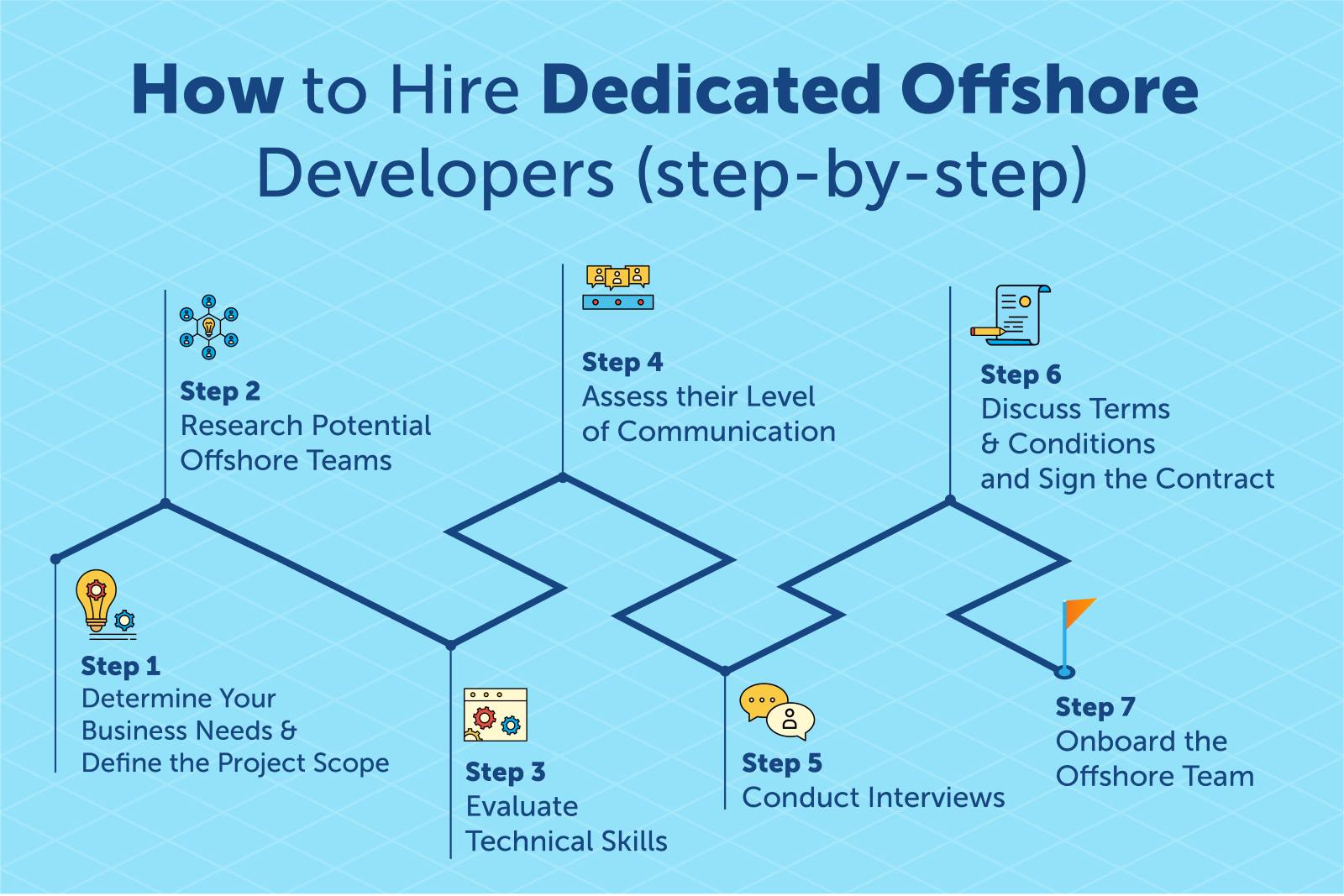
1. Define the scope and roles internally. Know what you're building and what skills it actually requires before you start talking to vendors. Vague requests get vague, expensive proposals back.
2. Shortlist offshore development partners. Look for relevant technical case studies, not generic testimonials. Ask about their bench strength for your specific stack.
3. Interview actual candidates. Not resumes. Not a sales deck. The people who would be writing your code.
4. Set up collaboration tools and communication protocols before day one. Decide on your stack, whether that's Slack plus Jira plus a shared Confluence space or something simpler, before the team's first day, not three weeks in.
5. Onboard like they're internal hires. Documentation, access, context. Treat the ramp-up seriously and it pays for itself within the first sprint.
Managing an Offshore Team So It Actually Works
Consistent communication is the single biggest predictor of whether this goes well. Not constant. Consistent. A daily async update plus a real-time call two or three times a week beats either extreme: too little contact, or meetings stacked so high nobody gets work done.
Strong project management tools matter more here than with a local team, simply because there's no hallway conversation to fall back on when something's unclear. Agile methodologies, particularly ones built around short, visible sprints, tend to translate well across time zones because progress gets checked frequently rather than assumed.
Don't skip the human side either. A few virtual team building activities, even something as simple as a monthly informal video call with no agenda, do more for long-term collaboration than people expect going in. And where budget allows, an occasional in-person visit, either your team traveling to them or vice versa, tends to accelerate trust faster than months of video calls.
AI and Offshore Development in 2026
AI tooling has changed the day-to-day texture of offshore work, though maybe not as dramatically as some vendors are currently claiming.
Developers on offshore teams increasingly use AI coding assistants for the same repetitive tasks developers everywhere use them for: boilerplate, test generation, first drafts of documentation. That frees up more time for architecture and review, which is exactly the kind of work that benefits from a team that already understands your codebase. This is actually a point in favor of dedicated teams over rotating freelancers. AI tools are only as good as the judgment behind them, and judgment comes from context that a stable, dedicated team accumulates and a revolving door of contractors never quite does.
We've also noticed more offshore providers actively building out AI, cloud, and cybersecurity specializations specifically, rather than treating them as a subset of general development work. That tracks with demand outpacing local talent pools in those areas. If your project touches any of them, ask a shortlisted provider directly about their bench depth there instead of assuming general development experience covers it automatically.
One honest caveat: claims about AI dramatically shrinking required team sizes are still mostly vendor talk at this point, not something backed by solid independent data. Ask for specifics if a provider leads with that pitch.
Softellar Case Studies
View All Case StudiesA few examples of how companies build and ship software with Softellar's dedicated engineering teams:


Conclusion
An offshore dedicated development team isn't a shortcut, exactly. It's a different way of building the same thing: real technical expertise, genuine team integration, a project manager keeping the work on track, at a lower cost than local hiring and a much shorter runway than building an in-house team from zero. It asks more of you upfront, in vendor selection, in communication discipline, in getting the legal basics right, than a lot of pitch decks let on. Get those right, though, and the model tends to deliver exactly what it promises: skilled people, focused entirely on your product, for less than you'd pay to keep the same roles local.


