


Overview
Your product roadmap is set, the budget is approved, and now someone has to build it. Do you hire developers, bring in an external team, or mix the two?
The short answer: it comes down to four things. How long you'll need the work done, whether you have people inside who can manage development, which skills the product requires, and what budget you can commit over time. A two-year product and a four-month integration project call for different setups.
This guide compares in-house vs outsourcing software development on cost, management, hiring speed, and long-term support, then turns that into a practical way to choose.
In-House vs Outsourced Software Development: Key Differences
In-house software development means the work is done by your own employees. They can sit in your office, work remotely, or be spread across several cities - what makes them in-house is that they're on your payroll and report to you.
Outsourced development means you bring in an outside company. It might deliver a whole project, provide specialists who join your team, or take on a defined part of the work.
One common misunderstanding: outsourcing doesn't have to mean handing over all development. Plenty of companies keep product ownership and technical leadership inside and outsource specific pieces.
Here's how the two compare in practice:
| Criterion | In-house | Outsourced |
|---|---|---|
| Management | You organize daily work and own the outcome | Split between you and the vendor, depending on the model |
| Costs | Mostly fixed: salaries, benefits, equipment, office space | Service fees, plus your own coordination time and setup |
| Hiring and onboarding | You recruit, interview, and onboard every hire | The vendor sources people; they still need to learn your product |
| Scaling | Growing takes recruiting time; shrinking means layoffs | Adjusted within the contract's notice periods and terms |
| Knowledge retention | Stays with your employees, as long as they stay | Stays with the vendor unless you plan the handover |
| Long-term commitment | Suited to ongoing, open-ended work | Suited to both defined projects and long engagements |
Notice there's no winner column. Each row is a trade-off, and which side of it matters more depends on your situation.
Understand the Different Outsourcing Models
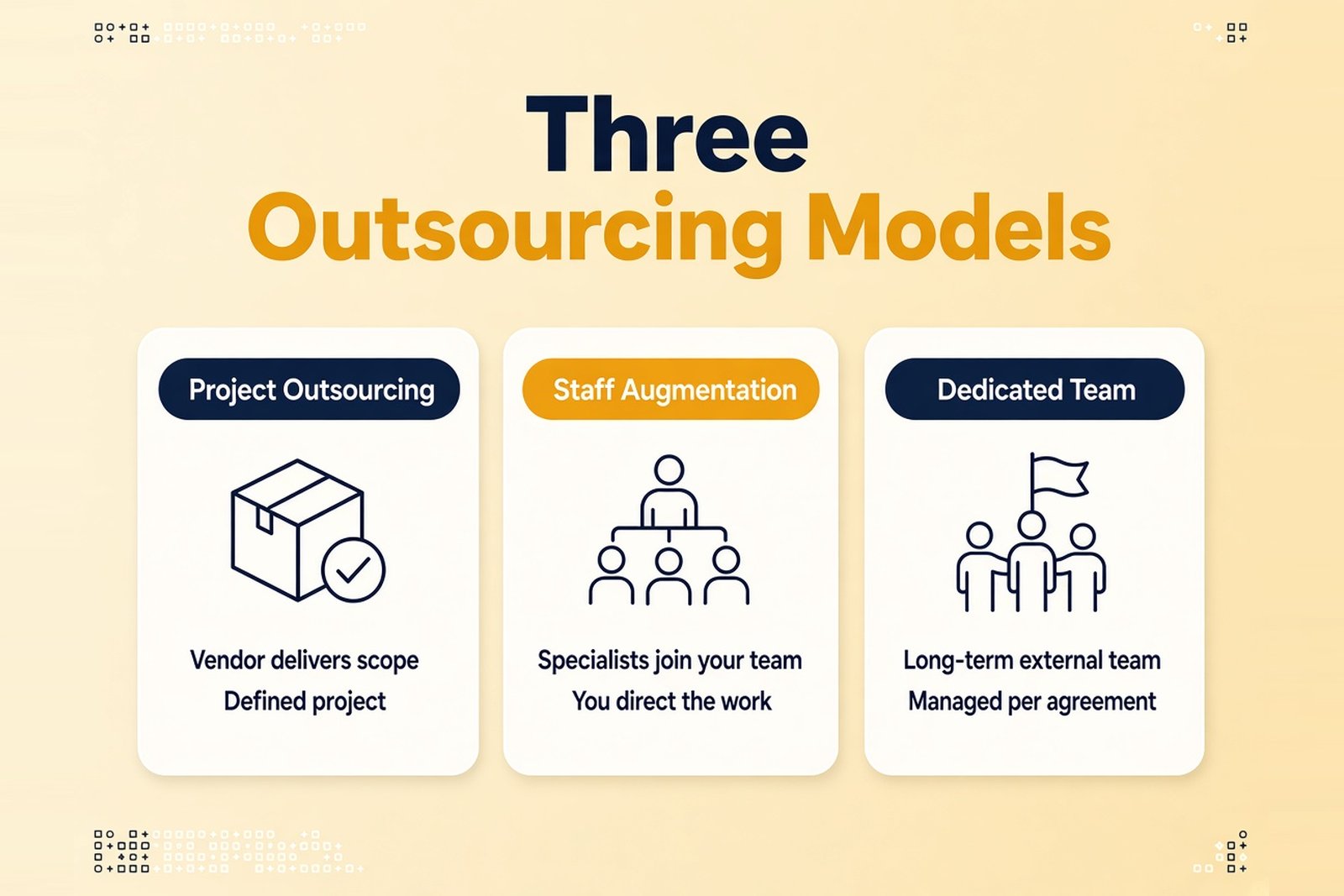
"Outsourcing" covers several very different arrangements. Mixing them up is how companies end up with the wrong contract.
Project Outsourcing
The vendor delivers an agreed project or a defined part of one - an integration, a new module, an MVP. The agreement sets who does what, how results are accepted, and how changes to requirements are handled.
It works best when the work can be described clearly and separated from the rest of your development. Project outsourcing isn't automatically fixed-price, by the way. It can also run on time and materials, with the scope adjusted as you go. Softellar describes this model on its custom software development page.
Staff Augmentation
External specialists join your existing team and work inside your process. You usually still set priorities, organize the work, and provide technical leadership - the vendor handles sourcing and employment.
This fits when you have a functioning team and management, but you're short on a specific skill or on capacity. Without someone inside to direct the work, augmented specialists won't fix much. See how staff augmentation works at Softellar.
Dedicated Development Team
A dedicated team is an external team that works on your product long-term. How much the vendor manages - daily coordination, delivery, process - depends on the specific agreement. Some dedicated teams run fairly independently with a team lead on the vendor side; others work closely under your product owner or CTO. Don't assume full autonomy by default. More on the dedicated development team model.
One more distinction. Onshore, nearshore, and offshore describe where the team is located. The three models above describe how you work together. You can have an offshore dedicated team or an onshore project contract - geography affects time zones and communication, not who's responsible for what.
Compare the Total Cost of In-House Development vs Outsourcing
The most common mistake is comparing one developer's salary with a vendor's monthly invoice. That's not a fair fight. The invoice may already include QA, a team lead, equipment, and replacements, while the salary leaves out half of what an employee actually costs.
The fair comparison is the total cost of a comparable team over the same period.
In-house development costs usually include:
- compensation plus employer costs - payroll taxes, benefits, paid time off
- recruiting and onboarding, including the months before a new hire is fully productive
- tools, equipment, software licenses, and office space if you use it
- management time and training
- turnover: replacing people who leave and rebuilding what they knew
Software development outsourcing costs usually include:
- the vendor's fees
- time your own managers spend coordinating the work
- onboarding: access, environments, and getting the team up to speed on your product
- changes in scope along the way
- knowledge transfer, ongoing support, and the cost of ending or switching vendors
A simple way to put it together:
Total cost = team costs + setup and recruitment + tools and infrastructure + management and coordination + transition costs
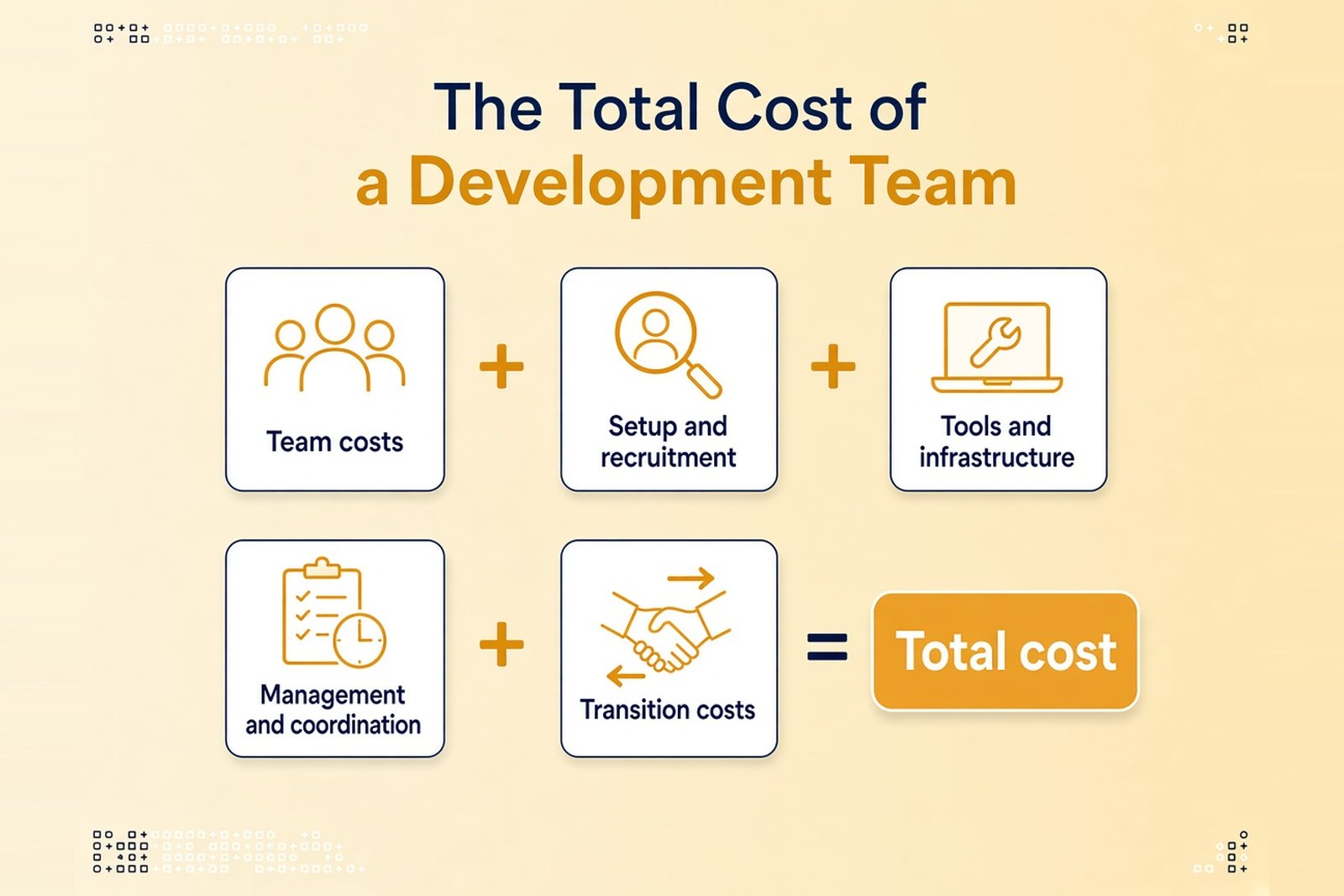
One rule while you fill it in: don't count anything twice. If the vendor's rate already covers equipment, management, or replacements, leave those lines empty on the outsourcing side.
Here's how that looks for a 12-month comparison. Say you need three developers, one QA engineer, and part-time technical leadership, with the same workload and responsibility in both options:
| Cost line | In-house team | Outsourced team |
|---|---|---|
| Team | Salaries plus employer costs for five roles | Vendor fees for the same roles and hours |
| Setup and recruitment | Recruiting for each role, ramp-up months | Vendor onboarding, your time on access and product walkthroughs |
| Tools and infrastructure | Laptops, licenses, environments | Often included - check the contract |
| Management and coordination | Your lead manages everything day to day | Your product owner still sets priorities and accepts the work |
| Transition | Turnover and knowledge loss when people leave | Handover to your team or a new vendor at the end |
Put real numbers from your own quotes and payroll into each cell, and the comparison becomes concrete. Be wary of universal savings percentages or cost-per-employee multipliers - they rarely match your roles, location, or contract terms.
Comparing the Real Cost of Your Options?
Softellar works in all three models - project delivery, staff augmentation, and dedicated teams. We'll walk through your roadmap, your current team, and your quotes and help you compare like for like.
Evaluate Hiring Speed and Delivery Capacity
Speed has two parts, and they're easy to confuse:
- Time to add people - finding specialists and getting them started.
- Time to deliver - how long until those people ship useful work.
An outsourcing partner can often fill roles faster than a hiring pipeline, because it often has specialists available or a ready pipeline. But a new person - employee or contractor - still needs to learn your domain, your codebase, and your release process. That second part depends on things neither model controls: how available the right specialists are, how complex the domain is, the state of the code, how quickly access gets granted, and how clear the requirements are.
Scaling has limits in both directions. Adding developers adds onboarding and coordination work, so doubling the team rarely doubles output - at least not right away. Scaling down depends on your obligations: employment commitments for an in-house team, notice periods and minimum terms for a vendor. Read those terms before you sign, not when you need them.
Assess Control, Quality, Data Security, and Knowledge Retention
"Control" sounds abstract until you break it into who does what. Whatever model you choose, make sure you know who owns each of these:
- defining requirements and priorities
- architecture decisions
- code review and testing
- access to repositories, cloud accounts, and infrastructure
- documentation and knowledge transfer
- accepting the delivered work
If the answer to any of these is "not sure," that's where problems will start - in-house or outsourced.
Quality works the same way. It comes from the people doing the work, the technical leadership above them, and the process they follow: reviews, tests, definitions of done. An in-house team without senior leadership can produce weak code. So can a vendor. The label on the contract doesn't decide it.
Knowledge retention
Both models have a dependency risk, just in different places. An in-house team can end up relying on one key developer who knows how everything works - when that person leaves, the knowledge leaves too. An outsourced team can create dependency on the vendor, especially if only its people understand the system.
The fixes overlap: up-to-date documentation, shared code reviews, repositories and environments under your own accounts, and more than one person who understands each critical area.
Data security and ownership
Treat data security as a list of requirements to check, not as a feeling about one model being safer. Look at who gets access to what, how that access is granted and revoked, where data is stored, and which security practices the vendor follows.
The contract matters as much as the process. An NDA helps, but it doesn't guarantee security by itself. And code ownership isn't automatic - make sure the agreement explicitly assigns intellectual property rights to your company and covers what happens to code, data, and credentials when the engagement ends.
When an In-House Development Team Makes Sense
Building your own team is usually the right call when:
- The need is permanent and predictable. You'll be developing the product for years, not months, and the workload stays steady.
- Product and technical knowledge is a long-term asset. The more your team learns about your users, data, and systems, the more valuable it becomes.
- You can hire and manage well. You have, or can hire, engineering leadership that attracts people and keeps them.
- Development works closely with other departments. Sales, support, or operations need daily contact with engineers, and a shared corporate culture helps that go smoothly.
One caveat. Having employees doesn't guarantee good results on its own. An in-house team still needs strong technical leadership, sound processes, and a plan for when key people leave. And building core products in-house is a common choice, not a rule - a core product can be built with an external team too, as long as product ownership and key knowledge stay under your control.
When Outsourcing Software Development Makes Sense
Outsourcing tends to fit these situations - each with its own condition for success:
- You're missing specific skills. Say you need cloud migration or data engineering experience your team doesn't have. It works if someone on your side can explain the context and review the result.
- You need extra capacity for a while. A launch deadline or a backlog spike. It works if the new people get access and onboarding quickly, and if the scope is clear enough to hand off.
- There's a separate project or module. An integration, an admin panel, a new mobile app. It works if the boundaries, acceptance criteria, and change process are agreed up front.
- You need a team without building every role. A startup might not have the budget or time to hire a QA engineer, a DevOps engineer, and a designer. It works if the division of responsibilities is written down.
What outsourcing doesn't do is take development off your plate entirely. Someone on your side still sets priorities, answers questions, and accepts the work. Plan for that time.
When a Hybrid Approach Works Better
A hybrid development team combines internal and external people on the same product. Two setups come up most often:
- Your in-house team owns the product, and external specialists cover specific skills. For example, your team builds the core platform while an outside DevOps engineer sets up infrastructure and a QA specialist builds test automation.
- Your in-house technical leader works with an external dedicated team. A CTO or engineering manager on your side sets direction and architecture; the external team does most of the implementation.
For either setup to work, agree on a few things early:
- who owns which decisions - product, architecture, releases
- where each group's work starts and ends
- one set of quality standards: code review rules, test coverage, definition of done
- how code gets integrated and released
- how knowledge moves between the two groups
The hybrid approach isn't free. Coordination takes time: shared meetings, reviews across teams, and working across time zones if the groups are far apart. It combines the strengths of both models only when that coordination is planned and someone clearly owns it.
How to Choose the Right Development Model
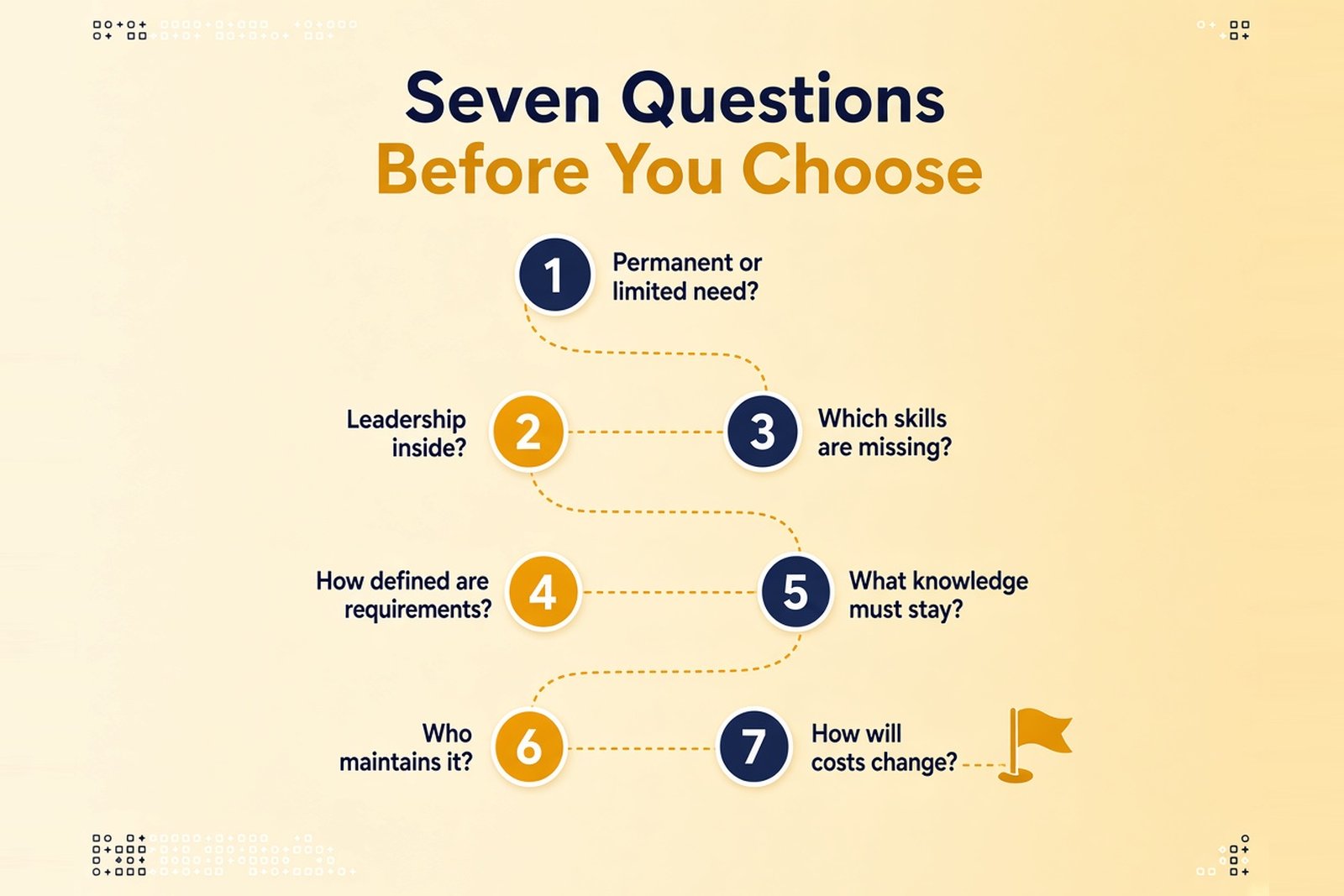
Start with seven questions. Answer them honestly, and the right direction usually becomes obvious:
- Do you need development permanently, or for a limited period?
- Do you have a technical leader and product management inside the company?
- Which skills do you already have, and which are missing?
- How well defined are the requirements?
- What knowledge must stay inside the company?
- Who will maintain the product after launch?
- How will costs change if the team grows, shrinks, or gets replaced?
Then match your situation to a starting point:
| Situation | Model to consider | What to check |
|---|---|---|
| Ongoing product development, and you can hire | In-house | Budget, availability of specialists, team management |
| An internal team exists, but specific specialists are missing | Staff augmentation | Onboarding and technical leadership on your side |
| A self-contained piece of work | Project outsourcing | Scope boundaries, acceptance, change process |
| A long-term external team is needed | Dedicated team | Responsibilities, knowledge retention, support |
| Internal and external skills complement each other | Hybrid | Coordination and clear ownership |
Treat the table as a direction for your evaluation, not a verdict. Two companies in the same row can still need different setups once you look at their product, team, and constraints.
Choosing Between In-House and Outsourcing
The choice comes down to how long you need the work, what skills and leadership you already have, and who will own each part of the process. Get those three answers straight, and the model follows from them.
Not sure which setup fits your situation? Talk to Softellar about your goals, your current team, and the roles you're missing. We'll help you figure out whether you need a few specialists, a dedicated team, a defined project, or no outside help at all.


