


Overview
Software development is a dynamic endeavour that often demands collaboration from experts specialised in diverse IT disciplines. Depending on the scale of the software project, these collaborative efforts can last from a few weeks to years, but the common denominator is that they all have well-established objectives and milestones upon whose achievement the project is deemed successful.
Considering the time-bound nature of some of these initiatives, hiring development specialists on a permanent basis comes across as inconsequential if not downright excessive. This is why IT companies are increasingly adopting IT staff augmentation as an employment strategy. It presents an alternative to traditional hiring practices that is not only more cost efficient but also more flexible. But what is IT staff augmentation and what exactly does it entail?
This comprehensive guide examines the concept in depth, highlighting its benefits, challenges, and various types. We also compare this model to other staffing solutions and provide some tips to help you choose a viable augmentation provider. Read on.
What Is IT Staff Augmentation?
Staff augmentation is a proactive outsourcing technique employed by organizations to effectively manage urgent staffing needs caused by staff shortages or workload spikes. This adaptable and expandable employment model enables organizations to reconfigure their internal teams and swiftly adjust to increases in workload or special project demands, without the need for permanent hiring.
Essentially, staff augmentation companies that offer augmentation services are extremely flexible. They offer staffing solutions to companies across a wide range of professions, including IT, healthcare, retail, finance, and telecommunications. These staffing options are usually temporary and include suggesting highly skilled individuals, but can also involve obtaining physical resources like office space or providing ongoing administrative assistance.
Because staff augmentation firms are more adept at handling the fast pace of innovation and fluctuating resource requirements that come with infrastructure management and software development projects, the staff augmentation strategy is preferred over traditional employment procedures in the IT industry.
Reasons Why Companies Are Turning to IT Staff Augmentation
As we will emphasize in this article, IT staff augmentation offers numerous advantages for IT firms that implement the strategy. However, there are numerous other reasons driving tech companies to adopt the staff augmentation approach.
Efficient Project Management
Staff augmentation streamlines the project management process by reducing the responsibilities of project managers in supervising augmented staff. As a project manager, the augmentation provider assumes the role of overseeing and handling augmented teams, freeing up in-house employees to focus on the day-to-day operations of the project.
Accessing Talent Beyond Borders
Finding the right level of expertise for an IT team working on a development project can sometimes be challenging to find locally. Staff augmentation offers the opportunity to tap into expertise from different parts of the world. With their vast network, a staffing augmentation vendor can assist software teams in locating highly skilled software professionals from around the world.
Expanding The Customer Base
When an organization seeks to expand into new markets, it can acquire valuable insights into the local market by temporarily hiring local talent from that region. Utilizing a vendor for staff augmentation enables businesses to tap into the expertise of local employees without the need for a long-term commitment in the area.
Adaptable Development
When it comes to optimizing costs and operational efficiency for software projects, many organizations need a flexible employment model that can accommodate temporary project-based work. From a managerial perspective, workforce augmentation offers a practical solution by providing a flexible workforce that can be adjusted as needed during different phases of a project.
Benefits of IT Staff Augmentation
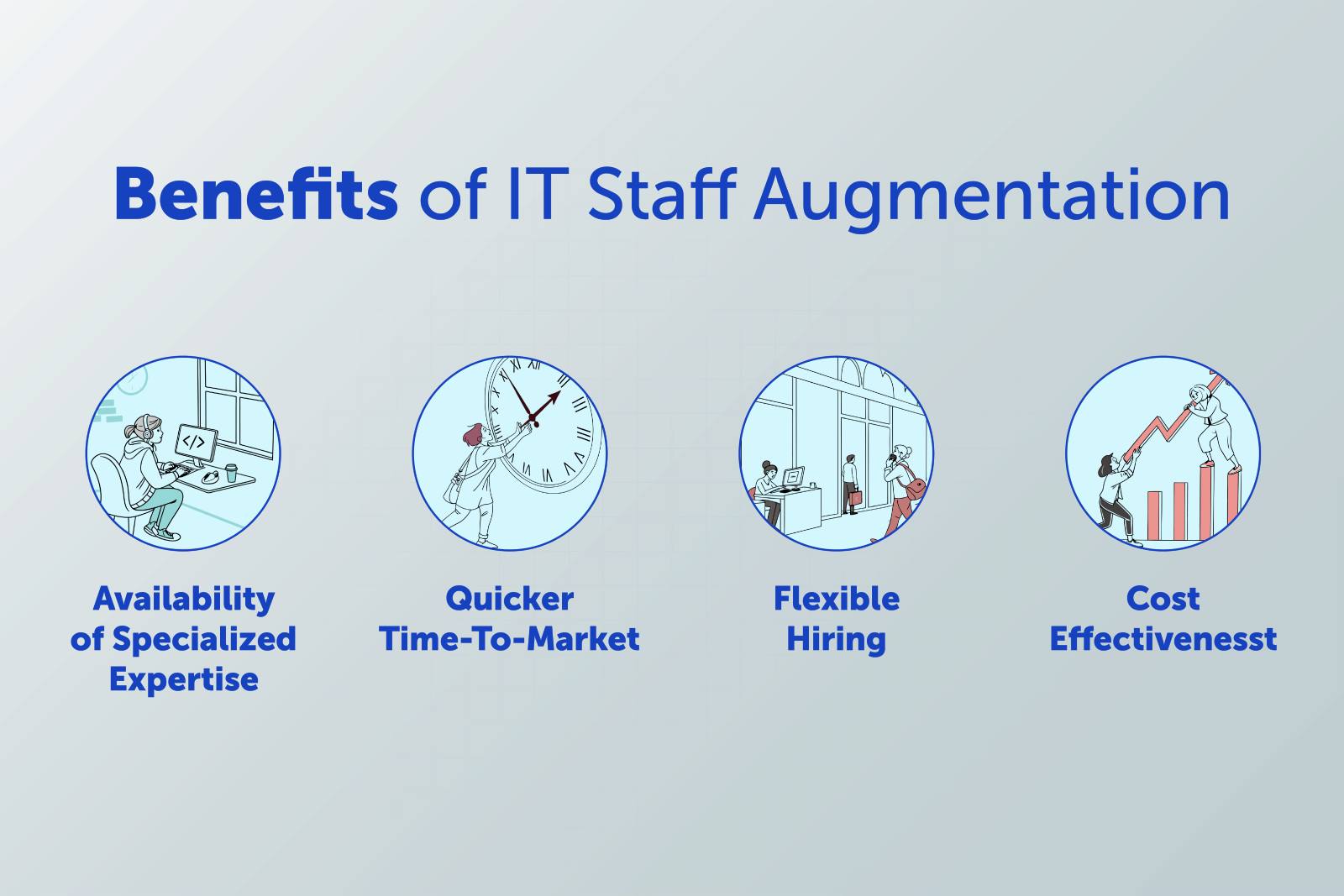
Availability Of Specialized Expertise
Organizations can acquire personnel that are urgently needed from a global talent pool by employing the staff augmentation model. Unrestricted access to highly specialized IT talent is arguably the best benefit associated with the utilization of augmentation service providers. Without requiring extra training, the augmented personnel they recommend are capable of initiating work processes and producing results from the onset.
Flexible Hiring
Flexibility is an inherent characteristic of staff augmentation services. Augmentation vendors provide human resources services that are purposefully designed to be easily scalable, enabling organizations to modify their workforce in response to the requirements of specific projects or responsibilities.
Quicker Time-To-Market
In the intensely competitive domain of information technology, the timely delivery of deliverables is of enormous worth. Staff augmentation facilitates this time-to-market by supplying specialized personnel who can readily assimilate into existing operations and deliver immediate value.
Cost Effectiveness
Staff augmentation consulting offers IT organizations a method of resource utilization that is both cost-effective and operationally efficient. When utilized correctly, it can help to limit expenditures typically associated with the recruitment of permanent staff. Organizations can use this method to optimize their financial strategies, paying for services only when they are needed.
Ready to Scale Your IT Team?
Get expert staff augmentation services to boost your project delivery and access specialized talent.
Types of IT Staff Augmentation
The specific augmentation services required by a software development team are contingent upon the nature of the given project. Some software development initiatives require a blend of several of the following augmentation types to achieve maximum operational efficiency. However, they are mostly adopted for project-specific purposes.
Project Based Augmentation
In the Project Based Augmentation model, organizations enlist augmented staff to assist with a project that has a specific deadline. These professionals collaborate in pursuit of the project's success together and may include an assemblage of quality assurance engineers, DevOps professionals, and software developers. Project-based augmentation is a technique specifically designed for projects that are overly intricate or too resource-intensive for an internal development team to manage.
Skill-Based Augmentation
The prevailing form of staff augmentation utilized in IT and other technology-intensive sectors is skill-based augmentation. Here, priority is given to recruiting personnel with specialized knowledge in technical domains that are currently understaffed internally. Typically, the engagement of these skill-bases staff is motivated by the need to fill in particular deficiencies in expertise or integrate cutting-edge technologies.
Dedicated Team Augmentation
As a form of staff augmentation, dedicated team augmentation involves a service provider assembling an IT-specialist team (e.g., developers, programmers, engineers, or managers) to work on a client project exclusively. Typically composed of highly experienced individuals, these groups operate in concert as an extension of the client's IT staff.
Time-Based Staff Augmentation
Time-based staff augmentation is an economically viable approach that enables IT departments to acquire supplementary personnel for a pre-established duration, ranging from hours to weeks. This transient staff augmentation strategy is frequently employed by development teams to fill in for staff members who are temporarily absent due to personal emergencies such as maternity or paternity leave or illness.
There are also three main types of staff augmentation depending on the location the remote team is working from:
Potential Challenges of Staff Augmentation
As discussed in this article, there are many reasons why an IT firm might opt for the augmentation approach. But just because it has profound benefits doesn't mean it's without its challenges. We explore a few of these drawbacks here:
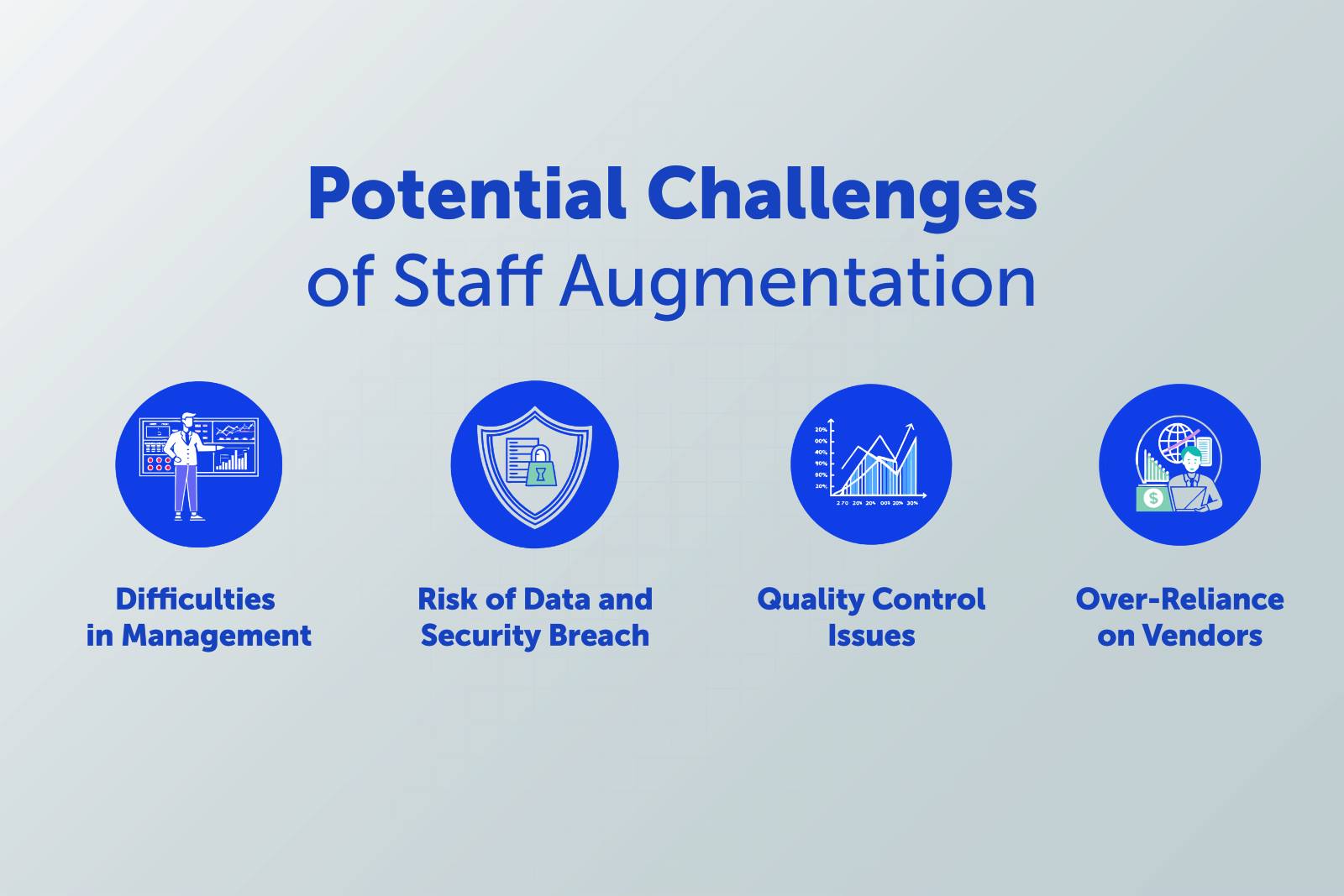
Difficulties In Management
When proportional input is required from both an outsourced team and an in-house team, additional resources and effort may be required to manage team members efficiently. In order to facilitate smooth collaboration among existing staff and ensure that newly hired team members are well-informed about project workflows, project team leads might be required to exert additional effort. Additionally, they would need to establish communication channels that are online 24/7 to ensure that remote employees are informed of the most recent advancements in the project.
Quality Control Issues
Quality assurance is a frequently encountered obstacle in the realm of staff augmentation. While external professionals are frequently highly-regarded by service providers, maintaining a uniform standard of technical proficiency among all team members can present challenges. The variability in working methodologies and standards among augmented employees can have an impact on the overall quality of project deliverables.
Risk of Data And Security Breach
When utilizing software team augmentation to build a development team, you often have to subject your sensitive projects to the scrutiny of impermanent staff. While augmentation service level agreements generally include specified safeguards to protect your sensitive proprietary information, the probability of confidentiality leaks and data security violations escalates with the addition of more personnel to a project.
Over-Reliance On Vendors
An excessive reliance on staff augmentation services to supply IT departments with human resources can result in vendor overdependency. This excessive reliance hampers an organization's capacity to cultivate its own internal capabilities and has the potential to erode productivity as time goes on.
Comparing IT Staff Augmentation and Other Staffing Solutions
Staff Augmentation vs Traditional employment
The work model is the traditional mode of employment with which we are most familiar. Typically, it entails hiring full-time employees on a long-term basis, with gradual career advancements as the employee's input progresses over time. Staff augmentation engagements, on the other hand, are typically short-term employment, with a fixed compensation rate and no promotion schemes.
Staff Augmentation vs Managed Services
Managed services refer to the utilization of external providers by organizations to create software, and maintain their IT infrastructure over a long period of time. This is typically done through a managed services provider. In contrast to staff augmentation, where the client company maintains control over augmented teams and project direction, managed services entail relinquishing a significant level of control. In this arrangement, the client places trust in the managed services provider to handle all project functions, from finding professionals, to providing IT support and disbursing payroll.
Staff Augmentation vs Consultancy Services
Consultancy services offer firms specialized advice and counsel on executing company plans and resolving specific business challenges.
While several staff augmentation organisations may provide some form of advice during the early phases of their involvement, this is typically not their primary focus or area of expertise. Augmented workers primarily handle project activities that are part of everyday development operations, whereas consultants typically concentrate on independent initiatives that may or may not be integrated into regular business activities.
Staff Augmentation vs Professional Services
Professional services is a holistic approach to outsourcing, in which firms entrust the complete project management responsibilities for long-term efforts to a professional service provider. Staff augmentation, however, is a method used by IT organizations to enhance their staff by bringing in external experts as needed for certain projects. Staff augmentation firms differ from professional service providers in that they do not assume complete responsibility for managing and delivering a project. Instead, their main focus is on managing their own teams and the contributions they make to an ongoing initiative.
IT Staff Augmentation Process Steps
The IT Staff augmentation process used by augmentation service providers follows distinct stages to ensure quality of augmented professionals. These include:
1. Determining Project Requirements
During the initial phase of a staff augmentation project, your staff augmentation provider evaluates the existing capabilities of your in-house teams to pinpoint project areas with skill gaps. This assists the incoming staff in gaining a clearer understanding of their role in the development process and the goals they need to accomplish in order to be deemed successful.
2. Talent Acquisition
Subsequently, the most qualified candidates for the undertaking are selected. Ideally, the augmentation partner conducts comprehensive evaluation exercises for every candidate, guaranteeing that all incoming talents are adequately prepared to tackle challenges that may emerge during the course of the project.
3. Talent Integration
The responsibility of training and integrating new team members may be delegated to the staffing agency or in-house administrators. This integration phase is critical because it ensures that all project participants are on the same page, thereby streamlining the project's progression.
4. Support and Maintenance
Reputable staff augmentation firms recognize the significance of offering direction and assistance to newly augmented teams for the duration of a project. This crucial final stage ensures that augmented teams remain efficient and aligned with the objectives of the project.
When to Choose Staff Augmentation
While there are advantages to using IT staff augmentation over other hiring methods, there are also situations in which augmentation might negatively impact the course of a project. As such, recognizing situations that are primed for augmentation can be the difference between a successful augmentation process and a disastrous one. If you want to dive in this topic in detail, read our article. For now, let's examine a couple of this scenarios:

When keeping costs in check
IT companies usually spend a substantial part of their budget on wages, benefits, training, and infrastructure when maintaining a permanent workforce. As a result, this often limits financial resources that can be allocated to other project areas. Staff augmentation can be used here as a cost-effective solution to help organizations avoid spending more than they can afford on staff expenses.
When completing projects that are time-sensitive
Time-bound development projects that must be completed within predetermined deadlines sometimes call for hiring processes to be hastened, something that traditional recruitment channels cannot guarantee. This is why staff augmentation works well for these kinds of initiatives. It can provide skilled experts an onboard them in record times.
When increasing business visibility
In the modern digital sphere, the clientele of IT companies' frequently spans national boundaries to include people from all over the world. Employing augmentation, businesses can engage professionals in these countries and leverage their knowledge of the local scene to develop their operations outside.
Tips for Choosing the Right Staff Augmentation Provider
Choosing a staffing provider that can efficiently help you fill skill gaps with competent alternatives isn't always a breezy task. In light of this, we offer the following IT staff augmentation tips to assist you in selecting the most suitable staff augmentation provider:
Consider The Ease Of Communication
For any business partnership to blossom without a hitch, either side must be able to reconcile their reservations and communicate openly. This holds true when discussing staff augmentation options. Before signing on, confirm that your provider has reliable communication channels in place to facilitate project coordination between augmented teams and in-house managers. This is essential to ensure any issues that arise during the project can be addressed promptly.
Assess Vendor Credentials
Not all augmentation companies can handle complex projects. While some providers can in fact assemble multidisciplinary teams for high-impact projects, smaller augmentation firms may only specialize in finding professionals in a specific discipline. For this reason, it is critical to evaluate a vendor's past client history and the caliber of projects they've handled in the past in order to determine if they're a good fit for you.
Prioritize Cultural Compatibility
Cultural compatibility describes the ability of augmented personnel to integrate with an existing IT team and collaborate productively. Prioritizing cultural fit should involve gauging the technical abilities of augmented staff, their employment history, and work values.
For example, if you are working on a project that requires constant collaboration and communication, it would be impractical to employ augmented staff from a region with different time zones and languages, knowing full well that their work hours will not allow them to collaborate efficiently with internal teams.
Choose Value Over Costs
In pursuit of a cost-saving avenue, it is easy for IT firms to lose track and compromise on the caliber of IT professionals they need. However, when cost concerns are put aside, IT companies will often go for the most premium talent they can afford. That said, it is important to consider the professional value of a staff augmentation service compared to its financial costs. If you can ascertain that your staffing partner will deliver talent of the highest quality when you need it, paying the cost of expertise might be more prudent in the long run.
Conclusion
In sum, this IT staff augmentation guide has summed up everything you need to know about augmentation. The augmentation strategy is a business model employed by IT organizations to temporarily enhance their internal teams with external experience.
By offering a range of augmentation options, this adaptable employment model enables rapid integration of additional employees and results in cost savings for technology companies. Nevertheless, it is not without its disadvantages. Ensuring the quality of service and protecting proprietary property can be challenging due to the temporary nature of engagements.
Staff augmentation is especially efficient when utilized for time-sensitive projects or for keeping operating expenses in check. The key to achieving a successful staff augmentation is in choosing the right augmentation partner. When considering this matter, various aspects come into play, including the vendor's credentials, the level of communication convenience, and the compatibility of the staff's work values with internal teams.


