

Overview
Clutch alone lists more than 9,200 software development companies in the USA. Most of them look the same on paper: agile teams, modern tech stack, happy clients. The real differences usually show up once the project is underway.
We put this list together to make that choice faster. We looked at 20 software companies serving US clients, from global firms with 300,000+ people to Midwest boutiques with fewer than 150. For each one you get the facts that matter when you shortlist a vendor: where the engineers actually sit, what they charge, the minimum budget they accept, and where they fall short.
Key takeaways
- Our pick for mid-size budgets (see disclosure): Softellar, rated 5.0 from 12 reviews on Clutch, $50–$99/hr, projects from $10,000.
- Large enterprise programs: EPAM, Cognizant and Thoughtworks.
- US-headquartered boutiques with the most Clutch reviews in this comparison: Atomic Object and TXI, each rated 4.9 on Clutch with more than 50 reviews.
- Regulated and embedded software: SEP.
- Rates: Clutch lists an average range of $50–$99/hr for US software development companies. The US boutiques in this list that publish rates charge $150–$300.
Top Software Development Companies in the USA at a Glance
Ratings, rates and minimums come from Clutch profiles as of October 4, 2026. Large IT services firms don't publish hourly rates and rarely collect Clutch reviews, so those cells say "Custom quote" or "Not rated".
| # | Company | Best for | HQ | US presence | Team size | Clutch rating | Rate (USD/hr) | Min. project |
|---|---|---|---|---|---|---|---|---|
| 1 | Softellar | Mid-market custom software, dedicated teams | Warsaw, Poland | Office in New York | 35+ | 5.0 (12 reviews) | $50–$99 | $10,000+ |
| 2 | EPAM Systems | Enterprise engineering at scale | Newtown, PA | US HQ, 8+ offices | ~62,850 | 5.0 (1 review) | Custom quote | $100,000+ |
| 3 | Thoughtworks | Complex modernization | Chicago, IL | US HQ, 3 offices + hubs | 10,000+ | Not rated | Custom quote | Custom |
| 4 | Slalom Build | Onshore product engineering | Seattle, WA | US HQ, local teams | Not disclosed | Not rated | Custom quote | Custom |
| 5 | Globant | Design-led digital products, LatAm nearshore | Buenos Aires / Luxembourg | NY, SF, Boston | ~28,800 | Not rated | Custom quote | Custom |
| 6 | Persistent Systems | Software product engineering for ISVs | Pune, India | 8+ US offices | ~27,500 | 4.5 (1 review) | Custom quote | $25,000+ |
| 7 | Cognizant | End-to-end IT for Fortune 500 | Teaneck, NJ | US HQ | ~351,600 | Not rated | Custom quote | Custom |
| 8 | Infosys | AI-led modernization at scale | Bengaluru, India | 5+ US innovation hubs | ~328,600 | Not rated | Custom quote | Custom |
| 9 | TCS | Very large transformation programs | Mumbai, India | Americas HQ in New York | ~584,500 | Not rated | Custom quote | Custom |
| 10 | HCLTech | Engineering, R&D and infrastructure | Noida, India | 23,000+ US staff | 227,000+ | Not rated | Custom quote | Custom |
| 11 | Wipro | Financial services transformation | Bengaluru, India | Americas HQ in NJ | ~242,000 | Not rated | Custom quote | Custom |
| 12 | Nagarro | Engineering-first product teams | Munich, Germany | 12 US offices | ~18,000 | Not rated | Custom quote | Custom |
| 13 | Zensar | Experience-led modernization | Pune, India | US hub in Cary, NC | 10,500+ | 4.0 (1 review) | Custom quote | Custom |
| 14 | Softtek | Nearshore delivery from Mexico | Monterrey, Mexico | US HQ in Addison, TX | ~14,000 | 4.5 (1 review) | Custom quote | $5,000+ |
| 15 | 8th Light | Modernization in regulated industries | Chicago, IL | US-based | 140+ | 4.5 (1 review) | Undisclosed | $250,000+ |
| 16 | Atomic Object | Custom web, mobile and IoT products | Grand Rapids, MI | US-based, 4 offices | ~115 | 4.9 (52 reviews) | $150–$199 | $25,000+ |
| 17 | TXI | AI workflow software for industrial ops | Chicago, IL | US-based, remote-first | ~75 | 4.9 (51 reviews) | $200–$300 | $50,000+ |
| 18 | MojoTech | AI-native product engineering | Providence, RI | US HQ, plus a team in Buenos Aires | 50–249 | 5.0 (13 reviews) | $150–$199 | $100,000+ |
| 19 | SEP | Regulated and embedded software | Westfield, IN | 100% US-based | ~180 | 5.0 (11 reviews) | $150–$199 | $100,000+ |
| 20 | SPR | Enterprise AI and legacy modernization | Chicago, IL | US-based | 150–250+ | 4.9 (8 reviews) | $150–$199 | $25,000+ |
How We Selected These Companies
This is an editorial selection. We shortlisted firms that appear on Clutch, The Manifest, Gartner's Magic Quadrant for Custom Software Development Services and the lists that currently rank for this topic. Then we kept only companies whose core business is custom software development. Software product companies like Microsoft or Oracle are mentioned briefly near the end.
Data sources
For each company we checked its own website, annual reports or SEC filings, its Clutch and GoodFirms profiles, and recent press releases. Employee counts and revenue come from the latest fiscal year each firm has reported. All directory data was pulled on the same day, October 4, 2026. Ratings move, so check them again before you sign anything.
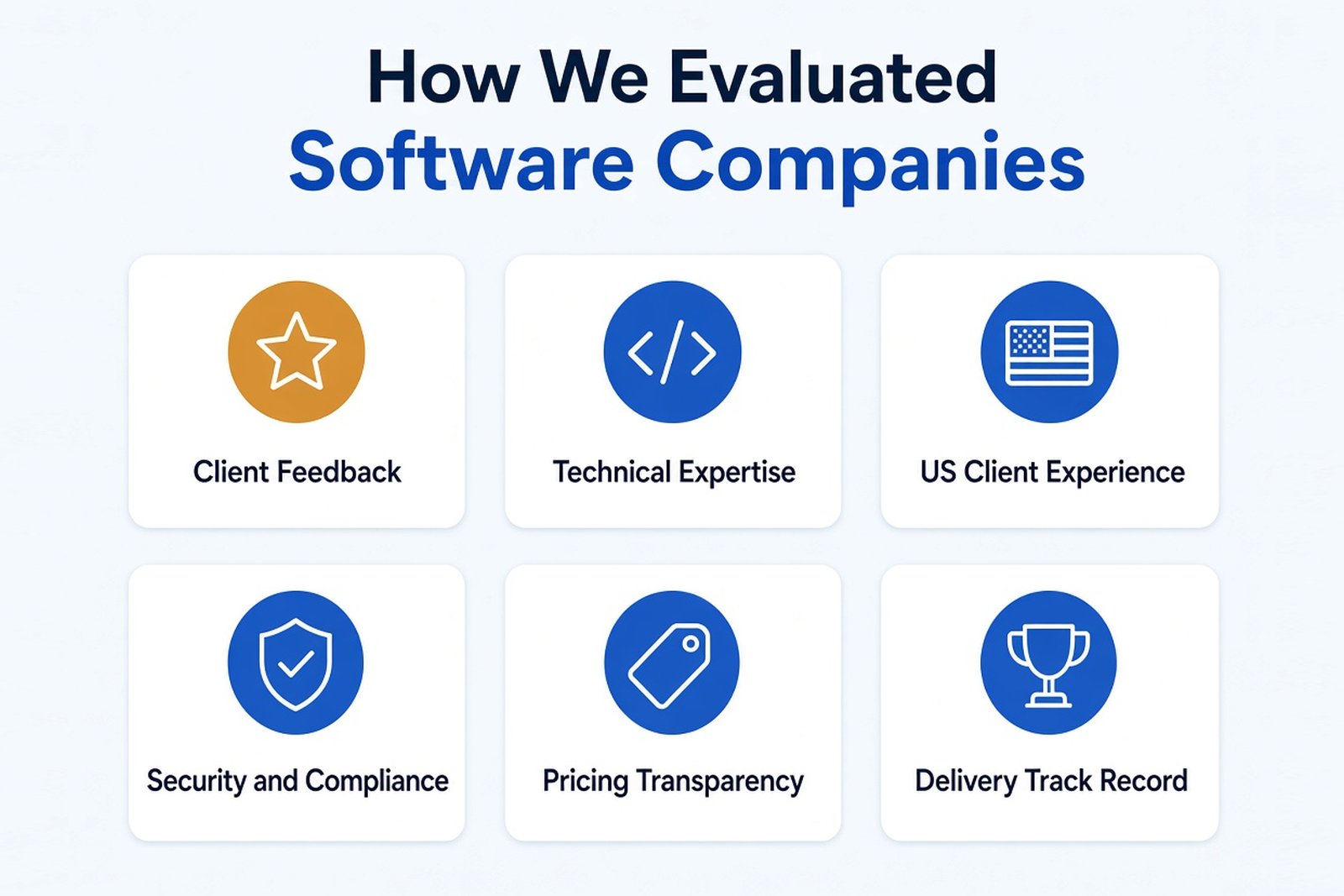
What we looked at
- Client feedback: verified reviews on Clutch and GoodFirms, and named client references.
- Technical expertise: engineering services, tech stack, AI, data and cloud capability.
- Experience with US clients: US offices, US case studies and time-zone overlap.
- Security and compliance: published certifications such as ISO 9001, ISO 27001 or CMMC.
- Pricing transparency: public hourly rates and minimum budgets.
- Delivery track record: case studies with measurable results.
We did not turn these factors into a numeric score. Most large IT services firms don't publish rates or collect Clutch reviews, so a single score would compare very different kinds of data. When a company has no Clutch profile, or only one or two reviews, we say so. Missing reviews limit independent verification, but they don't prove low quality.
The order of the list is our editorial judgment. Softellar comes first for the reason given in the disclosure. Large enterprise firms follow because they are on the default shortlist of many US companies. The US boutiques come last, not because they are weaker (several have the best reviews in this article), but because their minimum budgets and team sizes suit narrower needs.
What "US company" means in this list
Many "top US" lists mix American firms with vendors whose US presence is a sales office. We label every company by where its engineers actually work:
- US-based: headquarters and most engineers in the USA (for example, Atomic Object and SEP).
- US-headquartered, global delivery: a US head office with large teams abroad (EPAM, Cognizant).
- Global firms with a US presence: headquarters outside the USA, with US offices and onsite staff (Infosys, TCS, Globant, Softellar).
None of these models is better by default. They just come with different rates, time-zone overlap and contract terms, which we cover in the cost section.
The 20 Best Software Development Companies in the USA
1. Softellar: best for mid-market custom software development and dedicated teams
- Founded: 2021
- HQ: Warsaw, Poland
- US office: New York (353 Lexington Ave)
- Team: 35+ in-house specialists
- Clutch: 5.0 from 12 reviews
- Rate: $50–$99/hr
- Min. project: $10,000
Softellar is a custom software development company that builds web apps, enterprise systems and cloud platforms for US and European businesses. With 35+ in-house specialists, it suits projects that need a focused team rather than a large program.
The strongest area is Microsoft Azure and data engineering. Published case studies include an AI lending platform on Azure for a US private credit company, a cloud-native rebuild of a payroll SaaS product and an Azure migration for a travel portal. In a client review on TechReviewer, one client reported a 75% cut in data processing time.
Core services: custom software development, web development, cloud migration (AWS, Azure, GCP), legacy modernization, software consulting, dedicated teams and staff augmentation.
Tech stack: React, Next.js, Angular, TypeScript, .NET, Node.js, Python, Java, Azure Synapse, Azure Data Factory.
Industries: healthcare, fintech, e-commerce, real estate, SaaS, energy, logistics.
Pros
- Perfect scores on both Clutch and GoodFirms, with named clients such as Multi Radiance Medical and Grand Financial.
- Mid-range rates with a low $10,000 entry point, so you can start with a pilot instead of a long contract.
Cons
- A team of 35+ people can't staff a 100-engineer program.
- Engineers work from Poland. Warsaw is usually six hours ahead of New York, so on a standard Warsaw schedule the overlap with the East Coast is about two hours; ask how the team adjusts its hours for your project.

See a Real Softellar Project on Azure
An AI-powered lending platform built on Microsoft Azure for a US private credit company: automated document processing, underwriting workflows, and a partner portal, delivered by a focused dedicated team.
2. EPAM Systems: best for enterprise engineering at scale
- Founded: 1993
- HQ: Newtown, Pennsylvania
- Team: about 62,850 (end of 2025)
- Revenue: $5.46B in FY2025
- Min. project: $100,000+
EPAM started as a software engineering shop and never really stopped being one. More than 56,000 of its people are delivery professionals, which is unusual for a firm this size. Most of them work in Central and Eastern Europe, India and Latin America, with account management and architects in US offices.
The company has put real money into AI tooling. Its open-source DIAL platform and the AI/Run framework are used on client projects, and in 2025 it launched Agentic QA for quality engineering. Published results include 66% cloud cost savings for energy trader SEFE after an Azure migration.
Pros: deep engineering bench; strong data, cloud and quality engineering practices.
Cons: a $100K minimum on Clutch, so it is built for larger budgets; most engineers work outside the US.
3. Thoughtworks: best for complex modernization
- Founded: 1993
- HQ: Chicago, Illinois
- Team: 10,000+ in 18 countries
- Ownership: private (Apax Partners since November 2024)
If you've read about continuous delivery or microservices, you've probably read something written by Thoughtworks people. The company publishes the Technology Radar twice a year, and Gartner named it a Visionary in its 2025 Magic Quadrant for Custom Software Development Services.
Thoughtworks is a good fit when the hard part is the engineering culture, not just the code: replacing a mainframe, splitting a monolith, or teaching an internal team to ship weekly. For Beautycounter, it automated a manual commissions process and cut its run time by 99%.
Pros: strong engineering practices; AI/works and Agent/works platforms launched in 2026.
Cons: no public rates or Clutch reviews; as a private company since 2024, it publishes little financial data.
4. Slalom Build: best for onshore product engineering
- HQ: Seattle, Washington
- Parent: Slalom (founded 2001, about 12,000 people)
- Build centers: Seattle, Chicago, Toronto
Slalom Build is the product engineering arm of Slalom, a consulting company known for local teams in US cities. That local model is the main reason to choose it. Your engineers are likely in your time zone, and some may be in your city.
The team builds mobile apps, AI products and data platforms. Notable work includes an iOS app for Smith Optics that TIME listed among its Best Inventions, and AI-assisted cervical cancer screening with Hologic.
Pros: onshore delivery; more than 700 technology partnerships, including AWS, Microsoft and Snowflake.
Cons: onshore rates; few public reviews or numbers to compare.
5. Globant: best for design-led digital products with LatAm nearshore delivery
- Founded: 2003
- HQ: Buenos Aires (legal HQ in Luxembourg)
- US offices: New York, San Francisco, Boston
- Team: about 28,800
- Revenue: $2.46B in FY2025
Globant combines a strong design studio with engineering teams across Latin America, which gives US clients full workday overlap. It works with Google, Electronic Arts and Santander, and its predictive churn model for Liberty Latin America reduced churn by 25%.
Its newer offer, AI Pods, sells AI-assisted development as a subscription. By March 2026 it had reached $32.8M in annual recurring revenue.
Pros: design quality; US time zones.
Cons: no public rates or meaningful Clutch data; revenue grew only 1.6% in 2025.
6. Persistent Systems: best for software product engineering
- Founded: 1990
- HQ: Pune, India
- US offices: San Jose, New Jersey, Charlotte, Dallas and others
- Team: about 27,500
- Revenue: $1.65B in FY2026, up 17.4%
Persistent grew up building software for software companies, and that's still where it's strongest. It has reported 24 straight quarters of revenue growth (FY2026 results). In September 2026 its €1.1B takeover offer for Nagarro succeeded, with 83.25% of shares secured. An additional acceptance period runs until October 6, and the deal has not closed yet.
According to a published case study, a US bank cut loan decisioning time by 85% on a Persistent-built platform.
Pros: fast growth; product engineering depth and its own SASVA AI platform.
Cons: delivery is mostly from India; the Nagarro deal is a large integration, so ask how it affects your account team.
7. Cognizant: best for end-to-end IT services at Fortune 500 scale
- Founded: 1994
- HQ: Teaneck, New Jersey
- Team: about 351,600
- Revenue: $21.1B in FY2025
Cognizant is a US-headquartered giant that does everything from app development to running back offices. It signed 28 deals worth over $100M each in 2025. Healthcare is a real specialty thanks to its TriZetto products. In 2026 it closed the acquisitions of 3Cloud (Azure) and Astreya (AI infrastructure).
Pros: scale; healthcare and insurance depth.
Cons: large-firm process; most engineering is offshore, and small projects are not a fit.
8. Infosys: best for AI-led modernization at enterprise scale
- Founded: 1981
- HQ: Bengaluru, India
- US hubs: Indianapolis, Raleigh, Hartford, Providence, Richardson (TX)
- Team: about 328,600
- Revenue: over $20B in FY2026
Infosys signed $15B worth of large deals in its last fiscal year. Its Topaz AI suite and Cobalt cloud platform are used across most new engagements. According to an Infosys case study, Hertz modernized critical workflows 60% faster with AI-assisted code engineering. In 2026 Infosys bought two US firms, including Optimum Healthcare IT.
Pros: proven at very large scale; mature AI and cloud platforms.
Cons: built for large programs, not small projects; no public rates.
9. TCS: best for very large transformation programs
- Founded: 1968
- HQ: Mumbai, India
- Americas HQ: New York
- Team: about 584,500
- Revenue: $30.0B in FY2026
Tata Consultancy Services is the biggest company in this list by headcount, and North America brings in almost half its revenue. It also sells its own products, most notably BaNCS for banks and insurers. TCS reports that its annualized AI revenue has passed $2.3B.
Pros: unmatched scale; its own industry platforms.
Cons: revenue slipped slightly in FY2026 and headcount dropped by about 23,000. TCS also faces about $220M in exposure from the DXC trade-secrets case after the US Supreme Court declined its appeal in June 2026.
10. HCLTech: best for engineering, R&D and infrastructure
- Founded: 1991
- HQ: Noida, India
- US presence: 23,000+ staff, 26 delivery centers in 19 states
- Team: 227,000+
- Revenue: $14.7B in FY2026
HCLTech is the most engineering-heavy of the Indian majors. Its work with Xerox, which started in 2009, has produced 215 US patents. About three quarters of its US workforce is hired locally, and that matters if you want people onsite. In August 2026 it closed the purchase of HPE's telco solutions business.
Pros: strong engineering and R&D services; large onsite US workforce.
Cons: no public rates; growth slowed to 3.9% in constant currency in FY2026.
11. Wipro: best for financial services transformation
- Founded: 1945 (IT business since the early 1980s)
- HQ: Bengaluru, India
- Americas HQ: East Brunswick, New Jersey
- Revenue: $10.5B IT services revenue in FY2026
Wipro owns Capco, a consulting firm focused on banking and capital markets. Large deal bookings rose 45% last year to $7.8B. The $375M purchase of Harman's digital transformation unit added about 5,600 engineers.
Pros: banking and insurance expertise through Capco; stronger engineering after the Harman deal.
Cons: IT services revenue was roughly flat in FY2026; no public rates.
12. Nagarro: best for engineering-first product teams
- Founded: 1996
- HQ: Munich, Germany
- US offices: 12, including New York, Atlanta, Austin, Boston and San Jose
- Team: about 18,000
- Revenue: €999M in 2025
Nagarro sits between the boutiques and the giants. North America accounts for roughly a third of its revenue, and its services include agile product delivery and quality engineering. Public-sector clients include the City of Atlanta and NYC Public Schools, where, according to Nagarro, an AI helpdesk cut response times from minutes to seconds.
Pros: flexible mid-size firm; strong in manufacturing and automotive.
Cons: Persistent Systems' takeover offer succeeded in September 2026, so ownership will change once the deal closes. A 2025 short-seller report was investigated and not substantiated, though the review flagged governance improvements.
13. Zensar Technologies: best for experience-led modernization
- Roots: 1963 (Zensar brand since 2000)
- HQ: Pune, India
- US hub: Cary, North Carolina
- Team: 10,500+
- Revenue: $644M in FY2026
Zensar is part of India's RPG Group. It bought two design agencies, Foolproof and Indigo Slate, so UX work is done in-house instead of being outsourced. It reports that 85% of its staff hold AI certifications, and it recently signed a $210M framework deal with a financial services company.
Pros: in-house design teams from two acquired agencies; mid-size scale.
Cons: its US revenue shrank 2.2% year over year in the latest quarter; very few public reviews.
14. Softtek: best for nearshore delivery from Mexico
- Founded: 1982
- HQ: Monterrey, Mexico
- US HQ: Addison, Texas
- Team: about 14,000
- Clutch min. project: $5,000+
Softtek coined the term "nearshore" in 1997, and it still runs on that idea: Mexican and Latin American teams that work US hours. Gartner named it a Challenger in its December 2025 Magic Quadrant for Custom Software Development Services. Softtek reports that Real Madrid's fan app, which it supports, grew active users by more than 150%.
Pros: full overlap with US time zones; first ISO 42001 AI certification in Latin America.
Cons: private, with little financial disclosure; almost no public client reviews.
15. 8th Light: best for modernization in regulated industries
- Founded: 2006
- HQ: Chicago, Illinois
- Other offices: London, plus teams in Los Angeles, New York and Austin
- Team: 140+
- Min. project: $250,000+
8th Light made its name on software craftsmanship and a focus on clean, maintainable code. These days it focuses on enterprise modernization and agentic AI. According to 8th Light, its DevSecOps work for Pfizer cut deployment times by 50%, and other clients include Capital One, GoodRx and Riot Games.
Pros: senior, US-based engineers; serious enterprise references.
Cons: the highest minimum budget in this list; only one Clutch review, and that reviewer rated cost 3 out of 5.
16. Atomic Object: best for custom web, mobile and IoT products
- Founded: 2001
- HQ: Grand Rapids, Michigan
- Offices: Ann Arbor, Chicago, Raleigh-Durham
- Team: about 115
- Clutch: 4.9 from 52 reviews
- Rate: $150–$199/hr
- Min. project: $25,000+
Atomic Object has the highest Clutch review count among the boutiques in this comparison: 52 Clutch reviews with a 4.9 average. The company is employee-owned and a certified B Corp. It has worked with Ford, Johnson & Johnson, Cleveland Clinic and Qualcomm, and one recent project replaced a 30-year-old ERP system.
Pros: strong, consistent reviews; reachable $25K minimum for a US firm.
Cons: about 115 people, so capacity for large multi-team programs is limited.
17. TXI: best for AI workflow software in industrial and healthcare operations
- Founded: 2002 (as Table XI)
- HQ: Chicago, Illinois
- Team: about 75 consultants
- Clutch: 4.9 from 51 reviews
- Rate: $200–$300/hr
- Min. project: $50,000+
TXI publishes detailed case-study results. According to those case studies, a knowledge graph for a pharma company made 2,100 scientists 89% more efficient. An app for MotorCity Systems reaches 3.5 million truck drivers, and a patient app for Theragen cut treatment failure rates by 56%. The team averages 17 years of experience and is 100% employee-owned.
Pros: measurable outcomes; senior consultants on every project.
Cons: the highest hourly rates on this list; a small team.
18. MojoTech: best for AI-native product engineering
- Founded: 2008
- HQ: Providence, Rhode Island
- Offices: Boulder, New York, Buenos Aires
- Clutch: 5.0 from 13 reviews
- Rate: $150–$199/hr
- Min. project: $100,000+
MojoTech works with large consumer and financial brands. According to its published case study, its rebuild of 9.1 million landing pages for Angi led to a 300% increase in bookings. Blue Cross Blue Shield of Rhode Island saw individual plan conversions grow 161%. Other clients include Under Armour, Credit Karma and Fiserv.
Pros: a perfect Clutch score; Fortune 500 results with hard numbers.
Cons: $100K minimum; part of its team is in Buenos Aires, so confirm where your engineers will sit if you need onshore delivery.
19. SEP: best for regulated and embedded software
- Founded: 1988
- HQ: Westfield, Indiana
- Team: about 180, 100% US-based
- Clutch: 5.0 from 11 reviews
- Rate: $150–$199/hr
- Min. project: $100,000+
SEP builds software where a bug can hurt someone: medical devices, aerospace and defense, heavy machinery. It has held ISO 9001 since 2003 and operates a CMMC Level 2 certified environment for defense work. According to SEP, a diabetes management app it built now runs in more than 120 countries, with 5x user growth. Clients include Rolls-Royce Defense and Allegion.
Pros: compliance and safety-critical experience; fully onshore and employee-owned.
Cons: one location in Indiana; $100K minimum.
20. SPR: best for enterprise AI and legacy modernization
- Founded: 1973
- HQ: Chicago, Illinois
- Team: about 150–250
- Clutch: 4.9 from 8 reviews
- Rate: $150–$199/hr
- Min. project: $25,000+
SPR has been modernizing enterprise systems for over 50 years, longer than most software companies have existed. Now it pitches itself as an AI-powered modernization firm. In one published case, it reworked a generative AI court-case analysis tool for a litigation finance company. SPR reports a 90–95% error rate before the project and production use after it; the case study gives no final accuracy figure.
Pros: long enterprise history; covers cloud, data, AI and testing in one team.
Cons: most case studies are anonymous; a small Clutch sample.
Need Help Shortlisting a Vendor?
Softellar's team can review your project scope and tell you honestly whether we're the right fit, or point you toward a better one. Senior engineers, mid-range rates, projects from $10,000.
Best Software Development Companies by Use Case
The comparison above provides a starting point. Your shortlist should depend on the job, so here is how we'd narrow it.
| What you need | Look at first |
|---|---|
| MVP development for a startup or new product line | Softellar, Atomic Object |
| Mid-size custom software with a $25K–$250K budget | Softellar, Atomic Object, SPR |
| Enterprise software development at scale | EPAM, Cognizant, Infosys, TCS |
| Mainframe or legacy modernization | Thoughtworks, SPR, 8th Light |
| Fintech and banking | Wipro (Capco), Softellar, TCS |
| Healthcare and HIPAA-regulated software | Cognizant, SEP, Softellar |
| Medical devices, aerospace, defense | SEP |
| AI products and AI-assisted delivery | TXI, MojoTech, Globant, EPAM |
| Mobile app development | Atomic Object, Slalom Build, MojoTech |
| Same-time-zone nearshore teams | Softtek, Globant |
| Dedicated teams and staff augmentation | Softellar, EPAM, Nagarro |
| US-based delivery options (confirm where your dedicated team will sit) | Slalom Build, SEP, Atomic Object |
How Much Does It Cost to Hire a Software Development Company in the USA?
According to the Clutch pricing guide, projects reviewed on Clutch cost about $132,000 on average and took about 13 months, or roughly $10,200 a month. That sample covers vendors worldwide, not only US companies. The most common budget among those projects is much smaller, between $10,000 and $49,999. Where your project lands depends mostly on who builds it and how clearly you can describe it up front.
Hourly rates by region
| Where the team is | Rate (USD/hr) | Source |
|---|---|---|
| US boutiques in this list that publish rates | $150–$300 | Clutch profiles of Atomic Object, SEP, MojoTech, SPR ($150–$199) and TXI ($200–$300) |
| US software development companies | $50–$99 | Clutch average range |
| Canada, Australia | $100–$149 | Clutch average range |
| Poland | $50–$99 | Clutch average range |
| Ukraine, Mexico, India, Philippines | $25–$49 | Clutch average range |
| Large global IT services firms | Negotiated | Not published |
Every US boutique in this list that publishes a rate charges $150 an hour or more, well above Clutch's average range for US firms. Whatever the rate, ask what it includes: project management, QA and architecture time are sometimes billed separately.
Typical project budgets
These ranges are our own estimates from projects we've scoped and from public rate data. Treat them as a starting point, not a quote.
| Project | Typical budget | Typical timeline |
|---|---|---|
| Clickable prototype or proof of concept | $10,000 – $30,000 | 3 – 6 weeks |
| MVP (web or mobile app) | $30,000 – $120,000 | 2 – 4 months |
| Mid-size custom application | $100,000 – $300,000 | 4 – 9 months |
| Enterprise system or platform | $300,000 – $1M+ | 9 – 18 months |
Pricing models
- Fixed price works when the scope is small and clearly written down. You know the cost in advance, but every change goes through a change request, and vendors add a buffer for risk.
- Time and materials (T&M) means you pay for the hours actually worked. It suits projects where priorities will shift, and most agile teams prefer it. You need to watch the budget weekly.
- Dedicated team gives you a stable group of engineers who work only on your product for a monthly fee. It is the best fit for long, complex software projects.
- Staff augmentation adds individual developers to your existing team. Your managers run the work; the vendor handles hiring and payroll.
Hidden costs to budget for
The hourly rate is rarely the whole bill. Ask every vendor how they handle:
- project management and QA time (some firms bill it separately, others build it into the rate);
- discovery and design work before development starts;
- cloud hosting, third-party licenses and API fees;
- maintenance and support after launch, which should have its own yearly budget;
- knowledge transfer if you plan to take the code in-house later.
Onshore vs Nearshore vs Offshore: Which Model Fits You?
The location of your development team affects cost, but it also changes how your week feels. A team six hours ahead finishes a code review before you wake up. A team ten hours ahead might mean every question costs a day.
| Onshore (USA) | Nearshore (Latin America) | Offshore: Eastern Europe | Offshore: India, Southeast Asia | |
|---|---|---|---|---|
| Rate (USD/hr), per Clutch data above | $50–$300 | $25–$49 (Mexico) | $25–$99 | $25–$49 |
| Example overlap with US Eastern time | Full | Full or nearly full | About 2 hours on a standard schedule | Little or none on a standard schedule |
| Contracting considerations | Usually a US entity under US law | Check the contracting entity, governing law and IP assignment | For EU-based teams, such as those in Poland, GDPR applies; check governing law and IP assignment | Check the contracting entity, subcontractors and dispute resolution |
| Best for | Regulated work, onsite workshops, government contracts | Daily collaboration on a budget | Complex engineering at mid-range rates | Large, well-documented scopes |
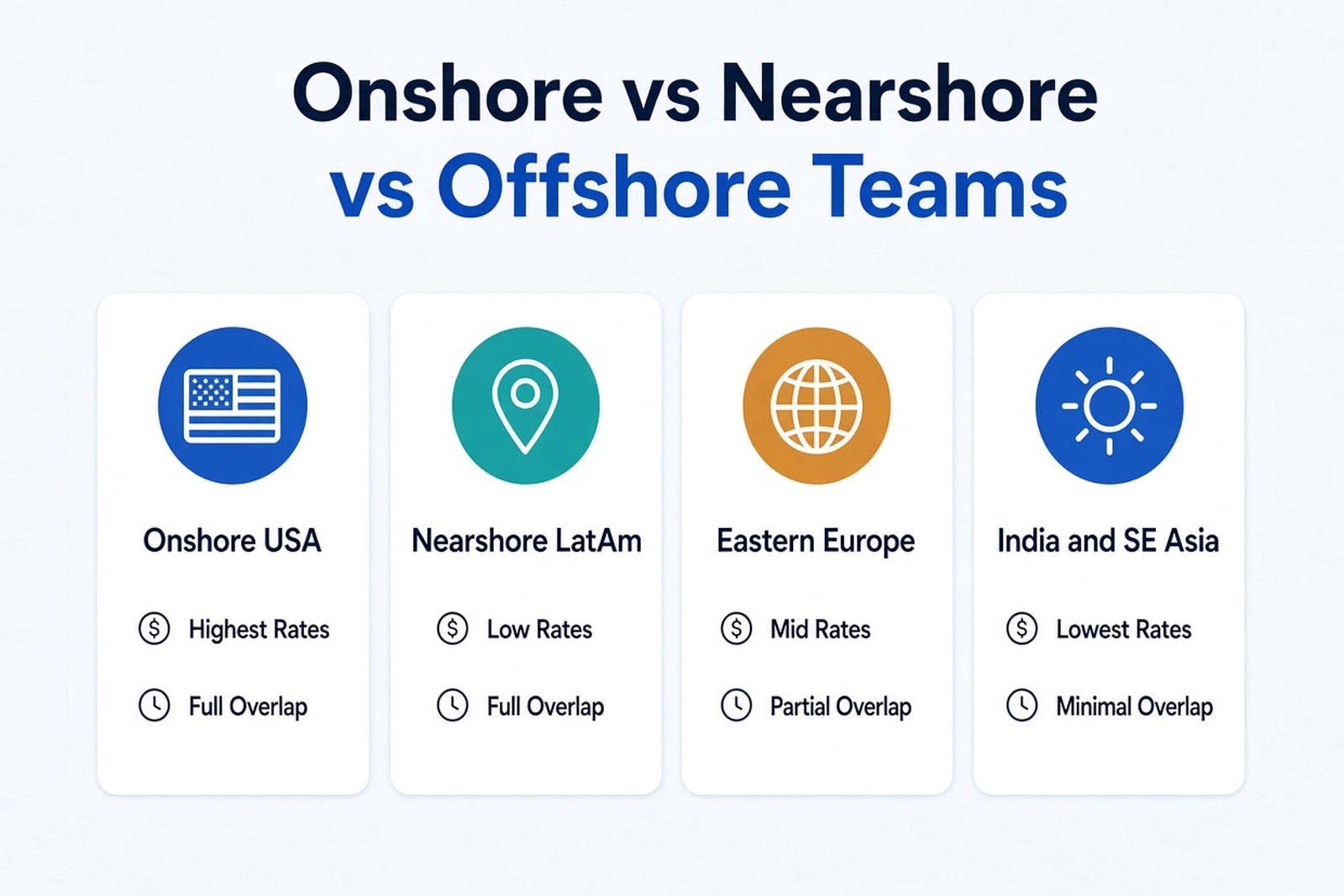
Overlap figures are examples for teams working standard local hours; many vendors shift schedules to extend them. Warsaw is usually six hours ahead of New York, but the gap changes for a few weeks each year because Europe and the US switch to daylight saving time on different dates. We show Eastern Europe separately from other offshore regions because its rates and time-zone overlap differ from Asian delivery centers. Not every Eastern European country is in the EU; teams in EU member states such as Poland work under GDPR.
Wherever the team sits, the contract decides who owns the code. Check which legal entity you sign with, the governing law, how and when IP transfers to you, whether the vendor uses subcontractors, and where disputes are resolved.
In our experience, offshore projects fail less often because of skill and more often because nobody wrote down what "done" means. If you pick a team far from your time zone, invest in specs, acceptance criteria and a weekly demo.
Engagement models in practice
Most companies end up using more than one model. A common setup is a dedicated team for the core product, plus staff augmentation when a release needs extra hands. Pick the model that fills the gap in your own team. If you have strong product managers but no engineers, a dedicated team model works well. If you have engineers but no architect, hire for that role specifically, and let your team keep ownership of the code.
Considering a Dedicated Team?
Softellar provides dedicated development teams and staff augmentation for US companies, with senior engineers who work only on your product and adjust their hours to your time zone.
How to Choose the Right Software Development Partner
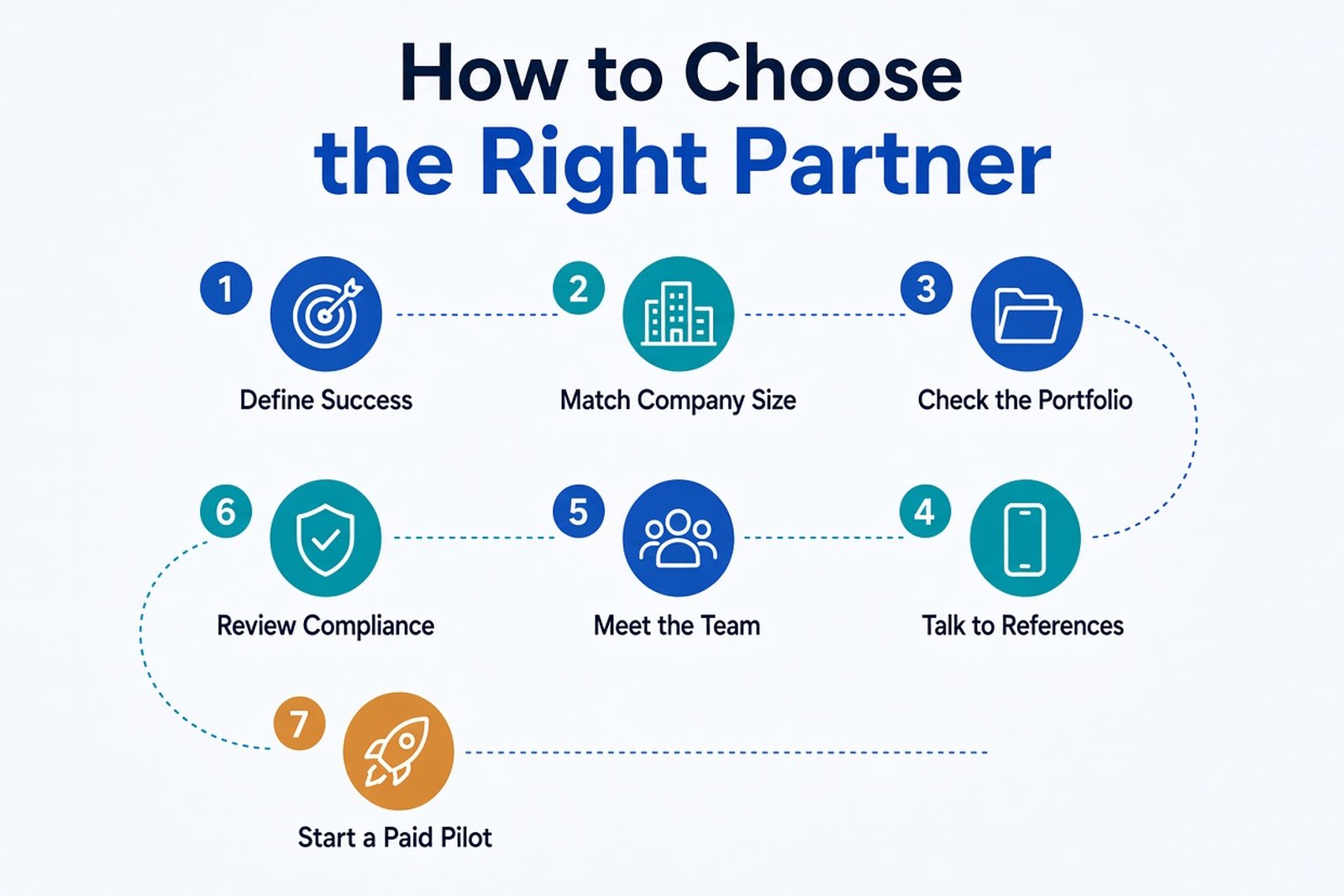
A long list of vendors is easy to find. Getting it down to two or three takes some homework, and these steps keep it manageable.
- Write down what success looks like. Before you talk to anyone, set two to four measurable goals: a launch date, a load target, a cost per transaction. Vendors can only quote well against something specific.
- Match the company size to your project. A $60,000 project is a big deal for a 40-person firm and a rounding error for a 300,000-person one. Whatever the vendor's size, check who will be assigned, how much time the lead engineer will spend on your project and how issues are escalated.
- Check the portfolio for similar work. Look for projects with a similar tech stack, industry and scale. A strong e-commerce portfolio says little about HIPAA-compliant software.
- Talk to references yourself. Ask for two clients with a project like yours, and ask them what went wrong and how the vendor handled it.
- Meet the actual team. The architect on the sales call is not always the architect on your project. Ask who will write the code and interview them.
- Review security and compliance. Ask for ISO 27001 or SOC 2 reports if you handle sensitive data. If your software handles protected health information, look for HIPAA experience and a vendor that will sign a BAA. If it stores or processes payment card data, PCI DSS applies.
- Start with a paid pilot. A two- to six-week discovery phase or small first release shows you how the team communicates, estimates and handles feedback before you commit the full budget.
Questions to ask on the first call
- Who owns the code and the intellectual property, and when does ownership transfer?
- How do you estimate, and what happens when an estimate is wrong?
- What does a normal week look like: stand-ups, demos, reports?
- How do you use AI coding tools, and who reviews AI-generated code?
- What is your developer turnover, and how do you replace someone mid-project?
- How do you hand the project over if we part ways?
Red flags
Be careful if a vendor quotes a fixed price after one call, can't name the engineers who'll work on your project, or avoids the question about code ownership. If rates look low for "senior" engineers, ask for CVs and interview the people who will be assigned. And a portfolio full of logos but no case studies with numbers is worth a second look.
Software Development Trends Shaping US Vendors in 2026
The US software market keeps growing fast. Grand View Research estimates it at $237 billion in 2024 and expects it to reach about $410 billion by 2030, growing 9.4% a year. Gartner's July 2026 forecast puts worldwide software spending at $1.47 trillion this year, up 15.5%. Here is what that growth looks like inside development teams.
AI writes more code, and somebody has to check it
In the 2025 Stack Overflow Developer Survey, 84% of developers said they use or plan to use AI tools. Only 2.7% of professional developers said they highly trust the output. Gartner expects 90% of enterprise software engineers to use AI code assistants by 2028. For buyers, the question has moved from "do you use AI?" to "how do you review what it writes, and who is accountable for it?"
Senior engineers stay expensive
The US Bureau of Labor Statistics puts the median software developer salary at $135,980 (May 2025) and projects 10% job growth through 2035. With US salaries at that level, many buyers compare the cost of hiring in-house with nearshore and Eastern European partners.
Demand for security specialists is growing
BLS projects employment of information security analysts to grow 21% between 2025 and 2035, about seven times the average for all jobs. In practice, more clients now ask for security reviews, SOC 2 evidence and data residency guarantees in the first sales call, especially in fintech and healthtech.
Legacy modernization is back on the budget
Many AI projects stall because the data sits in 20-year-old systems. Almost every firm on this list, from SPR to Thoughtworks, now sells modernization as the first step toward AI. Expect proposals that bundle data engineering, cloud migration and AI features into one roadmap.
Low-code for internal tools
Low-code platforms are now a normal choice for internal dashboards, approval flows and quick MVP validation. Good partners will tell you when a low-code tool is enough and custom development would be overkill.
Software Development Companies vs Software Product Companies
Some searches for "top software companies in the US" are really about the biggest tech companies, such as Microsoft, Apple, Alphabet, Oracle or Palantir. They primarily sell products and platforms rather than acting as general-purpose custom development partners. If you need a team to build software for your business, the 20 firms above are the relevant shortlist.
Final Thoughts
There is no single best software development company, only the best fit for your budget, timeline and existing team. Use the use-case table above to build a shortlist of two or three firms, then run a paid pilot before you commit.
If you need senior engineers for a custom software project between $10,000 and $500,000 and want to talk to the people who will actually build it, book a free consultation with Softellar. We'll review your scope and tell you honestly whether we're the right team, or who might be a better fit.
Sources
- Clutch: US software developers directory and pricing guide
- Grand View Research: US software market outlook
- Gartner: worldwide IT spending forecast, July 2026
- Gartner: top trends in software engineering, 2025
- Stack Overflow Developer Survey 2025: AI
- US BLS: software developers and information security analysts
- IBISWorld: US software publishing businesses
- Company annual reports and press releases: EPAM, Cognizant, Infosys, TCS, HCLTech, Wipro, Persistent, Zensar
- Clutch profiles: Softellar, Atomic Object, TXI, MojoTech, SEP, SPR, 8th Light
- Persistent: takeover offer for Nagarro successful (September 2026)
- TechReviewer: Softellar profile and client reviews
- Softellar case studies


