
Overview
Today, more than ever, modern businesses are presented with a multitude of options when looking to outsource software development projects. There is the extended team, which affords short-term collaboration and temporary adjustment to in-house staff; the freelancer route, which is cheaper but mainly used for one-time assignments; and then there is the dedicated team, which is where our lens is focused today.
Dedicated development teams are all about dedication and commitment- a commitment to you, your organization, and your aspirations for software creation. In this model of outsourcing software projects, the team provider takes into account everything you need to develop your software or application and provides them accordingly without you having to lift a finger.
These provisions range from professionals in varied IT disciplines to development infrastructure and testing frameworks. Because of this, the dedicated team model remains favored by IT companies who possess little resources and expertise but would like to outsource software development without too much oversight.
Why Is the Dedicated Team Model Best Suited for Outsourced Projects?
One of the reasons we can point to why dedicated teams outsourcing sounds like a great call to most firms is that it is a comprehensive solution that addresses multiple strategic features of outsourced projects at the same time.
Unlike traditional outsourcing models like team augmentation or freelance services, where developers work on a temporary basis and sometimes with little background information, developers working under the dedicated team engagement model get to have a full picture of what the project is all about because they are involved from the very beginning. The team is assembled to focus on a single product's development, from its ideation stages to the deployment and after-launch maintenance.
Dedicated software development teams continue to thrive in the face of shifting requirements, fixed timelines, and high technical proficiency needed on outsourced projects because they are exclusive and pull all the stops to ensure client projects remain on track even when unexpected challenges or last-minute changes occur.
The dedicated development team model excels in particular kinds of projects and tasks. Dedicated teams show consistent commitment and adaptability to changing project scopes for long-term development projects, including building and maintaining sophisticated software or digital platforms. Their fit with the customer's procedures guarantees a flawless flow even when priorities change.
Projects with uncertain requirements can gain much from this approach. Launching a startup or developing a product in a fast-changing market depends on the flexibility of a committed team that makes iterative development and response to new needs possible. In such situations, their capacity to change with feedback and modify their approach is priceless.
The dedicated development team model provides unmatched benefits for complex technological solutions where specialized knowledge and advanced abilities are most valued. Customers can leverage a pool of specialist experts catered to the particular needs of their project: programmers (DevOps, React Native and so on), UX designers, data analysts, project managers, and so on. This availability of skill guarantees creative ideas free from the overhead of internal staff employment.
Dedicated teams close the gap between vision and execution by matching their experience with the particular needs of outsourced projects, therefore producing outcomes that other models sometimes find difficult. For this reason, they are a great help to companies negotiating the complexity of contemporary project development.
Why Should You Choose the Dedicated Team Model for Outsourcing
What makes the dedicated development team model the right choice for forward-thinking organizations goes beyond its flexibility for project management or opportunities for long-term engagement. These teams transform how businesses approach software and web development by offering a method of project development that is devoid of operational gaps and tailored to specific client goals. But it doesn't stop there; here are four more reasons why you might want to pick an outsourcing dedicated team for your next project.

Focus On Precision
When a dedicated team is on your project, the distractions disappear. They integrate deeply to understand your goals and challenges pertaining to the nuances of your industry. They don't multitask between a dozen different clients but put their singular focus on your vision, maintaining precision and consistency throughout.
Built-in Flexibility
Outsourcing requires flexibility, and here's where the power of a dedicated team model steps in. Need to ramp up your team mid-project? Want to change the scope of work upon new insights? Teams are ready to evolve together with your project and pivot to accommodate new instructions without losing momentum for your project.
Cost-Saving Expertise
Cost efficiency is not about compromises; it is about value maximization. Having access to worldwide talent, dedicated teams offer elite expertise for a fraction of the cost of maintaining an in-house team. It's about achieving the best value for every dollar spent, not spending less.
Deep Integration
Dedicated teams are much more than a third-party partner. Every developer on the team gets deep into your business culture and ingrains themselves into your project like they were your very own employees. The level of integration can breed trust, iron out workflows, and bridge any gap between vision and execution.
Ready to Explore Dedicated Team Solutions?
Discover how dedicated teams can transform your outsourcing strategy. Our experts can help you evaluate whether this model fits your project requirements and guide you through the implementation process.
How Dedicated Teams Enhance Collaboration in Outsourcing
Earlier in this piece, we talked about how companies prefer dedicated teams because they can deliver impressive outcomes without being supervised constantly. Yet this ability to work with little oversight and deliver doesn't make the dedicated team model structure any less cooperative than other outsourcing means. In fact, upon closer scrutiny (as we are about to uncover), you might find that outsourcing software development to dedicated teams gives you more chances for collaboration. These are the aspects of the dedicated team approach that strengthen collaboration between you and your dedicated software development team.

A Unified Vision Based on Mutual Understanding
The cornerstone of any successful collaboration is alignment, which dedicated teams cultivate by taking the time to understand the client's goals and values. This common vision bridges any gaps, allowing the team to approach each task with both clarity and intention. With regular discussion and feedback loops, you and your team stay in sync, minimizing miscommunication and maximizing productivity.
Transparent Workflows
Collaboration works best when all are on the same wavelength, and with dedicated teams, advance collaboration tools make it effortless. Real-time task tracking, centralized documentation, and fluid communication platforms ensure that everyone in the loop has an actual perspective of where things stand. This kind of transparency gives birth to trust and further empowers each individual involved in making a difference to deliver the project's successful outcomes.
A Culture Embracing Inclusivity and Open Dialogue
Dedicated teams are not just service providers; they are collaborators deeply embedded in the client's ecosystem. By adopting the client's workflows and fostering inclusivity, they bridge gaps that often arise in outsourced arrangements. Open communication channels encourage team members to share ideas freely, driving innovation and preventing bottlenecks.
Adaptability Through Versatile Collaboration Frameworks
Collaboration is not static; neither are dedicated teams. Dedicated team providers offer different engagement models, so they can adapt to the unique requirements of any project. All this adaptability means the team can evolve with the project to accommodate changes in the scope or strategy without disruptions in the partnership.
When to Choose the Dedicated Team Model for Outsourcing
For many business leaders and managers, the decision to choose developers outsourcing dedicated team services over those who work on short-term projects is often driven by the need for customized solutions and long-term partnerships. The dedicated team model satisfies these criteria well, but when exactly is it the right choice for your project?
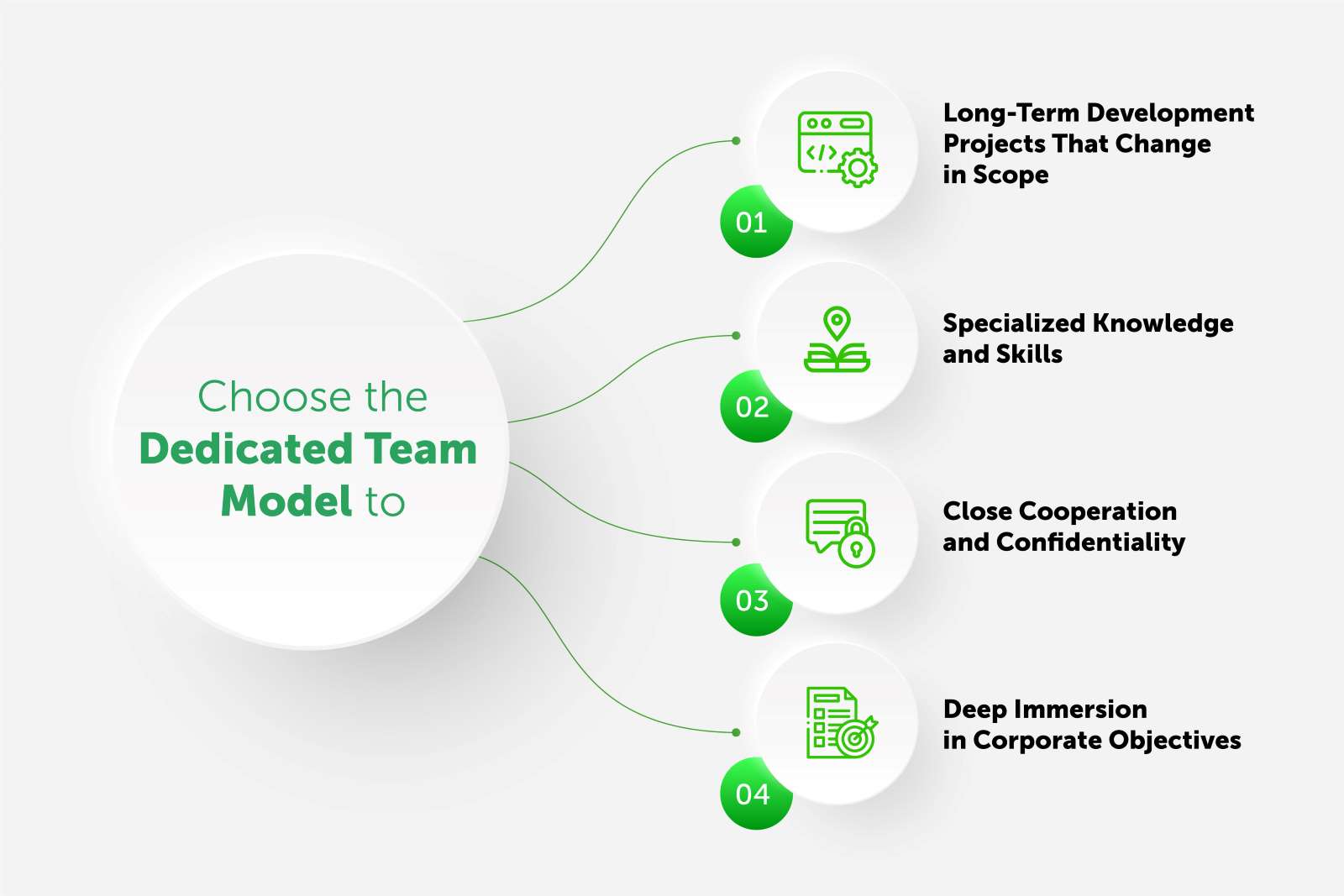
Long-Term Development Projects That Change in Scope
If one has a large initiative in software development that requires constant updating, iteration, and maintenance, it is better to have a dedicated development team. By doing so, a stable team of professionals can work on the project throughout its life cycle, and their understanding of the product and its changing needs improves.
Intricate Projects Necessitating Specialized Knowledge and Skills
Certain software projects are of such complexity that their realization in an organization could require human resources with experience in state-of-the-art technologies or even in obscure programming languages or frameworks. Under such conditions, it becomes indispensable to put together a dedicated development team of experts able to promptly address challenges and design solutions to the barriers the development process could come up against.
Projects That Require Close Cooperation and Confidentiality
When working on a project that warrants the utmost security, you might want the details regarding your software development project out of the prying public. The effectiveness of a dedicated team for such a project can be attributed to the team structure, which facilitates direct communication between stakeholders and developers, enabling clients to convey their vision, obtain updates on the project's progress, and make real-time adjustments as necessary.
Projects Needing Deep Immersion in Corporate Objectives
If a project calls for a comprehensive awareness of the goals and vision of your business, a dedicated team is the best possible fit. These unit operate as an extension of your company, matching their development approaches to your more general vision. Their full-time attention guarantees the subtleties of your objectives are incorporated into every deliverable, therefore promoting consistency and excellence.
Potential Challenges of Outsourcing with Dedicated Teams
Every model of outsourcing has its upsides and downsides and the dedicated team model is an exception. For all the benefits it provides, it also presents some potential pitfalls you need to consider before finalizing your decision.

Navigating Leadership Gaps
The success of a dedicated team depends on a well-defined direction. For customers not familiar with running remote teams, this can prove difficult. Even the most capable teams run the danger of veering off course without a strong project manager or defined duties. The fix here is this: define your hierarchy so you know who to hold accountable for what, designate a specific liaison so you can remain in touch with the latest project developments, and monitor progress by using project management tools.
Coordinating Over Time Zones
Time zone variances can cause communication breakdowns and slow down response times and the decision-making process. Although a global workforce is advantageous in many respects, its management calls for intentional planning. Asynchronous platforms like Loom or Slack, staggered meetings, and overlapping work hours help to close the temporal gap.
Maintaining Cultural Cohesion
Diverse teams sometimes bring different work methods and communication styles. Inaccurate expectations might cause misunderstandings or ineffective behavior. By establishing clear criteria and funding team-building activities, you can create a common sense of purpose that helps to build cohesiveness.
Balancing Costs and Commitment
Although cost-effectiveness is an important value sought by most development companies, underestimating budgetary requirements can complicate engagements. Dedicated teams need tools, training, and continuous support, among other things, to thrive. Therefore, scope the project thoroughly before you begin and note the financial cost to avoid surprises down the line.
Adapting the Dedicated Team Model to Fit Specific Client Needs
Clear demarcation of tasks and responsibilities between the client and the dedicated team provider is important to maximize the possibilities of the dedicated team model:
The Client's Role:
- Specifies project criteria and scope
- Tracks benchmark and gauges team performance
- Facilitates access to tools, environments, and systems
- Guarantees channels of open communication and teamwork
- Introduces corporate culture to guarantee harmony
The Team Provider's Role:
- Bring in competent experts to satisfy project requirements
- Oversees daily activities and team administration
- Handles employee benefits and compensation
- Supplies workspace and IT systems, among other things
- Provides consistent support for the success of projects
Working together with well-defined tasks helps clients and contractors guarantee flawless cooperation, customized project execution, and the best results from the dedicated team model.
Conclusion
All things considered, the dedicated software development team model is unique as a strategic solution for companies trying to keep ahead of the curve in the technologically advanced environment of today. By using specialized knowledge, flexibility, and scalability, these teams enable businesses to address challenging projects, guarantee continuous progress, and hasten speed-to-market. Success using this approach, however, depends on choosing the correct team and partner to guarantee alignment with project goals. When considered carefully, this model provides a spur for creativity and long-term expansion in an always-changing digital terrain.