


Overview
One of the better points of the modern workplace that the COVID-19 pandemic highlighted was the viability of remote work. But even before 2020, IT firms were early adopters of the remote concept. Remote staff augmentation had been in use for several years in the software development landscape before remote work became a staple in modern industries.
The paradox that software development is both an individualistic and collaborative endeavor drives the widespread adoption of this work model in tech circles. While individual developers may appreciate the freedom to design, write, and debug code from the comfort of their homes, in a professional setting they would need to homogenize this code with that of other developers using continuous integration and agile methodologies.
For IT development firms, remote staffing presents a unique opportunity to assemble a multidisciplinary team of developers consisting of the best qualified talent from across the world. When coupled with the fact that these remote teams are contracted temporarily and without the need for long-term financial commitment, it is obvious why this is such an appealing prospect for tech firms.
In this in-depth guide, we explore remote staff augmentation, its various types and benefits, and why it is important for IT teams. We also take a look at the different stages of the remote augmentation process and what the future holds for this staffing approach. For a broader context on models beyond remote teams, check our IT staff augmentation guide.
What Is Remote Staff Augmentation?
Remote staff augmentation is a staffing strategy used by IT enterprises to recruit external talent from remote locations for the purpose of bolstering existing team capabilities. This augmentation model enables IT firms to address project-specific requirements by going beyond geographical borders to source skilled professionals from a global talent pool.
You can also use IT staff augmentation on-premises; therefore, the term "remote" is crucial when describing this employment model, as it signifies the spatial proximity of augmented staff. Remote staff typically work from different locations around the world using sophisticated project management tools to collaborate with each other and the client's internal teams.
Why Is Remote Staff Augmentation Important?
As the IT business landscape continues to evolve, organizations worldwide are increasingly gravitating towards remote resource augmentation. The reasons for this are not far-fetched; remote employees are easier and cheaper to manage. However, the motives that contribute to the growing importance of this model extend beyond cost and ease of maintenance. They include:
Faster Time-To-Market
Remote staffing services give businesses an avenue through which they can accelerate their project timelines and reduce time to market for their digital products and services. When faced with workload surges that threaten the timely achievement of project milestones, project teams can quickly enlist the expertise of remote specialists without going through time-consuming vetting processes.
Risk Mitigation
IT teams can safeguard against risks that are inherent in software development by using remote team members positioned in scattered locations around the globe. That way, if scenarios like hardware complications, data security threats, or natural disasters that threaten project progress occur on one end, it won't collapse the entire operation.
Access To Global Talent
Finding highly skilled software professionals locally can sometimes be a daunting endeavor. For a tech company, this can result in delayed service delivery and, ultimately, customer dissatisfaction. Remote augmentation providers assuage this concern by providing access to a global pool of software talent, enabling companies to recruit specialized skills that are unavailable in their immediate vicinity from other territories.
Budget Optimization
The software product and service industry is a competitive one. As a result, tech companies are constantly on the lookout for alternative means of optimizing costs. Remote team augmentation, being more cost-effective than other employment and outsourcing models, offers this alternative without compromising the quality of personnel or output.
Benefits of Remote Staff Augmentation
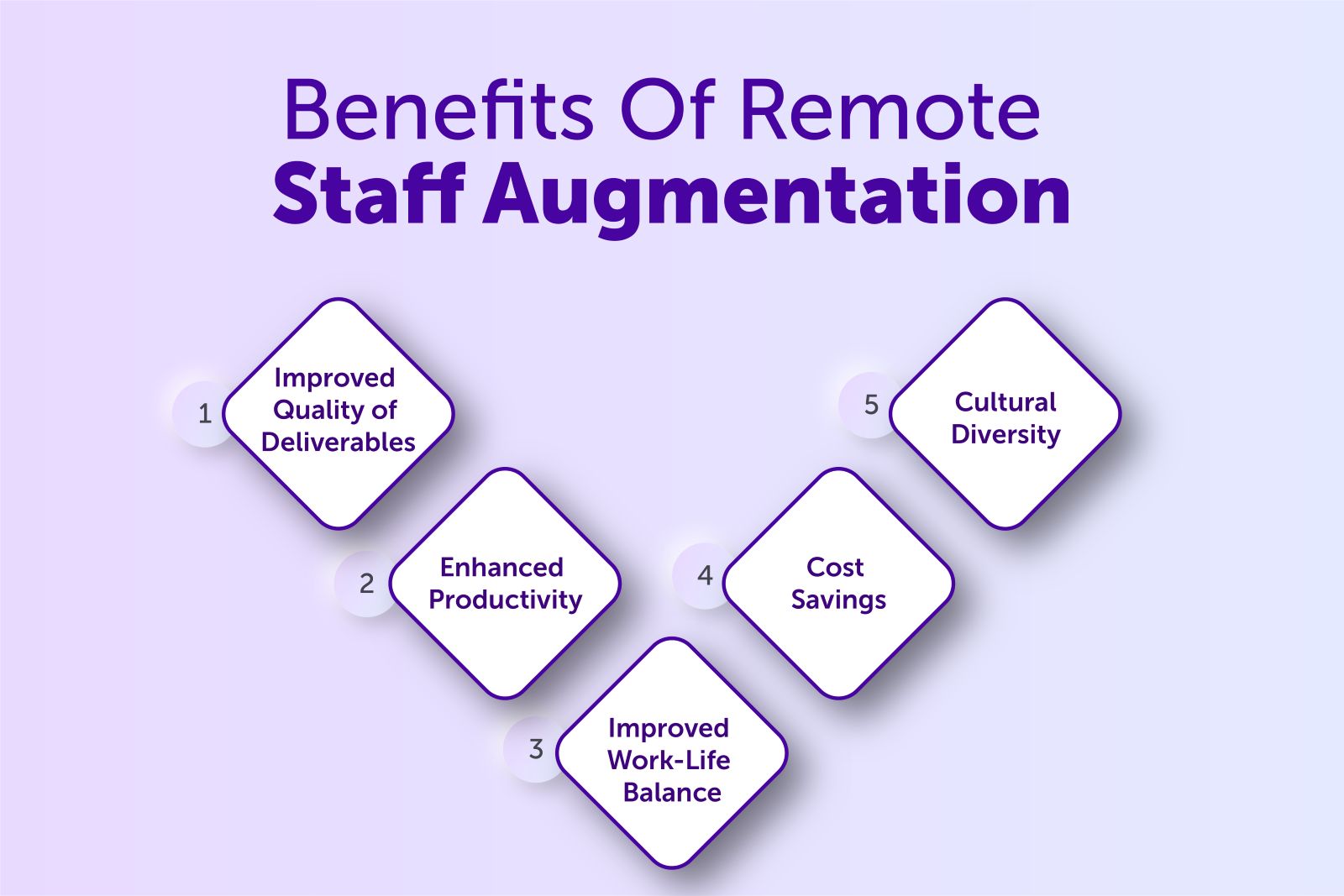
Improved Quality Of Deliverables
Because remote augmentation gives companies access to multiple talent options from the global market, IT teams can be more specific about the caliber of expertise they need. If premium talent isn't available on the local scene, augmentation agencies can go beyond borders to find them. This assemblage of skilled experts who are conversant in the latest tools and technologies often results in the delivery of higher-quality codes and designs.
Enhanced Productivity
Working around the clock isn't always an achievable feat for every IT company. However, with remote group augmentation, a company can hire staff working in different time zones, essentially allowing it to operate beyond regular work hours. This continuous operation minimizes the need for rework, thereby maximizing employee productivity.
Improved Work-Life Balance
For the stay-at-home developer, remote engagements can lead to increased job satisfaction by providing a perfect work-life balance. This job satisfaction often translates into having employees who are more committed and engaged with their roles on a project.
Cultural Diversity
When a staffing partner assembles remote team members, their cultural realities influence their unique perspectives on problem-solving and decision-making. These blends of diverse influences often lead to ideas and innovative solutions that a more homogeneous team might not consider.
Cost Savings
Remote staffing solutions can help companies save money on staff augmentation costs if the augmented hires are sourced from lower-income regions. Also, because augmented remote teams work from the comfort of their own space, IT organizations can save overhead on physical facilities and equipment.
Need Remote Talent?
Scale your team quickly with our remote staff augmentation services.
Types of Remote Staff Augmentation
When implementing a remote augmentation model, companies have numerous options to choose from, depending on their means and budget. We explore some of these here.
Project-Based Remote Augmentation
The project-based outsourcing model is designed for companies needing additional staff to help on projects with a defined scope and timeline. In this scenario, the staffing provider hires remote professionals under contract for only the duration of a project, and their contribution is halted upon the expiration of the contract.
Remote Offshore Development
This is a type of remote engagement in which a company establishes an offshore location in a foreign region and assembles remote teams to work from there in collaboration with the in-house staff. This is akin to a business setting up a functioning operational branch in an offshore location, with the major difference being that the "branch" in this context is managed by a staffing service.
Time-Based Remote Augmentation
As the name suggests, time-based remote augmentation has everything to do with time. There comes a period on a software development project when workload surges may necessitate staff reinforcement for only a short duration (hours or days). The time-based model compensates staff hired for this periodic engagement based on the work hours they put in and nothing more.
Skill-Based Remote Augmentation
We can argue that all types of augmentation, whether remote or otherwise, are skill-based. However, skill-based remote augmentation stands out because it exclusively focuses on sourcing personnel from remote areas with expertise in niche development disciplines such as robotics, machine learning, or artificial intelligence. Because these skills are in high demand and usually scarce on the local market, finding specialists who are adept at them can take tremendous time and processes.
Steps of a Remote Staff Augmentation Process
When IT firms approach augmentation providers for remote staffing solutions to facilitate in-house team expansion, a lot of the administrative responsibilities involved with the process, like conducting interviews and reviewing CVS, fall on the augmentation provider. Augmentation firms go through meticulous steps to ensure they don't get it wrong in fulfilling these duties.

Step 1: Assessing Project Requirements
Before commencement of a remote IT staff augmentation project, an augmentation provider would typically consult with the client's in-house managers to assess the project and identify skill gaps that need reinforcements. This helps the service provider ascertain the range of tech disciplines it would take to actualize the project's objectives, be it dedicated automation testing or Java development and so on.
Step 2: Finding The Right Talent
To find the most suitable software specialist, the resource augmentation provider leverages their extensive network to compile a list of candidates for interview. After interviewing these professionals and running all necessary background checks, the staffing firm then submits the candidates to the client for further in-house assessment.
Step 3: Talent Onboarding
If the development team is satisfied with the professionals that the augmentation provider recommends, the provider goes on to initiate the onboarding process. This is where the new hires are given a rundown of the company's culture, project workflows, and milestones expected of them. Depending on the structure of the organization, this onboarding phase can be handled by the client's internal project managers or the staffing agency. Effective onboarding is critical to creating a harmonious workforce. Without it, the distance between internal and remote teams and the communication challenges that accompany it can have remarked impact on project outcomes.
Step 4: Maintaining Continuous Support
After the onboarding phase, the staffing provider continues their duties by providing the new remote teams with ongoing support for the project's duration. This support may involve providing extra training, performance monitoring, issues resolution strategies, or physical resources the augmented staff may need through the course of the project. An astute augmentation provider will also put in place communication tools to facilitate effective and efficient cooperation between remote and in-house teams.
What Is the Future of Remote Staff Augmentation?
The future outlook for remote staff augmentation looks particularly promising for companies in the infotech space. In 2023, experts projected the remote staff augmentation market would grow by 11% between 2023 and 2028. This strong upward trajectory for the industry is largely driven by the benefits offered by remote teams, including scalable operations and cost-efficient staffing, and it doesn't look like slowing down anytime soon. As IT firms and enterprises in other industries continue to embrace the idea of remote work and discuss staff augmentation vs. managed services advantages, the remote staff augmentation sector is only bound to grow in revenue and cultural significance.
Conclusion
By all indications, the remote augmentation model has come to stay, cementing its place among various employment models used in tech environments. This augmentation model's accessibility and ease of scalability make it an ideal choice for companies implementing agile methodologies. For the technicians working remotely, this staffing model allows them to balance work and personal life in a way traditional employment structures do not necessarily prioritize. These spectral benefits, coupled with the cost-effectiveness of the remote option, make it a business strategy poised to increase in popularity in the near future.


