Overview
One of the more significant problems contemporary firms encounter is fluctuating staffing requirements that come about due to seasonal business demands, workload spikes, business expansion, or a need to fill roles that are short-staffed in-house. This challenge is not limited to only the small and medium enterprises but also multinational corporations.
Depending on the undertaking being pursued, these companies employ one of two strategies: staff augmentation or outsourcing. Both approaches to reinforcing existing team offer great resource management value to companies, but their models of engagement vary significantly. Hence, it is essential to be informed enough to discern the difference between the two.
In this article, we explore staff augmentation vs IT outsourcing, considering their various types, benefits, differences, and determinants to access when deliberating on the ultimate choice for your IT team.
What Is Staff Augmentation?
Staff augmentation is a business strategy software development teams use to supplement in-house talent with external expertise on a temporary or per-project basis.
Staff augmentation services are facilitated by specialized third-party staffing agencies known as augmentation vendors. Augmentation agencies are responsible for interviewing candidates that fit the job description, employing the most experienced, and orienting them on the client company's project development ambitions.
They also take on the administrative duties of managing a project's workforce, such as paying salaries and benefits, conducting performance reviews, maintaining project timelines, and supplying resources like hardware, office space, and network infrastructure.
Companies that employ this business model gain access to specialized technical expertise that allows them to meet development needs as they arise and at a fraction of the cost it would take if they were to hire these professionals full-time. It offers an effective temporal solution to a temporal IT problem.
Staff augmentation vendors such as Softellar provide technical staffing services in various IT disciplines, including software development (React Native, .NET, etc), DevOps services, cybersecurity, cloud computing, data analytics, data migration, and project management.
Types of Staff Augmentation
Staff augmentation models can be classified under distinct umbrellas depending on how you look at them. The fundamentals of these IT services are the same (i.e., predetermined service contracts for transient projects). However, they exhibit some characteristics between them that set them apart.
Traditional Staff Augmentation Services
In this employment model, companies developing new software or facing workload spikes approach staff augmentation vendors to help procure skilled professionals for specific tasks on a software development project. The staffing agency considers the project timeline and other essentials to assemble the right group of developers for the project. The client then puts the team through further internal processes and appoints a project manager to ensure the smooth integration of new hires. It is ideal for deadline-focused projects, where the client company demands more hands-on, direct control of the development process.
Dedicated Team Augmentation
The dedicated team augmentation model offers a more comprehensive augmentation service where the service provider assembles a software development team on behalf of a company to build new projects from the ground up or help in specific departments of a development pipeline.
In this case, the third-party provider assumes project management responsibilities like ensuring the coherence and timeliness of deliverables. Based on the nature of the task and the product being developed, the employing company may opt for the augmented staff to work together as remote teams or in collaboration with internal team on-site.
Benefits of Staff Augmentation
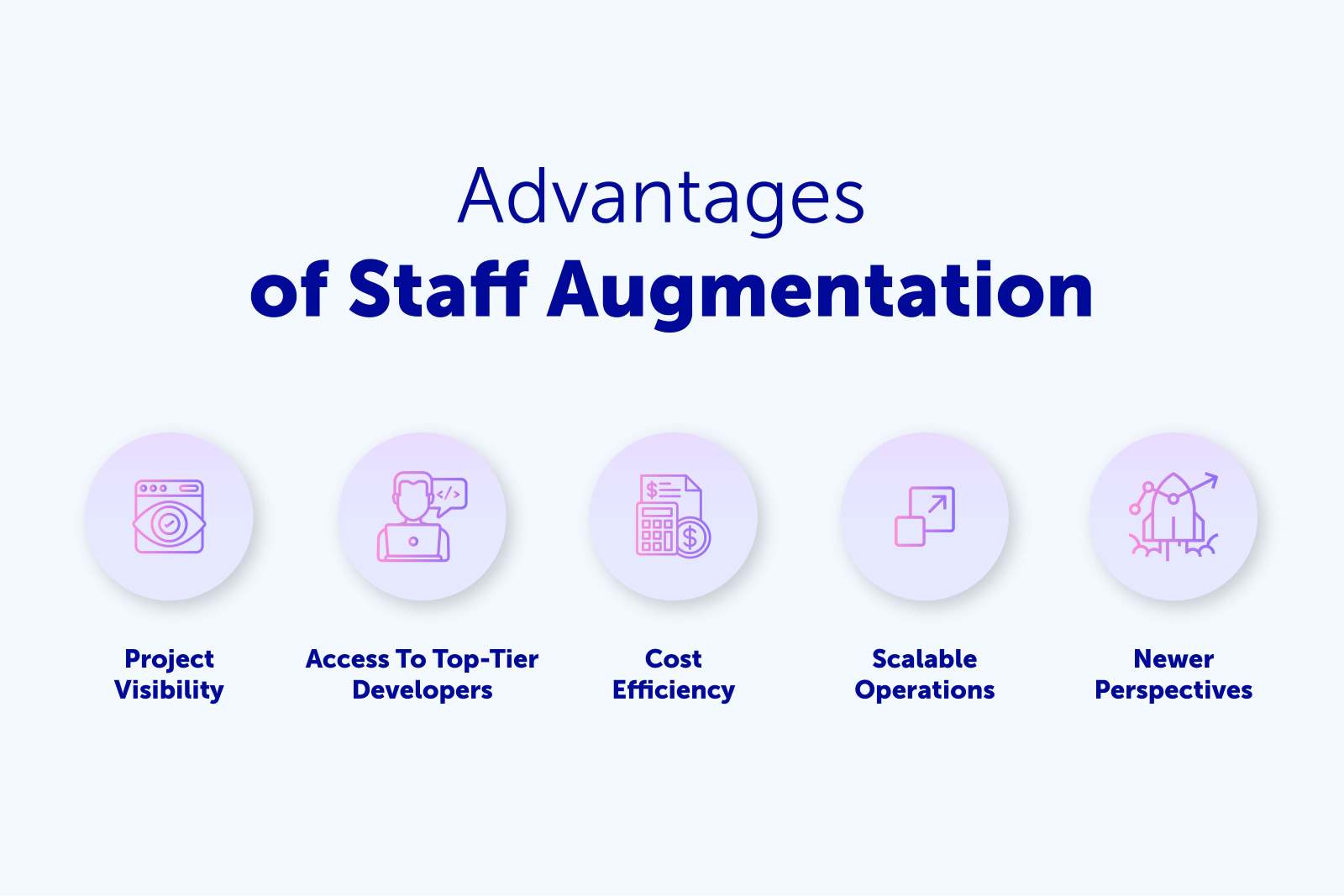
Project Visibility
One of the consequences of delegating internal IT projects to newly hired staff is that it can get easy to lose focus of project objectives, especially when the staff is not adequately oriented on project requirements before development commences.
Staff augmentation assuages this concern by ensuring project goals stay within sight of the entire team. Because augmentation providers are responsible for hiring and integrating new team members, they can better acquaint them with the culture and vision of the development company.
Access To Top-Tier Developers
Using the staff augmentation model of employment, enterprises of all sizes can secure the best tech talent to work on their IT projects. This quick access to top talent is especially important on software development projects where the client may require immediate input from recruits to keep up with project timelines. The augmentation provider makes the screening process hassle-free, and the local team can work freely, knowing capable hands are on the ground to contribute.
Cost Efficiency
Thanks to staff augmentation, companies working on development projects no longer have to worry about the exorbitant cost of hiring full-time employees. By providing access to first-rate talent without the recurring overhead cost of staff administration, augmentation vendors help enterprises limit operational costs so they can redirect resources to other pertinent business needs.
Scalable Operations
One of the reasons why project managers favor the augmentation model is its flexibility. For most companies, technical staffing requirements fluctuate based on a project's scale or development phase. As such, staff augmentation becomes an attractive option for IT projects because of the freedom it allows companies to scale the number of workers they need based on workflow demands.
Newer Perspectives
When in-house teams collaborate with augmented professionals on selected tasks, one team's experience tends to rub off on the other. Due to the varied experience gathered by working across industries, augmented staff coming onto a development team are better poised to take an out-of-the-box approach to solving problems that arise during development. They can suggest areas where the product can be better improved or faster ways of achieving deliverables.
Need Help Choosing the Right Model?
Struggling to decide between staff augmentation and outsourcing? Our experts will analyze your project requirements and help you choose the optimal approach for your team and business objectives.
What Is Outsourcing?
Outsourcing or project outsourcing is an IT employment model that involves handing over the execution of certain IT functions to a third-party outsourcing company in accordance with predetermined service agreements.
Ostensibly, staff augmentation and project-based outsourcing may seem the same, but the main difference between the two types of outsourcing services is the following: While an augmentation company furnishes clients with specific augmented staff to fill talent gaps for the period of a project, a project outsourcing company provides infotech enterprises with comprehensive solutions that cover every aspect of a particular project or development process from start to finish. Explore how augmentation works in detail in this IT staff augmentation guide.
In a project outsourcing model, the outsourcing agency is tasked with recruiting, training, and managing a team of professionals who work separately from the client organization but remain wholly devoted to promptly fulfilling the client's project requirements. By delegating an entire project to an outsourcing vendor, companies can leverage the skill of an external team while relieving their in-house teams to focus on core business projects.
Types of Outsourcing
Software Development Outsourcing
Software outsourcing is an outsourcing model used by enterprises looking to develop software applications. These companies hand over responsibilities such as assembling an outsourced development team to vendors, who then structure a project timeline for app development, performance testing, automation, and deployment, as well as a support system for ongoing maintenance for the application.
Infrastructure Management Outsourcing
Critical IT infrastructure such as servers, storage, networks, and hardware components of cloud infrastructures often require ongoing maintenance to ensure continued efficiency. Infrastructure management outsourcing facilitates this maintenance without hassle to the client company by assigning the task to technicians with singular expertise in infrastructure management.
Cybersecurity Outsourcing
Here, cybersecurity services such as threat detection and response, vulnerability assessment, and security monitoring are contracted to a third party whose job is to ensure enterprise and project security remains robust in the face of cyber attacks.
Managed Services
This outsourcing method entails delegating IT projects to an external contractor known as a managed services provider (MSP). This is the de facto outsourcing model Big Tech uses for many reasons.
Managed service providers offer holistic services that cover a range of IT functions, from quality assurance to data analytics, as well as the three outsourcing types mentioned earlier. They typically work independently and design a project's execution following the service level contract agreed by the client company.
NB: Depending on where outsourced teams are procured, outsourcing can be classified as onshore, nearshore, or offshore. Onshore outsourcing secures talents within the same country, while nearshore outsourcing connotes sourcing expertise from neighboring countries. In offshore outsourcing, however, technical skills are employed from far-off countries, often with cheaper labor costs.
Advantages Of Outsourcing
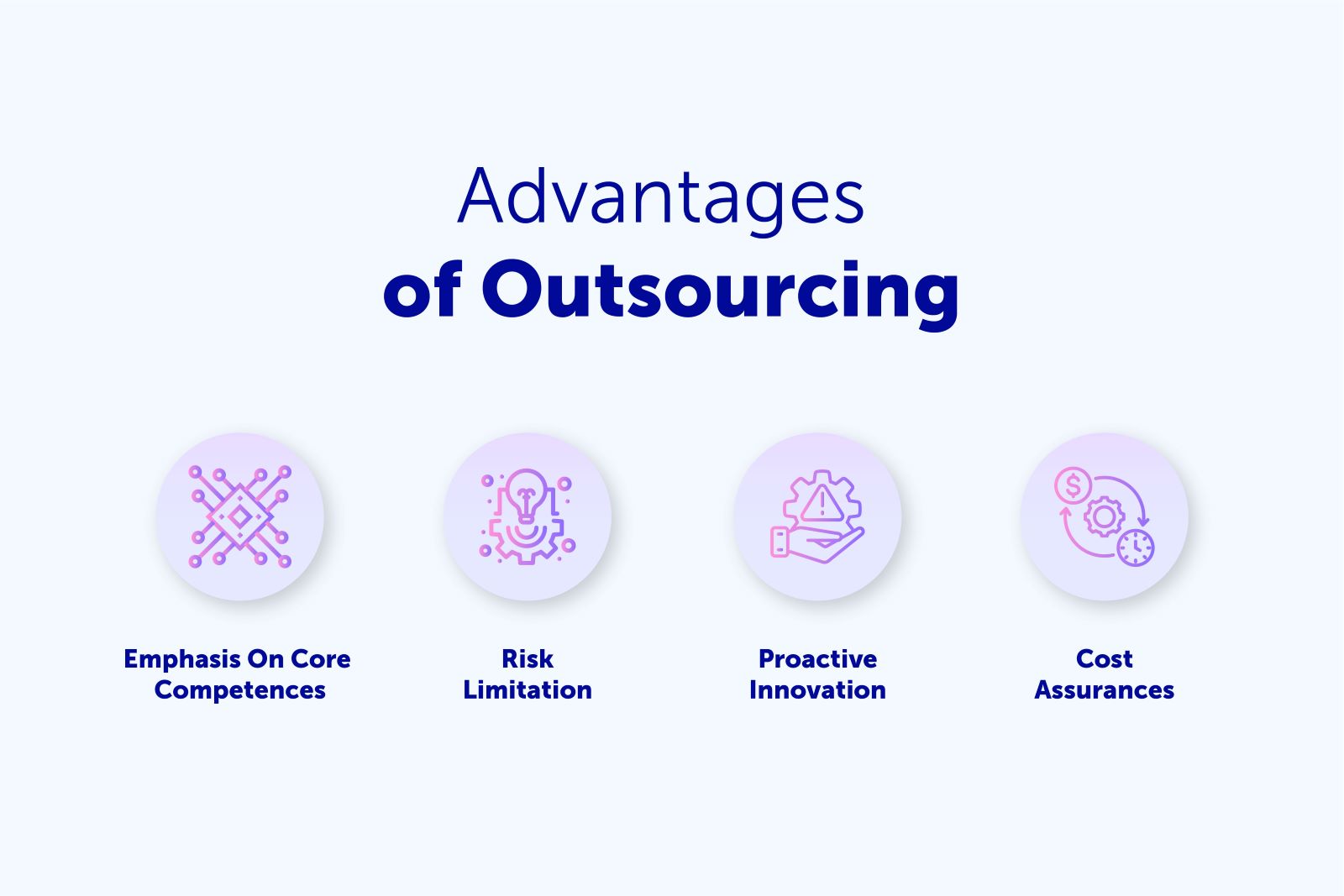
Emphasis On Core Competences
For many companies, IT operations such as software development, infrastructure management, and security maintenance are not a core part of everyday business operations. The outsourcing model helps relinquish this task to third-party providers, thereby allowing IT-dependent enterprises to focus their human resources on areas where they are most competent, be it product design, marketing, or business expansion.
Risk Limitation
Outsourced projects help firms mitigate certain risks that come with staffing in-house, such as skill deficits, employee turnover, personnel budgets, and compliance issues. These provisions are typically guaranteed in the service level agreements (SLA) entered into with outsourced teams.
Proactive Innovation
Another major upside that outsourcing providers present to companies is their enterprising approach to adopting new technologies. The operations of outsourcing providers run independently of any organization; therefore, they are able to integrate newer cutting-edge technologies into existing infrastructure and management processes without encountering administrative bottlenecks that in-house programmers and developers usually face.
Cost Assurances
When you hire an outsourcing company, bar your recurring subscription fees, you don't have to worry about customer or market shifts that lead to increasing project costs. The amount to be paid for the duration of the project, however long, is already discussed in the service level agreement. This can help businesses better budget financial resources.
Staff Augmentation vs Outsourcing: Knowing The Difference
In dictionary terms, any practice that involves subcontracting a project to a third party can be considered outsourcing, even staff augmentation. This is why the distinction between both models tends to get lost in translation when used in colloquial language. Yet, as this article highlights, they're different.
To make the distinction even more obvious, let's consider staff augmentation vs outsourcing based on their costs, flexibility, project responsibilities, and training demands.
Cost
The inherent structure of project-based outsourcing makes it considerably more expensive than staff augmentation. Still, it is noteworthy that outsourcing demands longer commitment on the part of the provider than staff augmentation.
Both models can be cost-effective in the right situations, but to get true value for your organization's outlay, you need to consider your project duration, staffing, and project requirements.
Flexibility
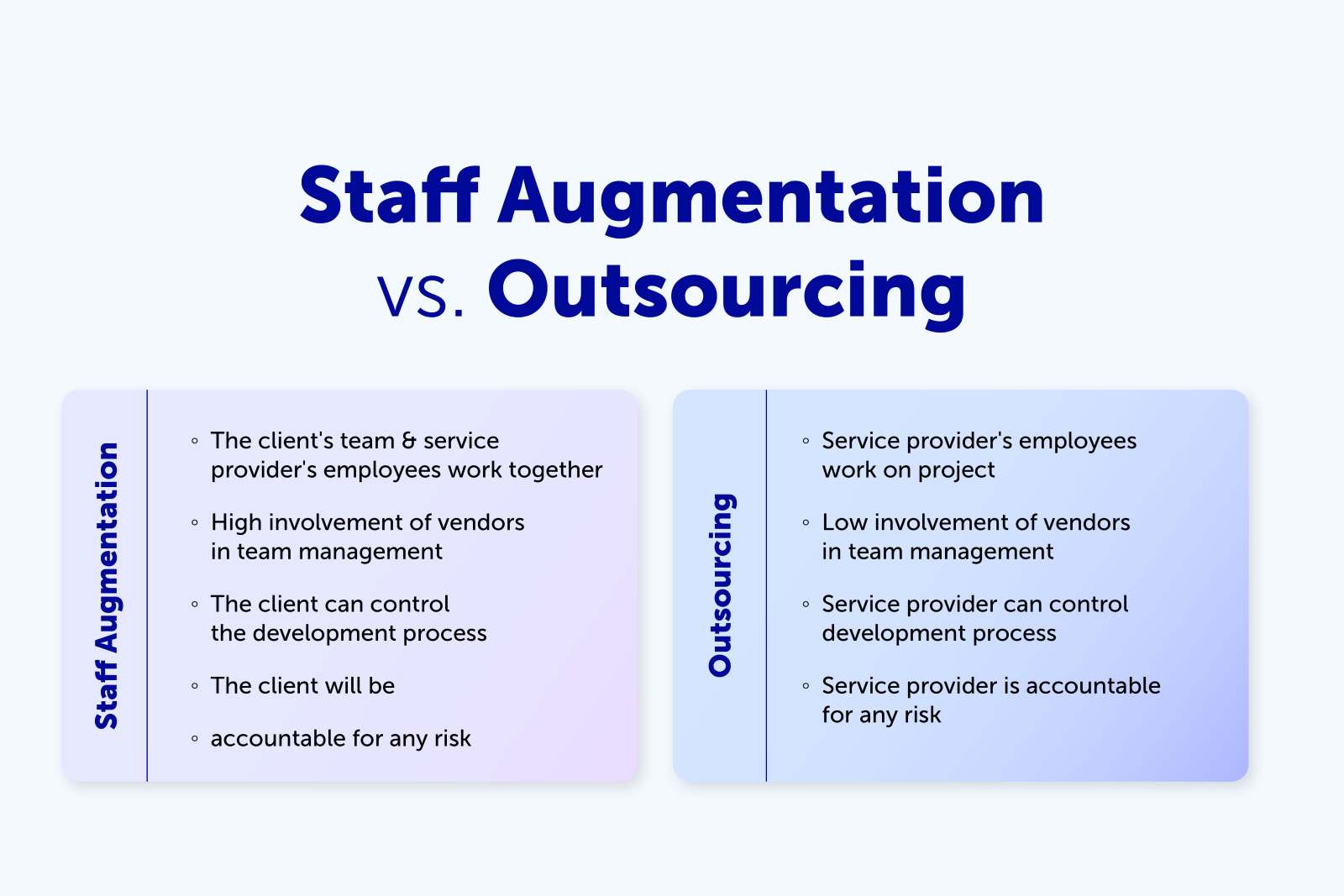
Staff augmentation offers more control to the client, so it is more flexible than outsourcing. The employing firms retain the imperative to expand or reduce teams as development and infrastructure demands change.
Comparably, the outsourcing model is more rigid. Clients are not afforded the freedom to pick or choose teams as in staff augmentation, but it comes with an advantage: organizations can be unfettered from IT demands with the assurance that their processes and infrastructure remain intact.
Project Responsibilities
In a staff augmentation model, the project management responsibilities fall to the team lead or project manager of the employing firm rather than the dedicated team supplier. The augmentation vendor fulfills their contractual obligation by sourcing the talents and onboarding them, but it is the project manager's responsibility (unless otherwise agreed) to oversee the direction of the project.
Outsourcing, on the other hand, relieves in-house staff of all activities agreed upon in the SLA. The outsourcing provider appoints its own team lead to integrate outsourced projects into the vendor's portfolio and monitor project progress.
Training And Onboarding
When a project is outsourced to an outsourcing provider, training requirements on the part of the client are almost non-existent. The vendor hires a vetted team of experts to work on actualizing it. However, in an augmentation model, the enterprise still has to onboard new recruits to the company's culture and project mission before they can commence work.
Augmentation vs Outsourcing: Factors To Consider When Choosing A Model
The choice between staff augmentation vs software sourcing is one that requires careful deliberation. Both models of engaging external IT personnel offer extensive services that cover a range of disciplines pertinent to contemporary information technology companies, hence why it is critical to consider the influence of the following factors:
Expertise And Specialization
The type of skills your project needs plays a role in your choice of a staffing model. Some IT tasks, such as programming and testing, naturally lend themselves to the staff augmentation model because of their temporal nature. Meanwhile, projects like infrastructure maintenance that require ongoing engagement may be better served by outsourcing.
Control And Oversight
How involved do you want to be in your IT processes? It is important to ascertain this before you approach a vendor. While maintaining direct control of support staff for a project's duration is a prominent feature of augmentation, outsourcing doesn't offer the same advantage. Therefore, if you would like to have continued oversight over augmented staff operations, pick augmentation. However, outsourcing might be better if you'd like to be removed from IT operations and focus more on your core enterprise objectives.
Intellectual Security
Augmentation and outsourcing providers maintain legal contracts with clients that ensure every party is well served. Yet, when it comes to project development, there might still be concerns relating to the safety of data and intellectual property on the client's part. Choosing an augmentation provider can help assuage this concern, as the hired teams will work directly under in-house managers who can better monitor activities.
Scalability
Does the project you're venturing into potentially have fluctuating work demands? If yes, staff augmentation might be the optimal option. For all the freedom it affords the modern-day IT enterprise, outsourcing is more rigid regarding scaling. You can't increase or reduce staff as the project demands. But then again, you barely have to worry about this, as scaling has no bearing on your finances or project outcomes.
Conclusion
The choice between staff augmentation and outsourcing depends on your project's specific needs, budget, timelines, and control preferences. Staff augmentation allows you to retain control over your projects and work closely with your extended team, making it ideal for companies looking for specialized skills to complement their existing workforce temporarily. On the other hand, outsourcing offloads entire projects to a third-party, offering a hands-off approach that can reduce operational costs and free up internal resources for other strategic initiatives.
Both models offer their unique benefits and can significantly impact your project's success and your company's operational efficiency. The ultimate goal is to leverage external expertise in a way that best suits your project needs and drives your business forward.