

Overview
The modern enterprise, as we know it, adopts a variety of business strategies to fulfil its lofty business visions and ambitions. Whether it be to build a stronger brand identity, implement data-driven insights, develop innovative technologies, or foster business expansion, present-day companies have various options to choose from when it comes to driving sustainability and profitability. These options include but are not limited to staff augmentation and professional services. These services are offered by specialized firms whose modus operandi look similar but are inherently disparate when observed closely. They both provide businesses with a medium to help outsource specific tasks, projects, or initiatives, but at varying capacities.
Understanding the differences between these two business strategies is crucial for businesses looking to adopt staffing solutions that keep them competitive in the global market. To this end, we at Softellar explore the prevalent question: what is the difference between staff augmentation and professional services? We define both service models, examine their pros and cons, and compare them based on popular criteria. We also look at some determinants for companies deliberating between both employment models to consider.
What Is Staff Augmentation?
Staff augmentation is a dynamic workforce management strategy that is used by organizations to address urgent staffing demands that arise due to personnel shortages. This flexible and scalable model of employment allows companies to recompose their internal teams and adapt quickly to workload spikes or specific project requirements without having to resort to permanent hires. This approach is particularly effective for React Native staff augmentation, enabling companies to quickly bring in skilled developers as needed.
At their core, the third-party vendors who provide augmentation services are highly adaptable. They provide staffing solutions to industries in various disciplines, ranging from IT to healthcare, finance, telecommunications, and manufacturing. These staffing solutions are typically for the short term and come in the form of recommending specialized talent, but may also include the procurement of physical resources like office space or the provision of ongoing administrative support.
The IT industry, in particular, favors staff augmentation as opposed to traditional hiring practices because of its adaptability. Staff augmentation companies are better equipped to deal with the rapid pace of innovation and fluctuating resource demands associated with infrastructure management and software development projects.
Pros of Staff Augmentation
Although staff augmentation invariably has its use cases in the IT industry, looking further into IT staff augmentation vs professional services, we can pinpoint some overlapping benefits as well as downsides.
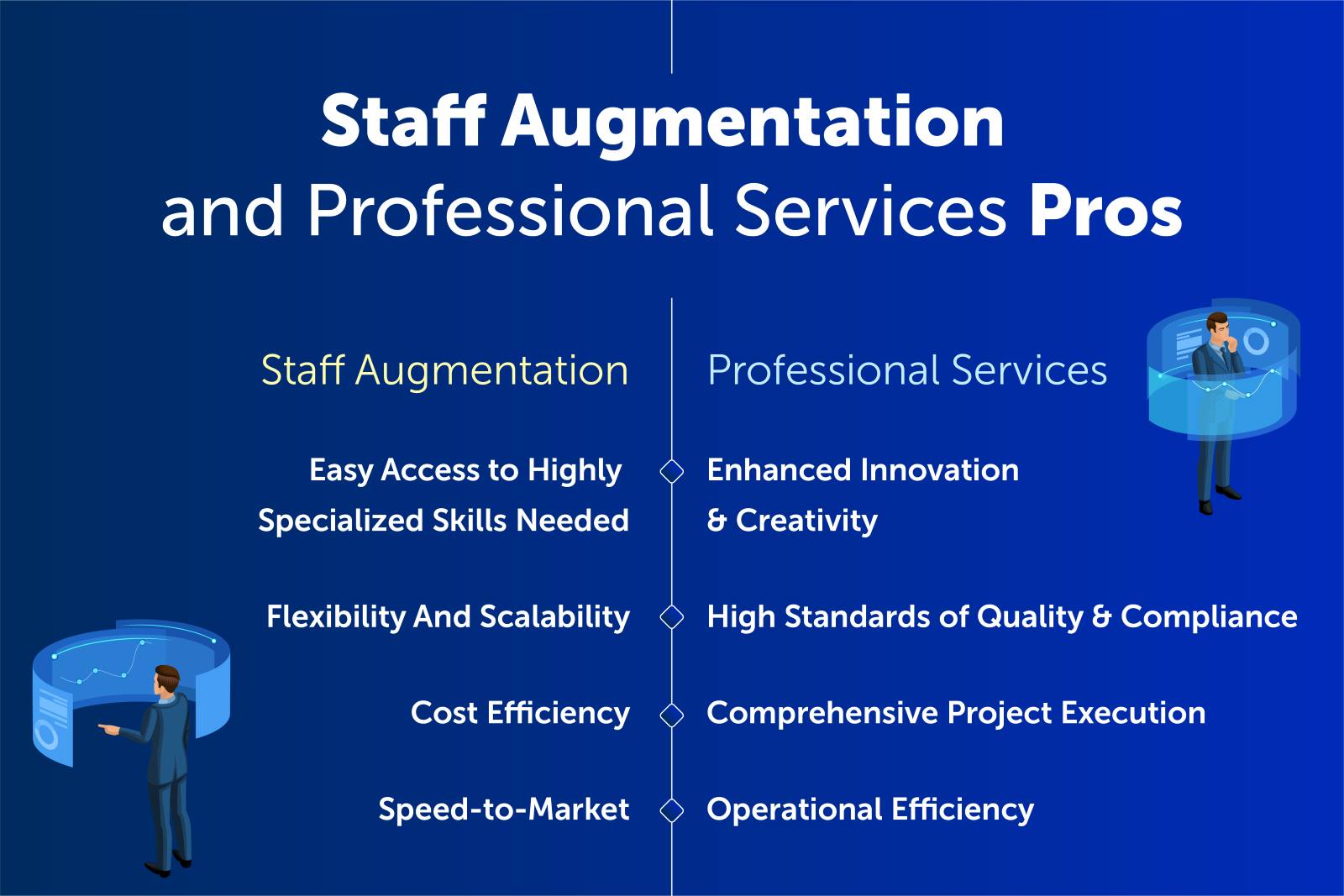
Easy Access to Highly Specialized Skills Needed
The staff augmentation model allows businesses to tap into a global pool of talent to fulfil immediate needs. This is perhaps the most significant benefit of engaging augmentation providers. For instance, companies looking for .NET staff augmentation can quickly onboard skilled developers without the hassle of long recruitment cycles. The augmented staff they provide don't have to be trained before they can commence work. You only need to orient them to your development objectives, and they are good to go.
Flexibility and Scalability
Staff augmentation services are inherently flexible. Human resources provided by augmentation providers are designed to be easily scalable, enabling businesses to scale their workforce up or down based on specific project needs or workloads.
Cost Efficiency
Augmentation is a cost-effective means of resource utilization for IT businesses. Being that it limits costs associated with hiring permanent employees, such as training fees, benefits, and salaries, it allows companies to optimize their budgets to only pay for services when needed.
Speed-to-Market
In an industry as competitive as information technology, speedy delivery of software development deliverables is a highly valued asset. Staff augmentation facilitates this speed-to-market by supplying professionals who can rapidly integrate with existing workflows and contribute value from the get-go.
Cons of Staff Augmentation
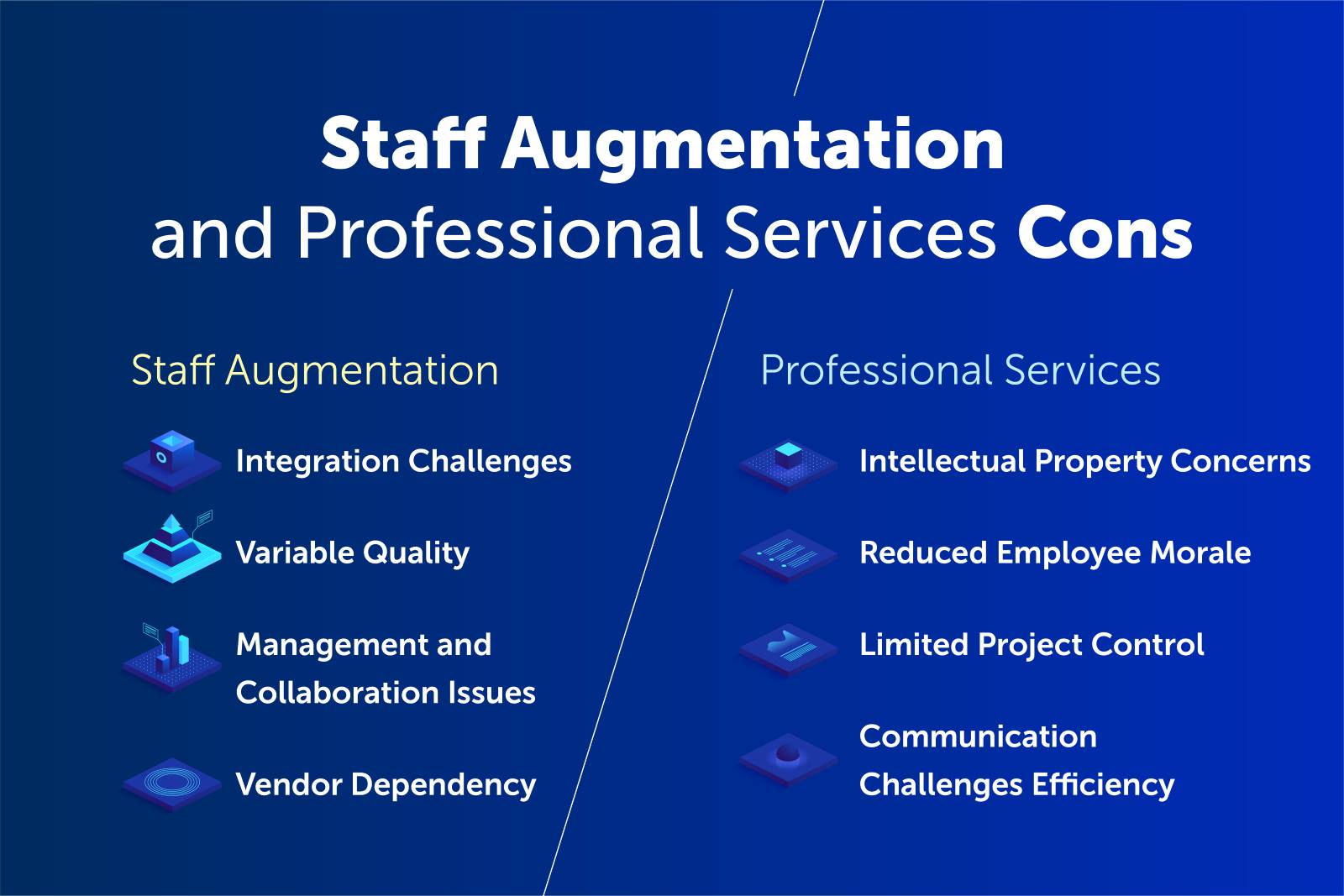
Integration Challenges
Although rapid integration and onboarding are essential elements of staff augmentation, the technical talent sourced by an external service provider may not always easily adapt to the work culture and existing team dynamics of the client company. For instance, businesses leveraging C++ staff augmentation must ensure that developers not only possess strong technical skills but can also integrate smoothly with in-house teams. Without proper alignment, this can potentially lead to disengagement which affects team morale and productivity.
Variable Quality
Depending on the service provider, there is a chance that the recommended augmented staff may not all be on par with each other in terms of proficiency. Such variance in skill levels or working styles can potentially affect the coherence of project deliverables and the quality of project outcomes.
Management and Collaboration Issues
Managing an augmented external team alongside in-house teams can make team collaboration and project management more complex than usual. This is especially evident when the augmented staff are working remotely or offshore.
Vendor Dependency
Relying too much on staff augmentation providers for skills and resources critical to business processes can prove damaging should the vendor fail to deliver the required talent on time when needed.
What Are Professional Services?
Professional services are a mode of outsourcing used by enterprises to delegate complex long-term projects to external experts who have the requisite skilled professionals and specialized knowledge to execute them from start to finish. A major characteristic of professional service providers is that they take a holistic approach to project management that ensures every aspect of an undertaking is handled by a team of specialists. Their services are distinguishable from those of other third-party service providers by the strong emphasis they place on engaging deeply with projects from the ideation to the execution phase.
Professional services are adopted to a greater degree in industries such as manufacturing, marketing, and consulting primarily because they are adept at catering to long-term strategic business demands that have to do with organizational restructuring, system integrations, risk management, regulatory compliance, and transformation of business processes.
Unlike a staff augmentation company, a professional services provider doesn't furnish organizations with temporary staff to fill skill gaps on a project; rather, they will assume responsibility for managing and executing the project from infancy till its maturity. During this process, they are responsible for all administrative, legal, and operational duties, and they deliver the project outcomes to their clients once the objective is deemed accomplished.
Pros of Professional Services
Enhanced Innovation & Creativity
Professional service firms often work with clients across various industries; this helps them bring diverse experiences that may not be available in-house to your project. Their cross-industry exposure enables them to inject fresh perspectives and apply innovative solutions to project challenges as they arise.
High Standards of Quality & Compliance
Professional service providers maintain high standards of quality and compliance in their deliverables. They ensure that all project outcomes meet industry standards and regulatory requirements, providing businesses with peace of mind regarding the quality of their work.
Need Help Deciding Between These Approaches?
Choosing between staff augmentation and professional services can significantly impact your project's success. Our experts will analyze your requirements and help you select the optimal workforce strategy for your business objectives.
Professional services can help companies mitigate compliance and quality assurance risks associated with executing complex projects. Most service providers are bound to industry regulatory requirements and guidelines that ensure they apply the best practices within their area of expertise.
Comprehensive Project Execution
Professional service providers ensure all aspects of a client's projects are managed meticulously from conception to delivery. They provide comprehensive project management that alleviates the burden of micro-management from client organizations, allowing them to focus on core business operations.
Operational Efficiency
One of the more popular advantages of outsourcing complex tasks to professional service companies is the substantial boost in operational efficiency they offer. Leveraging the specialized expertise of professionals can help organizations streamline operations and eliminate bottlenecks that occur when in-house teams are stretched too thin.
Cons of Professional Services
Intellectual Property Concerns
When developing projects that require innovation, outsourcing to professional service providers comes with certain intellectual property risks. As such, it is important to protect your rights to any developed product or process by clearly defining the terms of your engagement in a detailed service-level agreement.
Reduced Employee Morale
When an organization delegates much of its high-value projects and tasks to professional services, internal staff might start to feel undervalued or concerned for their job security. This situation can down the morale of in-house teams, potentially affecting their loyalty and productivity.
Limited Project Control
Although professional service vendors are independent contractors and can deliver optimally with minimal supervision, outsourcing projects to them equates to foregoing oversight and direct control of your project's direction. You would have to trust the vendor's capabilities to deliver based on their track record.
Communication Challenges Efficiency
Professional services are basically project-based consulting services that operate independently for the long term. Therefore, maintaining consistent contact with project managers to ascertain project progress over a sustained period may prove a challenge. This situation can be assuaged by establishing unequivocal communication channels with your service provider before project commencement.
Staff Augmentation vs Professional Services: A Comparative Analysis
When you compare staff augmentation to professional services on the surface, both outsourcing models bear the same fundamental characteristics – providing access to external skills and specialized expertise for a defined period. Yet, they differ considerably in terms of the cost savings, range of flexibility, and level of control they offer to businesses. For businesses looking to pick between either model, understanding the difference between professional services and staff augmentation is crucial. We examine them in depth here.
Flexibility
Staff augmentation provides businesses with a medium through which to tackle temporary initiatives and respond to the demands of short-term projects nimbly. Augmentation providers keep a roster of technical talent on standby so their clients can rapidly onboard and integrate them into development endeavors. In this engagement model, the client retains the right to downsize or upsize staff as the budget and project dictate.
Professional services also offer flexibility but not in the same vein as augmentation. Professional service firms help free internal resources to be channeled to other business areas by taking on projects in their entirety. However, they lock organizations into more structured service contracts that don't leave room for resource adjustments.
Costs
The financial costs of professional services vs staff augmentation are influenced by factors not limited to project duration, complexity, and required level of expertise. While staff augmentation can help businesses save costs on short-term projects by circumventing overhead associated with hiring staff full-time, these costs can add up to substantial sums over time if the project length deviates from the original plan. Conversely, the fixed costs and retainer-based pricing models used by professional services can make budgeting more predictable, albeit at the cost of a significant upfront investment.
Level of Control
With staff augmentation, businesses can directly oversee the integration and performance of external talent throughout a project's lifecycle. This direct management helps augmented teams adapt swiftly to company culture and development initiatives. In contrast, the professional services model puts the onus of providing expertise and managing project functions on the service provider.
While this model has obvious advantages, such as limiting the client company's day-to-day administrative burden, it also distances them from control of project execution and resulting outcomes.
Staff Augmentation vs. Professional Services: Factors to Consider
When deciding between the staff augmentation vs professional services model, several decisive factors warrant scrupulous consideration. Among these are:
Available Internal Resources
How equipped is your organization to manage and integrate a dedicated team of external professionals? If your team has the resources required to effectively oversee augmented personnel, staff augmentation might be a good project fit. However, if managing an external team will be too resource-intensive or demanding of internal project managers, outsourcing the task to professional services might be a more viable solution.
Control and Collaboration Preferences
Staff augmentation allows for greater control and collaboration between internal and external teams; hence, it is ideal for projects where the client company would like to retain a high degree of oversight. Professional services, on the other hand, will require you to entrust a significant portion of project management and execution to the service provider. This can be beneficial for companies trying to leverage external expertise while remaining unencumbered by day-to-day operations.
Project Scope and Complexity
What's your project about? Is it software development, infrastructure management, cybersecurity, or other less tangible outcomes like business transformation? Depending on your undertaking, choosing between staff augmentation and professional teams can have an immense impact on project outcomes. Because staff augmentation is typically used to complement an existing workforce by furnishing organizations with external resources, it is well-suited for dynamic projects that evolve in the short term. Nevertheless, executing complex projects with a clearly defined scope and duration might benefit more from professional services.
Budget Considerations
Augmentation is a cost-effective means of scaling a workforce without the cost associated with traditional hiring practices. This makes it suitable for short-term projects where having permanent staff won't be feasible. Professional services offer comprehensive solutions that go beyond manpower to include expert advice, strategic planning, and innovative methodologies. This makes them a tad more expensive than augmentation. However, when you consider the overall value they bring to projects, they can potentially save you more money in the long run.
For a deeper dive into how staff augmentation operates end-to-end, see our IT staff augmentation guide.