


Overview
In recent years, nearshore software development has gained a reputation among global companies. The growing demand for and scarcity of qualified IT talent have partly influenced this trend, especially in industrialized countries with bustling tech hubs.
To stay competitive in a constantly expanding IT market, global organizations now seek technical expertise from foreign countries with lower labor costs and close enough that their proximity or time zone difference would hinder seamless cooperation. But exactly what is nearshore software development?

Img source – Felic Illustration
What Is the Nearshore Model?
The nearshore development model is a method of outsourcing used by companies to hire dedicated development teams from neighboring countries, typically those with which they share borders or time zones.
In other forms of outsourcing, such as offshore development, businesses have to collaborate with specialists in far-off locations, sometimes to the detriment of operational efficiency. The nearshore model circumvents these drawbacks as a middle-ground between proximity and efficient operations.
With this model, you can procure dedicated IT team services close by without worrying about communication lag, cultural differences, or any other separations that may slow down application development.
One of the main reasons nearshore outsourcing is such an attractive option for companies is that it is cost-effective compared to onshore options. It also offers advantages found in onshoring, like cultural compatibility and geographical closeness, without sacrificing close monitoring and control as in offshoring. It can be advantageous when hiring dedicated DevOps developers or other specialists with high-responsibility work, which is critical for clients' projects.
How Does Nearshore Software Outsourcing Work?
Working with nearshore software development teams is an astute way to go about software development. However, if you want a productive and successful collaboration, there are certain fundamental principles that you should follow. These are more like guidelines for devising a nearshore software development strategy, so they shouldn't be immutable. Depending on the project scope or business goals, you can always alter your approach.
1. Business Needs Identification
Before you kick start any nearshore software development outsourcing collaboration, you should do your due diligence to pinpoint your project requirements in terms of skill and infrastructure. This gives you a lens through which you can access software development companies that fit your bill.
2. Nearshore Partner Selection
Geography is only one criterion for selecting a nearshore development partner. When putting together a nearshore development team, gauge how their experience and expertise align with your outlined objectives before proceeding further.
3. Definition Of Roles and Responsibilities
At this stage, you and your nearshore software development company of choice meet to determine the project scope, team composition, communication protocols, project workflows, and timelines for submitting deliverables.
4. Collaboration and Ongoing Development
Using agreed-upon technologies and development approaches, the nearshore development company proceeds to actualize your digital transformation plans, whether dedicated web development services, native development, or enterprise-standard software engineering.
5. Software Delivery and Support
The nearshore team delivers your project after completing your nearshore solutions and putting them through due quality assurance to ensure their functionality. Depending on your previous agreement, they may continue to provide support for the application by means of bug fixes or entire system upgrades.
How to Choose the Right Outsourcing Model
The success of a software development project largely depends on choosing the right outsourcing model. It is important to note that the three main models (i.e., nearshoring, offshoring, and onshoring) have their own pros and cons. Take a look at the table below to get more information to help you make the best choice:
| Model | Time Zone Alignment | Communication Efficiency | Skill Availability |
|---|---|---|---|
| Nearshore | Similar time zones. Little to no difference. | Strong. Possibility of in-person meetings. | High in predominant nearshoring territories. |
| Offshore | Significantly different time zones. | Low. Meetings are mostly remote. | High. But quality can fluctuate. |
| Onshore | Same time zone. | Frequent in-person interaction. | Variable. Depends on location and tech climate. |
The Advantages of Nearshore Dedicated Software Development Services
Engaging in nearshore software development services presents many advantages that can considerably augment a corporation's operational efficiency and project outcomes. Below are some salient benefits worthy of attention:
Mitigating Workforce Shortages
In modern times, companies need more competent developers. In this context, the strategic implementation of nearshore development provides businesses access to a large talent pool in neighboring countries. It offers a cost-effective and efficient solution to staff deficiencies.
This helps companies quickly solve team shortages, protect project schedules, and maintain high-quality standards throughout the software development lifecycle.
Close Proximity
A particularly noteworthy advantage of nearshore development is geographical closeness. Collaborating with teams situated within neighboring territories diminishes the complexities conventionally associated with disparities in time zones and protracted communication channels.
This nearness facilitates regular face-to-face interactions when necessary and fosters a more integrated working rapport, ultimately enhancing the overall processes involved in development endeavors.
Optimizing Organizational Efficacy
Working with a nearshore software development team allows companies to focus on key capabilities and help streamline their operational processes. Nearshore developers enable internal teams to focus on strategic efforts by managing many aspects of the development process, from initial planning to deployment. This division of labor increases effectiveness and accelerates time-to-market for customized software projects.
Real-time Collaboration
Effective communication is vital in any development initiative, and nearshore teams exhibit an advantage in real-time collaboration. Because of shared work hours, teams can participate more in synchronous communication so that issues can be resolved on time and decisions can be made on the spot. This level of collaboration is beneficial in dynamic projects where requirements may change very quickly.
Comparatively Cheaper than Onshore
Although nearshore IT solutions cannot compete with the extremely low prices of offshore services, they are often more cost-effective than onshore services. Businesses using the nearshore development model can collaborate efficiently and create high-quality deliverables, all at a cost advantage.
Ready to Explore Nearshore Development?
Discover how nearshore dedicated development teams can accelerate your projects while maintaining quality and cost-effectiveness. Our experts can help you find the perfect nearshore partner.
Top Nearshore Software Development Regions Around the World
If you're looking to hire nearshore development teams, it is noteworthy to consider that not all territories offer the same advantages. Just because a country shares similar borders or time zones with you doesn't make it an ideal environment for sourcing nearshore software developers.
Some regions stand out more than others for the quality of their IT talent and favorable business environments. Among these regions are Northern and Eastern Europe, Latin America, and Asia, which all offer a combination of technical expertise, cultural similarities, and competitive costs that make them attractive options for outsourcing companies.
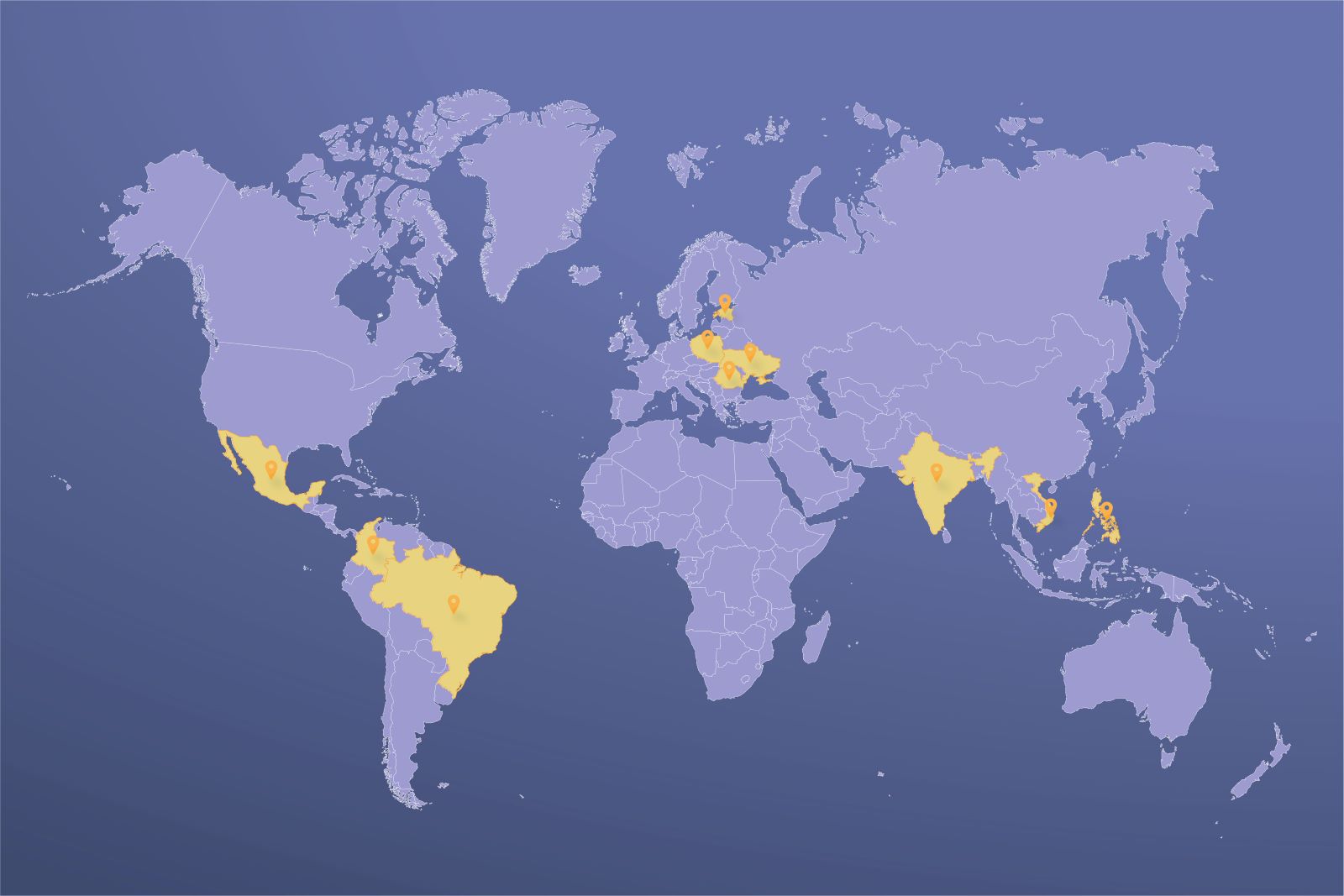
1. Poland
Poland is a powerhouse in the Eastern European IT sector, with around 525,000 IT workers as of 2023 — more than 157,000 active in software development outsourcing.
Poland's excellent STEM education program and high English proficiency help to support its top ranking in the EU region for IT talent. For companies seeking quality and economy in their nearshore development endeavors, Poland's competitive software development costs, which are usually 20–25% lower than those in Western Europe or the USA, make it a top pick.
2. Ukraine
Despite the ongoing conflict, Ukraine remains a key player in the European IT market. Ukraine is a leader in the field, with over 250,000 technologists and a robust IT outsourcing sector that generated $7.1 billion in revenue in 2022 alone. However, in these challenging times, the exports dropped 8.2% to $6.7 billion.
Ukraine ranks fourth in Eastern Europe in terms of outsourced developers, and its tech sector continues to grow, supported by a soft infrastructure and a strong focus on education. The average labor wage is significantly less than in Western Europe and America, which makes Ukraine a low-cost option for nearshore technology solutions.
3. Romania
Romania is becoming a top nearshore destination in Europe's IT industry, with more than 191,000 technology professionals and rising and a large number of tech graduates each year. The government of Romania has implemented various tax incentives to attract foreign investment, which has made the region a favorable environment for nearshore programming.
The cost of hiring developers in this country is approximately 40-50% cheaper than in Western Europe, making it an attractive destination for companies looking for cheaper and more skilled talent.
4. Estonia
Estonia, often referred to as the "Digital Nation," is characterized by its relatively small populace but notable technological impact. It has emerged as a global frontrunner in digital innovation while establishing itself as a preeminent nearshoring destination within Northern Europe. Exports of ICT services attained a monetary value of $3.9 billion in 2023.
Revered for its sophisticated digital infrastructure and conducive business, Estonia has implemented initiatives such as the e-Residency program that serve to attract entrepreneurial entities from across the globe. The nation's concentrated efforts in the domains of cybersecurity and digital public service, compounded with the allure of competitive compensation for developers, contribute to its status as a preferential option for software development nearshoring.
Top 3 Nearshoring Destinations in Latin America
1. Mexico
Mexico's sizable and rapidly expanding IT sector makes it a great site for scouting nearshore development teams. Over 380,000 IT experts call the country home, many of them focusing on software development. Mexico's software development industry is well acclaimed for its proficiency in Java, Python, and C++, among other programming languages.
The proximity to the U.S. and shared time zones make cooperation easy and enable real-time communication and faster project turnaround times. Because the nation is especially strong in custom software development and cloud-based solutions, companies looking to create scalable, high-quality software products turn to Mexico's nearshore developers when considering outsourcing software development.
2. Brazil
Brazil is the largest economy in Latin America and a powerhouse in the tech industry. The country enjoys a large talent pool, with over 400,000 IT professionals in 2021. Brazil is home to more than 6,000 software development firms, more than 100 tech parks, and multiple innovation clusters that serve as the foundation of a thriving IT sector.
The time zone in Brazil and the country's cultural similarities to the U.S. make it an excellent choice for nearshore software services. Despite slightly higher costs compared to other Latin American countries, Brazil's robust infrastructure and government support for the IT sector make it one of the leading nearshore development destinations in the world.
3. Colombia
Colombia is one of the fastest-growing nearshoring hubs. Its tech talent pool includes more than 65,000 developers, and its government actively supports the expansion of the IT industry. Cities such as Bogotá and Medellín have become known as global tech centers, attracting companies like IBM, Google, and Amazon.
In addition to being cost-competitive with other countries offering similar nearshore software development team services, Colombia also benefits from having a convenient time zone – only one hour behind New York. This combination makes it an ideal choice for businesses looking to save money without sacrificing quality in software development outsourcing. The nation also boasts a thriving innovation ecosystem and an increasingly popular startup community, further heightening its appeal as a nearshoring destination.
Top 3 Nearshoring Destinations in Asia
1. India
The Indian IT industry is among the largest in the world, with well over 4.5 million IT professionals in 2023. The country is a software development paradise, luring giants like Google, Microsoft, and IBM to maintain massive development centers across its major cities, like Bangalore, Hyderabad, and Pune. The IT sector in India recorded a turnover of over $245 billion in 2023, and most of this revenue was derived from software development services for foreign clients.
The country's numerous multinational corporations specialize in areas like cloud computing, AI, and data engineering, making it a perfect location for nearshore development. This means most Indian nearshore software companies have the infrastructure to help tackle projects of different scales.
2. The Philippines
Another top location for nearshore software development is the Philippines, which appeals notably to American businesses because of its population's cultural fit and strong English language proficiency. The nation's IT industry employs more than 190,000 professionals and focuses on software development, web development, and business process automation.
The BPO industry in the Philippines, including IT and software services, generated revenues of $26.7 billion for year-end 2022 alone. That highlights the country's importance as a top nearshoring destination for companies like Accenture, JPMorgan Chase, and Citibank, which have large operations there.
3. Vietnam
Vietnam is quickly becoming an emerging technology hotbed as companies look to source affordable but highly skilled nearshore software development teams. The country has attracted many foreign investments from tech giants like Samsung, LG, and Intel, which have set up large R&D centers in its cities in the past.
Vietnamese developers are competent in mobile application development (e.g., dedicated React Native developers), embedded systems, and IoT solutions. Vietnam's increasing reputation in the IT sector is further reinforced by its flexibility and quick acceptance of new technologies, which gives it an edge as a destination where software products can be developed cost-effectively in Asia.
Nearshore Software Outsourcing Cost vs Other Types of Outsourcing
Suppose you want to maximize your development budgets with onshoring. In that case, when choosing software development solutions, you need to have a clear picture of the cost consequences of onshore, nearshore, and offshore outsourcing. Here is a relative analysis:
- Onshore Development: Onshore development within the US is the most expensive option. While it allows for close collaboration and easy communication with developers, the higher costs make it the priciest alternative.
- Nearshore Development: Nearshore outsourcing offers a more affordable solution while maintaining ease of collaboration due to similar time zones and cultural compatibility. This model provides access to highly skilled developers at significantly lower rates than those in the US.
- Offshore Development: Offshore development is the most cost-effective option, with significantly lower rates compared to onshore or nearshore alternatives. While the savings can be substantial, challenges such as time zone differences and potential communication barriers due to geographic separation should be carefully managed.
Conclusion
Recently, nearshore software development has risen in popularity for companies seeking cost-effectiveness and efficiency. Regions like Latin America, Eastern Europe, and Asia are leading this movement, providing high-quality human resources close to their clients' geographic locations.
Nearshore development is much less expensive than domestic outsourcing, yet it does not sacrifice advantages such as convenient communication channels or real-time cooperation between teams working on different sides of the world. As international competition becomes more intense, nearshoring will become even more attractive to foreign businesses seeking improved development processes without compromising on quality or overspending.


