


Overview
US engineering salaries have not slowed down, and neither has the pressure to ship more with the same headcount. The median annual wage for software developers in the US reached $135,980 in May 2025, according to the Bureau of Labor Statistics, before employer-side benefits, payroll tax, and recruiting costs get added on top, and the top 10% of earners cleared $214,670. That gap between what a US hire actually costs and what a growing team can afford is a big part of why more companies are looking past their own borders for engineering capacity, and Poland keeps coming up in that search.
Poland has built one of the largest and most established technology sectors in Central and Eastern Europe, with a deep bench of engineers, a mature outsourcing industry, and full membership in the EU’s legal and data protection framework. None of that makes Poland a perfect fit for every company. The time zone gap with the US is real, ranging from six to nine hours depending on where your team sits, and it shapes how a distributed team actually works day to day.
This guide breaks down what software nearshoring to Poland really costs, what you get for that cost, and when the model makes sense for a US organization looking to scale engineering teams abroad. No inflated headcount numbers, no “same time zone” claims that don’t hold up under a calendar check. Just the numbers, the trade-offs, and a framework for deciding.
What Is Nearshore Software Development in Poland?
Nearshoring means hiring an external team in a country that sits within a reasonably close time zone and cultural distance from your own, as opposed to offshore software development, where the location gets chosen mainly for cost and the time difference is treated as a fixed cost of doing business. Onshoring, the third option, keeps everything inside your own country.
Here’s where the term gets stretched. For a company among Western European countries, based in Berlin or Amsterdam, say, Poland is a textbook nearshore location: one to two hours’ flight, a one-hour time difference at most, and a shared regulatory environment among nearby EU countries. For a company in San Francisco or New York, the geography tells a different story. Poland is typically six to nine hours ahead of major US business hubs, depending on the city and time of year, a gap wide enough that by most working definitions it puts Poland closer to offshore than nearshore.
The industry uses “nearshore Poland” as a search term and a marketing label regardless, and this guide keeps that terminology because that’s how US buyers actually search for this option. What matters more than the label is being honest about what the model delivers: a European engineering base with strong technical depth, GDPR-aligned data handling, and a workday that overlaps with the US for only part of the day rather than all of it. Companies that go in expecting full real-time collaboration, the kind you’d get from a nearshore partner in Mexico or Colombia, tend to be disappointed. Companies that plan around a partial-overlap, async-friendly workflow tend to get exactly what they were looking for.
Poland’s IT Market at a Glance
| Metric | Value | Source |
|---|---|---|
| ICT industry employment | ~338,300 (2024) | Statistics Poland |
| ICT specialists’ share of total employment | 4.5% (2024) | Eurostat |
| ICT companies with 10+ employees | 2,825 (2024) | Statistics Poland |
| Share of those companies providing ICT services | 92.7% (2024) | Statistics Poland |
| ICT sector sales | PLN 287.6 billion (2024), approx. $74 billion | Statistics Poland |
| ICT graduates | 16,161 (2023/24 academic year) | Statistics Poland |
| English proficiency (tech professionals) | 15th globally, score 600; IT occupations score 621 | EF EPI 2025 |
The table above pulls from Poland’s own statistical agency and PARP’s IT/ICT sector reporting, not from a vendor blog repeating a number nobody can trace back to a source.
Notice the gap between “ICT industry employment” and “ICT specialists in total employment.” These measure different things, and most nearshoring guides collapse them into one big number that sounds impressive and means very little. ICT industry employment, roughly 338,300 people as of 2024, counts everyone working inside companies classified as part of the ICT sector: developers, yes, but also QA, project managers, sales, support, and administrative staff. It is not a developer headcount.
The 4.5% figure from Eurostat measures something else again, the share of ICT specialists across the entire Polish economy, including people writing code inside banks, retailers, and manufacturers that aren’t IT companies at all. Add those together and you get a workforce that’s genuinely large by European standards. You still don’t get one clean number for “software developers in Poland.” Anyone who hands you that number without explaining which definition they’re using is asking you to trust math they haven’t shown.
The commercial side of Poland’s IT services market backs this up. Roughly 2,825 ICT companies employ 10 or more people, and the vast majority of them, 92.7%, operated in ICT services rather than hardware or product manufacturing, highlighting the service-heavy structure of Poland’s IT sector. Combined sector sales reached PLN 287.6 billion in 2024.
Geographically, the talent isn’t concentrated in one city. Warsaw carries the largest share as the corporate and fintech hub, but Kraków, Wrocław, the Tri-City area, Poznań, Katowice, and Łódź all run active, scalable tech hubs of their own.
On the language side, Poland ranked 15th globally in the 2025 EF English Proficiency Index with a score of 600, while respondents working in IT scored 621.
Poland’s Software Engineering Talent Pipeline
An IT talent pool only stays useful if it keeps refilling itself. The pipeline behind today’s workforce matters as much as the current headcount.
Polish universities awarded 16,161 degrees in ICT fields during the 2023/24 academic year, according to Statistics Poland. Set against 291,986 total higher-education graduates that same year, ICT accounts for a little over 5.5% of everyone leaving Polish universities with a degree, a meaningful share for a single technical field. Roughly 70,000 students were enrolled in ICT-related programs in the 2022/23 academic year, per Poland’s Investment and Trade Agency (PAIH), which points to a pipeline that isn’t shrinking.
A caution worth repeating: a graduate is not a developer. Some of these 16,161 people go straight into backend or mobile roles. Others move into data analysis, IT support, product management, or fields outside software entirely. Treating “16,000 ICT graduates” as “16,000 new developers hitting the job market” overstates what the number actually shows, and it’s the same kind of shortcut this guide is trying to avoid everywhere else.
What the pipeline does confirm is structural depth, not anecdotal depth. Poland’s technical universities, AGH University of Krakow, Warsaw University of Technology, and Wrocław University of Science and Technology among them, have produced computer science and engineering graduates for decades. Poland combines that long-established technical university system with a mature commercial technology sector, which creates a continuous pipeline of graduates alongside an established base of experienced software engineers and technology professionals, not just an entry-level talent pool.
None of this means hiring is effortless. Talent availability varies sharply by seniority and specialization: highly specialized senior engineers in AI/ML, platform engineering, cloud, and security can be significantly harder to recruit than candidates in broader software-development categories, particularly with more international companies opening engineering hubs in Warsaw and Kraków. The graduate pipeline keeps the funnel full at the entry and mid levels. It does less to solve a shortage at the top.
Why Companies Choose Poland for Software Development
Ask five different companies why they picked Poland and you’ll get five different primary reasons, but they tend to cluster around the same handful of factors.
A talent pool with real depth, not just size. The ICT workforce runs into the hundreds of thousands across the broader economy, and it spans specialized talent that many smaller nearshore markets can’t match at scale: backend and platform engineering, mobile, data engineering, DevOps, cybersecurity, and increasingly AI/ML. A US company hiring five highly skilled engineers across three different stacks isn’t fighting over the same narrow slice of candidates the way it might in a market with a thinner bench.
Technical education with decades behind it. Poland’s computer science programs aren’t a recent policy initiative built to attract outsourcing revenue. They extend a much older engineering and mathematics tradition, one that produced generations of scientists and engineers well before “IT outsourcing” existed as an industry category. That history shows up as a stronger senior and staff-engineer layer than markets where the tech sector is younger, and it compounds into technical expertise you can’t build overnight no matter how much a newer market invests.
Costs that are genuinely lower, without being the cheapest option on the table. Polish engineering costs sit meaningfully below US levels. They also sit above some other outsourcing destinations, Ukraine and parts of LATAM among them. The exact numbers get their own section further down, because summarizing software development cost in one bullet point is exactly the kind of oversimplification this guide is built to avoid.
An enterprise ecosystem that goes beyond outsourcing vendors. International companies including Google, Microsoft, IBM, and a long list of other global names run engineering, R&D, or shared-services operations in Poland. Their presence isn’t proof that any particular outsourcing company is good, and no company should read “Google has an office in Warsaw” as evidence about a specific vendor’s quality. What it does prove is that Poland’s tech ecosystem includes serious enterprise-grade work building production software solutions, not just staff-augmentation shops filling short-term gaps.
A legal environment built on EU law. GDPR governs data handling. Polish and EU copyright and industrial property law govern intellectual property. Neither framework is unique to outsourcing arrangements, they apply to every company operating in Poland, and that consistency, combined with government R&D tax credits and innovation grants for qualifying technology work, adds up to a genuinely business friendly environment for companies planning a longer-term presence. The legal and IP details get their own section below, because the two concepts get conflated constantly and that mistake causes real confusion.
English proficiency that holds up in technical conversations. Poland’s 2025 EF EPI score of 600 puts it 15th globally, and technology professionals specifically scored 621, higher than the national average. In practice that means fewer miscommunications in architecture reviews and sprint planning, though it’s worth saying plainly: strong English proficiency doesn’t eliminate the need for clear written specs and defined ownership. No location does that for you.
Infrastructure that doesn’t get discussed enough. Fixed broadband and mobile connectivity across Poland’s major tech hubs are solid by European standards, which matters more than it sounds like it should once a team is running daily video calls, CI/CD pipelines, and cloud deployments across a distributed org.
A market that has done this before. Poland has run large-scale IT outsourcing, nearshore services, and staff augmentation operations for well over a decade, long enough to have developed established recruiting pipelines, vendor management practices, and a labor market that already understands how distributed, contract-heavy engineering work operates. That’s different from markets where nearshoring is a newer phenomenon and processes are still being figured out in real time.
Softellar Case Studies
View All Case StudiesA few examples of how US companies build and ship software with Softellar's Warsaw-based engineering teams:

How Much Does Software Development Cost in Poland?
Here’s the rule that gets broken more than any other in content about hiring software developers in Poland: salary is not the same thing as an outsourcing rate, and neither one is the same thing as what you’ll actually pay per hour once a vendor is involved. Real cost effectiveness only becomes visible once all three numbers are separated and compared correctly.
Salary: what a Polish developer earns. According to the Just Join IT Salary Report 2026, median monthly compensation in Poland breaks down roughly as follows:
| Level | B2B (net invoice, excl. VAT) | Employment contract / UoP (gross) |
|---|---|---|
| Junior | 9,780 PLN/month (≈ $2,500/month, ≈ $30,100/year) | 8,500 PLN/month (≈ $2,200/month, ≈ $26,150/year) |
| Mid-level | 18,900 PLN/month (≈ $4,850/month, ≈ $58,150/year) | 15,000 PLN/month (≈ $3,850/month, ≈ $46,150/year) |
| Senior | 24,780 PLN/month (≈ $6,350/month, ≈ $76,200/year) | 21,573 PLN/month (≈ $5,530/month, ≈ $66,400/year) |
USD equivalents are approximate, converted at the October 2026 exchange rate of about 3.9 PLN per US dollar. The actual dollar figure moves with the USD/PLN exchange rate. B2B invoice amounts running above UoP gross salaries is expected: a contractor’s invoice has to cover the social contributions, paid leave, and benefits that an employer pays separately for UoP employees.
Two things complicate a direct read of that table. B2B figures represent net invoice amounts excluding VAT, the sum the developer bills the employer, not take-home pay after the developer’s own income tax and ZUS social contributions come out. UoP figures are gross employment salaries, before employee-side taxes and social contributions come out; the exact net amount depends on individual tax thresholds, reliefs, and deductible expenses, so it isn’t a fixed percentage. B2B has a slight lead over traditional employment contracts among Polish IT specialists rather than an outright dominant share: the Just Join IT Salary Report 2026 puts the split at roughly 48.7% B2B, 45.5% UoP, and 5.8% other arrangements. It’s a structural feature of the Polish market either way, not a red flag, though it does mean the “employee” in a staff augmentation arrangement is sometimes a contractor under Polish tax law even while working full-time on your team.
Vendor rate: what you’ll pay through an outsourcing partner. This number sits well above salary, because it has to cover the vendor’s overhead, recruiting, management, benefits administration, and margin on top of what the engineer actually takes home. There’s no official benchmark for Polish outsourcing rates, and no central registry publishes verified hourly figures. Published vendor estimates vary substantially depending on whether they represent freelancer rates, individual staff augmentation, or full-service development companies, so treat any hourly rate quoted here, or anywhere else, as indicative rather than a fixed market average. For example, Devico’s 2026 Eastern Europe rate analysis estimates Polish developers at $20 to $30 an hour for junior roles, $35 to $50 for mid-level roles, and $65 to $90 for senior roles. Specialized skills or full-service engagements can run higher still. The “right” number for your project depends heavily on which vendor, which specialization, and which contract structure you’re comparing, more than it depends on which report you happen to be reading.
Poland vs. the US, apples to apples. Comparing US salaries to Polish salaries, or US vendor rates to Polish vendor rates, gives you a usable answer. Comparing a US salary to a Polish vendor rate, or the other way around, does not, because you’re pricing two different things: one includes an employer’s full internal cost structure, the other already has a vendor’s margin baked in. On the US side, the BLS median of $135,980 a year for software developers is the most defensible benchmark available; a senior individual contributor in a major tech hub typically sits in the upper part of that distribution and above, before benefits, payroll tax, and recruiting costs are added. On the Poland side, a senior developer’s median B2B invoice runs around PLN 24,780 a month (≈ $6,350), or PLN 297,360 a year (≈ $76,200), according to the Just Join IT Salary Report 2026. The USD equivalents are approximate, converted at about 3.9 PLN per US dollar, and move with the USD/PLN exchange rate, so convert at a current rate rather than relying on a fixed figure that will drift out of date. The gap between the two markets is real and substantial either way, even before accounting for the lower cost of benefits and office overhead in Poland.
What the numbers don’t cover. Specialization moves the price regardless of which dataset you use. Compensation varies substantially by specialization, with AI/ML, data, security, cloud, and platform roles often priced differently from general frontend or backend positions. Seniority matters more than title, a “senior” title means different things at different companies. And every rate you see, salary or vendor, is a snapshot from a specific report at a specific point in time. Compensation benchmarks can change materially over a multi-year engagement. Don’t assume a number from an older article still holds.
The Real Cost: Total Cost of Ownership
An hourly rate answers one question. It doesn’t answer the question that actually matters to a CFO: what does this engineer cost the business over a year, fully loaded?
Total cost of ownership pulls together everything a rate quote leaves out: compensation, employment costs (taxes, benefits, statutory contributions), recruitment, vendor fees where applicable, management overhead, infrastructure and tooling, turnover-driven rehiring, travel for onboarding or planning sessions, and the transition cost of ramping a new engineer or team up to speed.
Run that formula across a few common setups and the comparison shifts:
- US in-house hire. Highest compensation and benefits load. External recruiting fees and internal hiring costs can materially increase first-year cost on top of salary alone. Lowest management overhead, since the person sits inside your existing structure and time zone.
- US contractor. A compensation premium over a full-time hire, often significant, in exchange for flexibility and no benefits obligation.
- Poland staff augmentation. Lower compensation than a US hire, plus a vendor management fee layered on top. Recruitment is largely the vendor’s job, which cuts your internal hiring cost but shifts some of it into the vendor’s margin instead.
- Poland dedicated team. A similar cost structure to staff augmentation, with more of the vendor’s fee going toward team continuity, process, and delivery management rather than pure staffing.
- Own legal entity in Poland. The highest upfront cost and the longest ramp time, entity setup, local HR and payroll infrastructure, compliance overhead. Can reduce marginal cost per engineer at sufficient scale once the entity is running, and gives full control over hiring and culture.
No single model wins on every line item. A staff augmentation arrangement looks cheapest on paper until you count the management time your own team spends coordinating with a distributed vendor relationship. An own-entity setup looks expensive until you’re three years in, comparing its marginal cost per hire against what a vendor would charge for the same headcount at scale.
One more point worth stating plainly: there isn’t a single “TCO number” this guide can hand you that applies to your situation. What matters is running the formula against your own numbers, for your specific team size and timeline, rather than accepting a vendor’s hourly rate as if it were the whole answer. Real operational efficiency comes from that full picture, not from chasing the lowest line-item rate.
What Technologies Are Polish Developers Strong In?
Poland’s engineering talent isn’t concentrated in one programming language or stack. That breadth, spanning various programming languages and specializations, is part of what makes the market useful for companies with more than one kind of hiring need.
Java has deep roots in Poland’s enterprise and financial services sector, where large, long-running systems built for banks and insurers created years of demand for Java engineers at scale; Just Join IT’s 2025 job-market data puts Java at roughly 9.5% of listed openings. JavaScript, close to 10.7% of listings, and TypeScript cover the other end of the spectrum, frontend, Node.js backends, and the full range of modern web development, with TypeScript adoption strong enough that it’s now a standard requirement rather than a nice-to-have in most job listings. .NET and C# hold a smaller but solid position, around 5.8% of listings, often tied to the same enterprise clients that built out Java teams, plus a wave of companies running Microsoft-centric infrastructure. Python, close to 6% of listings, shows up everywhere: backend services, data pipelines, automation, and increasingly machine learning work. Mobile development has its own steady lane too, native iOS and Android work alongside cross-platform frameworks like React Native and Flutter, concentrated mainly around Warsaw and Kraków’s product-focused teams.
Beyond core languages, Polish teams run deep in cloud and DevOps. AWS, Azure, and GCP all have an established presence among Polish engineers, alongside the Kubernetes, Terraform, and CI/CD tooling that goes with running production infrastructure at scale. Data engineering and data science have grown into their own specializations rather than a side skill tacked onto backend work, and demand for data specialists keeps climbing alongside the same curve driving Python adoption. AI/ML has become an increasingly visible part of Poland’s technology job market, pulled by both global demand and a wave of Polish AI startups working on emerging technologies that have attracted real investment in recent years. Cybersecurity talent has deepened alongside GDPR and NIS2 compliance requirements pushing more companies to build security into their engineering process rather than bolt it on afterward. And in specific hubs, particularly around Kraków and Wrocław, there’s a smaller but genuine pool of embedded and IoT engineers, tied to automotive and industrial clients with a presence in the region.
One caution here, consistent with the rest of this guide: skip the “#1 in the world” claims that circulate in outsourcing marketing content. Poland’s technology talent is broad and genuinely strong across multiple domains. It isn’t uniquely dominant in any single one of them in a way an unsourced superlative could honestly capture.
Best Cities for Software Development in Poland
Poland’s tech workforce doesn’t sit in one city waiting to be hired. Seven major hubs run active, distinct engineering markets, and picking the right Polish tech hub, or spreading a search across several, changes both the talent you can access and what you’ll pay for it.
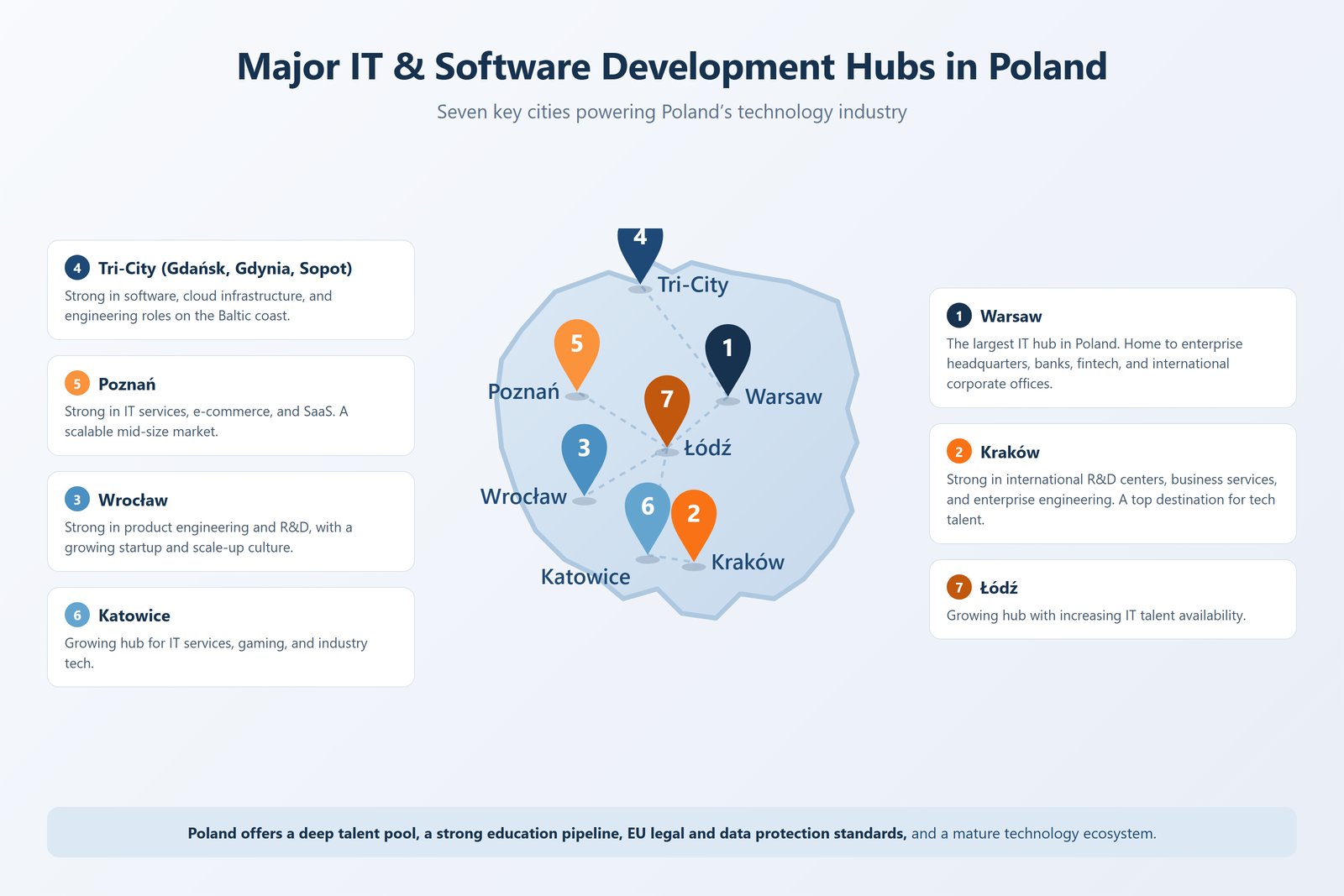
Warsaw is generally Poland’s largest corporate, business, and fintech labor market, home to the biggest concentration of enterprise headquarters, banks, and international corporate offices, with compensation levels that tend to run highest in the country as a result. It’s also a common choice as an engineering base for outsourcing partners themselves: Softellar, for one, runs its core engineering delivery out of Warsaw alongside a client-facing office in New York, the same two-location pattern this guide describes throughout. If your project needs enterprise integration experience or fintech-specific domain knowledge, Warsaw is usually where you’ll find it fastest.
Kraków built its reputation on international R&D centers, business services, and enterprise engineering operations, the kind of long-term, in-house teams that global companies set up rather than outsource. It’s also home to some of Poland’s strongest technical universities, which keeps a steady stream of new graduates feeding into the local market alongside a genuinely senior bench of experienced engineers, with deep expertise built over decades.
Wrocław is generally associated with product engineering and R&D work, with a startup and scale-up culture that’s grown noticeably over the past decade. Companies building their own products, rather than staffing outsourced client work, often find Wrocław’s talent pool a strong match for in-house tech teams.
The Tri-City area, Gdańsk, Gdynia, and Sopot together, is generally known for software, cloud infrastructure, and engineering roles, helped by a coastal location that’s made it attractive to both talent and the international companies recruiting them.
Poznań, Katowice, and Łódź round out the list as smaller but genuinely scalable markets. None matches Warsaw or Kraków in raw talent volume, but all three offer real engineering depth, often at somewhat lower compensation levels than the largest hubs, and they’re growing fast enough that they shouldn’t be treated as an afterthought.
A note on what this guide won’t do: hand you a precise developer headcount for each city. Reliable, sourced, city-level breakdowns of software developer counts don’t exist in the official statistics this guide relies on, and any number you see quoted for “developers in Kraków” or “developers in Wrocław” almost certainly traces back to a vendor’s internal estimate rather than a government dataset. Use city reputation and specialization as a directional guide, not a precise headcount.
Practically, most US companies don’t need to pick just one city. A dedicated team or staff augmentation vendor, or one of the many software development companies with offices across several Polish tech hubs, can source specialists from wherever the right skill set happens to be concentrated, rather than limiting the search to a single metro area’s labor pool.
On-site visits are worth planning for even with a fully distributed team. Direct transatlantic flights connect Warsaw with several major US cities, but travel remains significantly less convenient than between Poland and Western Europe. Budget for an occasional kickoff or planning visit rather than routine travel.
Poland-US Time Zone Difference
This is the section most nearshoring content either skips or gets wrong, usually by borrowing language written for a European audience and applying it to US buyers without checking whether it still holds. It doesn’t.
Poland runs on Central European Time (CET/CEST), and for most of the year the gap to major US business hubs looks like this, based on Timeanddate data:
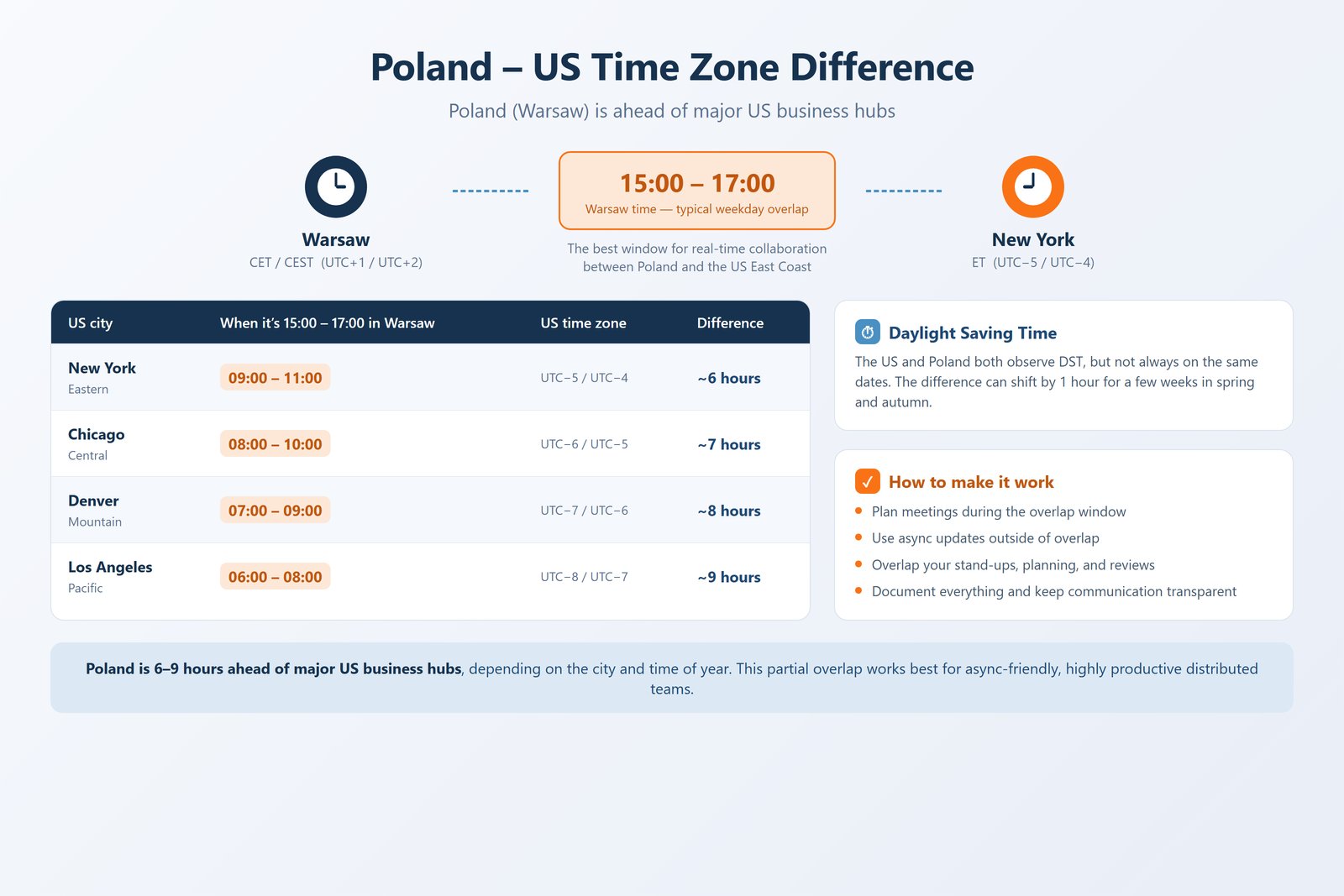
| US city | Time zone | Approximate difference from Warsaw |
|---|---|---|
| New York | Eastern | ~6 hours |
| Chicago | Central | ~7 hours |
| Denver | Mountain | ~8 hours |
| Los Angeles | Pacific | ~9 hours |
That range, six to nine hours depending on the city, is a real operational gap. It’s not the “same time zone” or “minimal difference” language that shows up in some outsourcing content aimed at a US audience, and it’s worth calling out directly because that inaccuracy sets teams up for a rough first few months once reality doesn’t match the pitch.
There’s a wrinkle underneath the averages, too: the US and EU don’t switch to and from daylight saving time on the same dates. For a few weeks each spring and fall, the actual gap shifts by an hour from what the “typical” figure suggests. Teams that don’t track this tend to show up to a meeting an hour off, twice a year, until someone finally puts both DST calendars on the shared team calendar!
What does a workable schedule actually look like? Take a Warsaw-based team working 9 AM to 5 PM CET and a New York team working 9 AM to 5 PM Eastern. With a six-hour gap, that’s a roughly two-hour overlap window, late afternoon in Warsaw, around 3 to 5 PM, against mid-morning in New York, around 9 to 11 AM, enough for a daily standup, a focused planning session, or a code review call, but not enough for a full day of real-time back-and-forth. Push the comparison to a Los Angeles team and that overlap window disappears almost entirely: a Warsaw team wrapping up its workday at 5 PM local time is only just reaching 8 AM in Los Angeles, right as a Pacific-time team is clocking in.
The teams that make this work don’t fight the gap, they build around it. A tight window of overlapping time zones handles synchronous decisions and blockers. Everything else runs async: written specs instead of verbal handoffs, recorded demos instead of live walkthroughs, and clear single-owner accountability for tasks that don’t need a meeting to move forward. Some teams go further and run a genuine follow-the-sun handoff: work handed off at the end of the US day is picked up first thing the next morning in Warsaw, moves forward through the Polish workday while the US team is offline, and is ready for review when the US team logs back on. Run in reverse for the next cycle, it keeps development cycles moving around the clock, though pulling it off well takes real process discipline, not just good intentions.
Poland vs Other Software Development Locations
Poland isn’t the only serious option among nearshore locations for a US company sourcing engineering talent abroad, and pretending otherwise does a disservice to anyone making this decision. Here’s how it stacks up against the three destinations that come up most often in the same conversation.
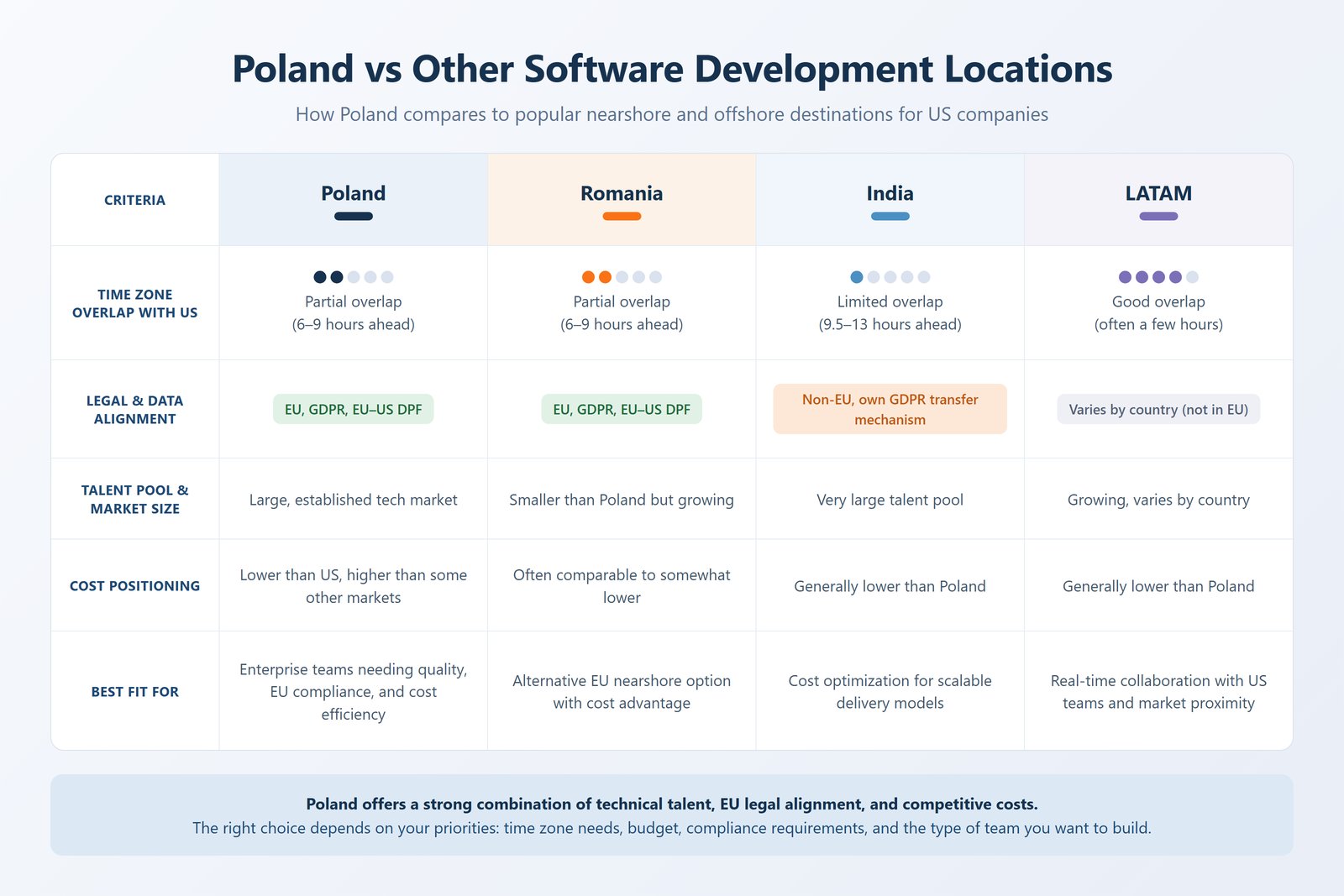
Poland vs. LATAM (Mexico, Colombia, Argentina, Brazil). This comparison usually comes down to one trade-off: time zone versus regulatory and enterprise ecosystem depth. Many major LATAM outsourcing hubs offer substantially more US workday overlap than Poland, often operating within a few hours of US business time zones, which supports real-time pairing and considerably shorter travel than a transatlantic trip. Poland can’t match that. What Poland offers instead is EU legal and data protection alignment, which matters directly if your product handles EU user data, and a Central and Eastern European enterprise ecosystem built over more than a decade of large-scale outsourcing and R&D operations. If your priority is synchronous, West Coast-friendly collaboration, LATAM has a structural advantage that Poland’s talent depth doesn’t offset.
Poland vs. India. India’s talent pool is larger than Poland’s by a wide margin, and its outsourcing industry has decades more scale and maturity behind it. No honest comparison pretends otherwise. What shifts the calculus for some US companies is time zone, India sits 9.5 to 13 hours from major US cities, wider than Poland’s gap, not narrower, and, for EU-facing products, jurisdiction: transfers of EU personal data to India require an appropriate GDPR transfer mechanism, since India doesn’t have an EU adequacy decision, while data handled inside Poland already sits within the EU framework by default. US transfers have their own path, too: American organizations participating in the EU-US Data Privacy Framework can rely on the European Commission’s adequacy decision rather than building a transfer mechanism from scratch. This isn’t a case for “Poland has better developers” or any variation of that claim. Quality exists at every level of experience in both markets, and any comparison that leans on national stereotypes about developer skill deserves the same skepticism this guide applies to unsourced statistics.
Poland vs. Romania. This is the closest comparison on the list, and one that comes up more than most other European countries in this conversation. Both are EU member states, both run mature CEE outsourcing markets, and both offer broadly similar time zone alignment with the US. The differences show up at the margins. Poland’s talent pool and enterprise ecosystem are larger in absolute terms, backed by a bigger domestic economy and more international corporate presence. Romania often comes in at a somewhat lower cost point, though the gap has narrowed as both markets have matured and salaries have risen across the region.
| Destination | Time zone gap from US | Legal / data alignment | Typical market positioning | Best fit when |
|---|---|---|---|---|
| Poland | 6-9 hours | GDPR / EU | Mid-range CEE | EU compliance, enterprise-grade delivery, long-term teams |
| LATAM | Often a few hours, varies by country | Varies by country | Varies significantly by country | Full workday overlap matters most |
| India | 9.5-13 hours | Non-EU, requires its own GDPR transfer mechanism | Broad range, often lower at scale | Largest possible talent pool, cost is the top priority |
| Romania | 6-9 hours | GDPR / EU | Often comparable to somewhat lower | Smaller teams, tighter budgets, still need EU alignment |
None of these comparisons produce a universal winner, and any guide that tells you one does is selling you something. The right choice depends on which trade-off matters most for your specific project: overlap hours, absolute talent pool size, EU jurisdiction, cost, or the maturity of the local enterprise ecosystem. The same logic applies if you’re weighing Poland against other nearby countries beyond Romania, the Baltics or the Czech Republic included. Weigh those factors against what your team actually needs before picking a location, not after.
Wondering What a Warsaw-Based Team Would Cost for Your Project?
Softellar can scope a sample team composition, engagement model, and budget for your roadmap within a few days - no commitment required.
Engagement Models for Building a Team in Poland
Poland works with the same handful of nearshore outsourcing models used across most CEE markets for building nearshore development teams, but the wrong fit between model and project is one of the most common, and most avoidable, sources of frustration in a nearshoring relationship.
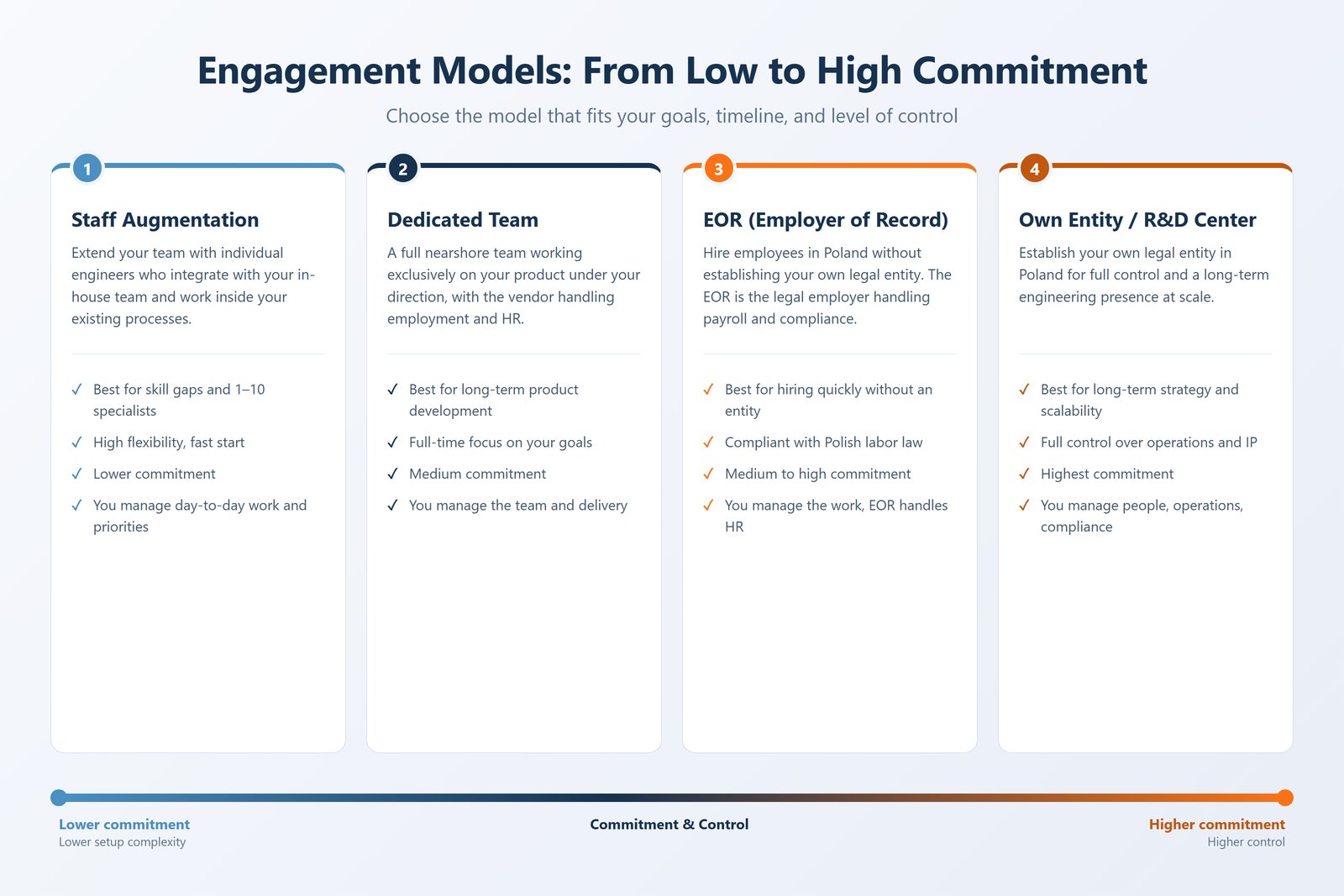
| Model | Control | Setup complexity | Scalability | Best suited for |
|---|---|---|---|---|
| Staff augmentation | High | Low | High | Filling skill gaps / 1-10 specialists |
| Dedicated team | High | Low | High | Long-term product development |
| Project outsourcing | Medium | Low | Medium | Defined, bounded scope |
| Employer of Record (EOR) | Very high | Medium | High | Hiring employees without establishing your own Polish entity |
| Own entity / R&D center | Very high | High | Very high | Long-term strategic expansion |
| Build-Operate-Transfer (BOT) | Very high eventually | Medium-high | Very high | Strategic expansion with a later ownership transfer |
Staff augmentation adds individual specialists into your existing team and processes. It’s the fastest way to fill a specific skill gap, a senior React developer for a six-month push, an extra DevOps engineer during a migration, without building out a whole new team structure. Control stays high because these engineers work inside your team’s existing workflow.
Dedicated teams go a step further: a full nearshore team, sometimes assembled from scratch, that operates as an extension of your internal team under your direction, usually with a vendor handling the local employment, payroll, and HR layer underneath. This model fits companies that need sustained product development over a year or more, not a short-term fill-in, and it’s worth understanding how a dedicated team differs from a lighter-touch extended team before committing to either.
Project outsourcing hands a defined, scoped piece of work to a vendor that manages delivery and project management end to end. You get less day-to-day control in exchange for less management overhead, which works well when the scope is genuinely well-defined upfront and doesn’t need constant redirection.
EOR (Employer of Record) solves a narrower problem: engaging a Poland-based employee without setting up a Polish legal entity yourself. The EOR serves as the legal employer, handling payroll, compliance, and local HR, while you direct the person’s day-to-day work. That split gives you very high control over the work itself without the entity setup that would otherwise be required.
Your own legal entity or R&D center is the highest-commitment option, and the most expensive to set up. It also gives you the most control and, at sufficient scale, can reduce vendor-related marginal costs per hire. This model fits companies planning a multi-year, large-scale engineering presence in Poland rather than a specific project or a handful of roles.
Build-Operate-Transfer structures a path from a vendor-managed team to an owned entity over time: a partner builds and initially operates the team, then transfers ownership and infrastructure to you once it’s proven out. It suits companies that want the lower-risk ramp of a vendor relationship now, with a clear intention to own the operation outright later.
Match the model to your actual timeline and headcount, not to whichever option a vendor’s sales conversation steers you toward. A single specialist for a defined sprint doesn’t need an R&D center. A five-year product roadmap with a growing engineering team, or a build-out serving several client teams internally, probably shouldn’t run on short-term staff augmentation indefinitely.
Legal, IP and Data Protection Considerations
Two different legal questions get bundled together constantly in nearshoring content, and untangling them matters more than almost anything else in this guide: how personal data gets protected, and who owns the code your team writes. They are not the same body of law, and treating them as interchangeable is a mistake that shows up even in content written by companies that should know better.
Data protection runs through the GDPR. As an EU member state, Poland’s data handling is governed directly by the General Data Protection Regulation, which sets the rules for how personal data gets collected, processed, and stored, along with the rights individuals have over their own data. Poland’s own data protection authority, the UODO, enforces this domestically alongside national implementing legislation, so compliance isn’t just an EU-level abstraction, there’s a real regulator behind it inside the country. If your product handles any EU user data, a Poland-based team already operates inside that framework rather than needing a separate compliance layer bolted on. For transfers of personal data from the EU to the US, the mechanism depends on the recipient. Transfers to US organizations participating in the EU-US Data Privacy Framework can rely on the European Commission’s adequacy decision; other transfers may need safeguards such as Standard Contractual Clauses (SCCs). Confirming which situation applies is a question for counsel familiar with cross-border data flows, not something to assume your vendor has already handled correctly on your behalf.
Intellectual property is a separate legal question entirely. Ownership of the code, documentation, and other work product your Poland-based team creates is governed by Polish and EU copyright law, plus whatever assignment terms sit inside your specific contract. GDPR has nothing to do with who owns your codebase. Confusing the two, treating “GDPR compliant” as if it also means “our IP is protected,” leaves a real gap that only gets discovered once it’s already a problem.
IP ownership depends on both Polish law and the contract. Under Article 74(3) of the Polish Copyright Act, economic rights to software created by an employee in the course of their employment generally belong to the employer by default, unless the employment agreement says otherwise. B2B contractors don’t benefit from that same default rule, which makes explicit IP assignment language particularly important in contractor and outsourcing agreements: spell out that work product belongs to you, not the individual engineer or the vendor, from the moment it’s created. NDAs covering both the engagement and individual engineers add another layer, and they’re standard practice rather than an unusual request.
Contractor and EOR structures add their own wrinkles. Whether an engineer works as a B2B contractor, a direct hire, or through an EOR changes who’s legally responsible for what, from tax withholding to termination terms to exactly how IP assignment gets documented. None of these structures is inherently riskier than the others. Each one just needs its own review to confirm the paperwork actually says what you think it says.
This section, like the rest of this guide, isn’t legal advice, and it shouldn’t be treated as a substitute for it. Contract structure, IP assignment language, local labor laws, and data transfer mechanisms should be reviewed by qualified Polish and US legal and tax advisors before you sign anything, not after a problem surfaces.
Risks and Challenges of Nearshoring to Poland
Every model in this guide comes with trade-offs, and pretending nearshoring to Poland is risk-free would undercut everything said so far about honesty over marketing polish. Here’s what actually goes wrong, laid out as risk, business impact, and what mitigates it, rather than a vague list of “challenges” with no path forward.
| Risk | Business impact | Mitigation |
|---|---|---|
| Time zone gap | Slower decision cycles, delayed unblocking | Define a fixed daily overlap window; move non-urgent decisions to async, written formats |
| Senior talent competition | Longer time-to-hire for senior and niche roles | Realistic compensation benchmarking; source across multiple cities, not just Warsaw |
| Compensation growth | Rates negotiated today may not hold multi-year | Build in periodic rate reviews; budget for year-over-year growth instead of treating today’s number as fixed |
| Turnover | Knowledge loss, delivery disruption | Documentation as a standing practice; cross-train so no single engineer is a single point of failure |
| Knowledge concentration | Project risk when one or two people hold most of the context | A deliberate knowledge-sharing cadence; documented architecture decisions, not just code comments |
| Vendor lock-in | Difficult, costly exit from a vendor relationship | Clear IP ownership terms, data export rights, and exit clauses defined in the contract before signing |
| Contractor compliance | Misclassification or payroll/tax exposure across B2B, UoP, and EOR structures | Confirm contract structure with qualified counsel; don’t assume every vendor has this correctly documented |
| Communication gaps | Rework, misaligned expectations | Written specs over verbal handoffs; async-friendly processes; clear single-owner accountability per task |
A few of these deserve more than a table row. Compensation growth is easy to underweight because a rate quoted today feels fixed, and it isn’t. Compensation expectations can shift meaningfully over a multi-year engagement, driven by demand from both local and international employers competing for the same senior talent, and a budget built on this year’s numbers can look outdated by the time a multi-year engagement is two years in.
Talent competition compounds that pressure at the senior end specifically. Hiring difficulty varies substantially by seniority and specialization. Senior specialists, particularly in AI/ML, platform engineering, and security, get competed for by the same pool of international companies opening or expanding Polish engineering hubs, and highly specialized senior roles can require a longer search than broader software-engineering positions.
Vendor lock-in is the risk companies underestimate most, because it’s invisible right up until you try to leave. A dedicated team or staff augmentation arrangement that never had clear IP assignment or data export terms written into the contract can turn a vendor switch into a months-long, expensive extraction process, one that sometimes involves re-hiring the same engineers independently just to keep continuity. Get the exit terms defined before the relationship starts, not after you’ve decided you need to leave.
When Poland Is a Good Nearshore Destination
Strip away the marketing and the decision usually comes down to a short list of conditions. Poland tends to be a strong fit when most of the following are true:
- You’re building a long-term team, six months or longer, not filling a two-week gap.
- The roles you need sit at mid to senior level, in stacks where Poland’s talent pool runs deep: Java, JavaScript/TypeScript, .NET, Python, cloud, and increasingly AI/ML.
- Your product handles EU user data, and GDPR-aligned infrastructure and processes matter to how you operate.
- Your workflow can tolerate partial-day overlap and genuinely async collaboration, rather than requiring full real-time coordination with your core US team.
- You’re comparing Poland against other CEE or EU options, Romania in particular, and value Poland’s larger talent pool and more established enterprise ecosystem enough to justify the cost difference.
- You want a partner or team that’s done large-scale outsourcing work before, not a market still figuring out how distributed engineering operates.
Notice what’s missing from that list: “lowest possible cost” and “exact same time zone as our team.” Neither one describes Poland accurately, and building your decision around either sets the wrong expectations from day one.
When Poland May Not Be the Best Choice
Poland isn’t the right answer for every engineering need, and a decision guide that only tells you when to say yes isn’t being straight with you. Skip it, or at least weigh it carefully against alternatives, if any of these describe your situation:
- You need full-day overlap with a West Coast team. With an eight- to nine-hour gap to Denver and Los Angeles, real-time collaboration across a normal US workday isn’t realistic. LATAM will serve that need better.
- Absolute lowest cost is the priority, above everything else. Poland’s costs sit meaningfully below the US, but other markets, India and parts of LATAM among them, typically come in lower still.
- The engagement is very short, a few weeks, a single sprint, a proof of concept. The ramp-up time to onboard a new team or contractor rarely pays for itself on that short a timeline, regardless of location.
- You need daily, synchronous pairing with Pacific-time engineers. The overlap window at that time difference is thin enough that it stops functioning as a real collaboration window and becomes just an inconvenient one.
If two or more of these match your situation, Poland is probably the wrong starting point, whatever a vendor’s pitch deck tells you.
How to Start Nearshoring Software Development to Poland
Timelines vary significantly by role, seniority, team size, and engagement model, faster for a single specialist, slower for a multi-person dedicated team that requires more coordination on both sides. What stays constant is the sequence below: skip a step to move faster, and it usually costs more time later, not less.
- Define the tech skills gap precisely. Not “we need developers,” but which stack, which seniority level, and which specific outcomes this hire or team needs to deliver.
- Pick the engagement model that fits your timeline. Staff augmentation for a defined gap, a dedicated team for sustained product work, an EOR if you’re hiring a specific person without a Polish entity.
- Set a realistic budget using TCO, not a headline rate. Build in employment costs, management overhead, and the other line items covered earlier, not just an hourly number a vendor quoted on a first call.
- Shortlist partners or direct-hire channels. Vendor selection deserves its own process, covered in the next section, rather than picking whoever responds fastest to an inbound inquiry.
- Confirm legal structure before you commit. B2B, EOR, or entity, decide which fits your situation and get the paperwork, IP assignment included, reviewed by counsel before candidates start interviewing.
- Define your overlap hours and working agreement upfront. Set the daily window that works for both sides before the team starts, not after the first missed handoff.
- Run a real interview process, not a resume review. Insist on the ability to interview candidates directly rather than accepting a vendor’s internal vetting as the only filter.
- Start with a pilot, not a full build-out. One to three engineers for the first 60 to 90 days gives you a real read on quality, communication, and delivery before you commit to a larger team; it also gives you time to settle into managing a distributed team well before scaling it.
- Set KPIs before the pilot starts, not after. Delivery velocity, code quality, communication responsiveness, whatever matters most to your team, agree on what success looks like before you’re evaluating it in hindsight.
- Scale based on results, not on the original plan. If the pilot delivers, expand the team deliberately, adding roles as real need emerges rather than front-loading a large team based on an initial estimate that may not hold once work actually starts.
Ten steps, but the sequence matters more than the count. Skipping straight from step one to step eight, defining the gap and then jumping to a full team, is how companies end up with a five-person dedicated team built around assumptions nobody tested with a smaller pilot first.
How to Choose a Software Development Partner in Poland
Both partner quality and engagement-model fit materially affect the outcome, and it’s easy to spend all your time picking the right model while treating vendor selection as an afterthought. Not every one of the outsourcing companies active in Poland runs due diligence, delivery capabilities, or client relationships the same way. A good dedicated team with the wrong vendor underneath it still fails, and a well-run staff augmentation relationship with the right partner can outperform a more elaborate structure poorly executed.
Due diligence here isn’t optional, and it isn’t complicated either, it just requires asking direct questions and being willing to walk away from vague answers. This applies whether you’re evaluating large nearshore companies or a smaller shop staffed mostly by nearshore developers working B2B. Before signing anything, get clear answers to these:
- Who employs the engineers, the vendor, an EOR, or you directly?
- Who owns the source code and documentation, and where does that ownership sit in the contract?
- What happens if an engineer leaves mid-project, and how fast can they be replaced?
- How quickly can the vendor actually replace a specialist, with a real number, not “quickly”?
- Which working hours overlap with your US team, confirmed, not assumed?
- Can you interview engineers directly before they’re assigned to your project?
- Which security standards and controls does the vendor actually use, ISO 27001, SOC 2, or otherwise?
- How is personal data handled, and does that align with your GDPR obligations?
- What’s actually included in the hourly or monthly rate, management overhead, benefits, recruiting fees, or just the engineer’s time?
- What happens if you terminate the engagement, notice period, transition support, data handover?
A vendor that answers all ten clearly and specifically is worth a serious look. A vendor that gets vague, defensive, or evasive on any of them, particularly questions 2, 3, and 10, is telling you something important before you’ve signed anything.
One more thing worth checking that doesn’t fit neatly into a checklist: ask for references from clients who’ve stayed with the vendor for two or more years, not just recent logos on a homepage. A partner that retains clients over the long term is showing you something a case study can’t.
Treat the sales conversation itself as a data point too. A vendor spending most of the call on their own credentials rather than asking about your specific engineering needs is previewing how the relationship will run once you’re a client rather than a prospect. The nearshore partnerships worth entering usually start with a vendor asking more questions than answering them in that first call, not the other way around. The best of these relationships grow into strategic partnerships rather than staying transactional staffing arrangements.
The Bottom Line
Poland isn’t the cheapest place to hire engineers, and it isn’t the closest to a US workday either. What it offers is a large, genuinely deep technical talent pool, a legal and data protection framework that already sits inside the EU’s regulatory structure, and an IT industry mature enough to have already worked through most of the operational problems newer markets building nearshore teams are still figuring out.
That combination fits some US engineering needs very well: long-term nearshore teams, EU-facing products, mid-to-senior technical depth across a wide range of stacks. It fits others poorly: same-day West Coast collaboration, the absolute lowest possible rate, or a two-week project that doesn’t justify any ramp-up time at all.
The right next step isn’t picking a location because it topped a search result. It’s running the numbers above against your specific team, timeline, and budget, and choosing a partner willing to answer the ten questions in the checklist above without flinching. If you’re ready to put those questions to a partner directly, get in touch and start with a conversation, not a contract.
Sources
Poland official statistics
- Statistics Poland - Information Society in Poland 2025
- Statistics Poland - Higher education in the 2024/2025 academic year
- PARP - The IT/ICT Sector in Poland, Report 2025
- PAIH - The Information & Communication Technology Sector
EU-level sources
- Eurostat - ICT specialists in employment
- Eurostat - ICT specialists databrowser (isoc_sks_itspt)
- European Commission - Poland’s 2026 Digital Decade Country Report
- European Commission - Data protection: adequacy decisions
- European Commission - Q&A: EU-US Data Privacy Framework
Legal
- WIPO Lex - Poland, Act on Copyright and Related Rights (includes Article 74(3))
Salary and vendor rates
- Just Join IT - Salary Report 2026
- Devico - Software Development Rates in Eastern Europe, 2026 breakdown
US benchmark
- US Bureau of Labor Statistics - Occupational Employment and Wage Statistics, Software Developers
English proficiency
- EF English Proficiency Index - Poland
Time zone
- Timeanddate - World Clock: Warsaw vs. New York, Denver, Los Angeles


