Overview
Staff Augmentation is a business practice that can be traced as far back as the Industrial Revolution. Notable advancements in industry drove the need for a flexible workforce that businesses could scale up or down according to available jobs. This was especially common within sectors where short-term project commitments were rampant, such as construction and oil exploration.
In today's parlance, staff augmentation is almost exclusively used to refer to temporary hiring practices in the IT industry. But what does staff augmentation mean in the context of information technology, and why is it such a sought-after practice in IT? We answer these questions and more in this article. We also have a detailed guide on IT staff augmentation in 2025, so be sure to check it out.
What Is Staff Augmentation?
Staff augmentation is an outsourcing strategy used by tech companies to hire external professionals to supplement in-house teams temporarily. The definition of staff augmentation is incomplete without outsourcing. It is the basic foundation on which staff augmentation is built. You can learn more in our article on what staff augmentation is.
Businesses looking to bolster their existing in-house teams with new tech talent outsource the recruitment of augmented staff to a third-party outsourcing company like Softellar. Depending on the business' project needs, the staff augmentation provider then puts together a team of competent developers or engineers to work on that project till it is completed or until their obligations are contractually fulfilled.
Benefits of Staff Augmentation Services
What are staff augmentation services? These are flexible cooperation models to provide skilled IT professionals, developers, and engineers to clients on a contract basis to supplement the client's existing workforce.
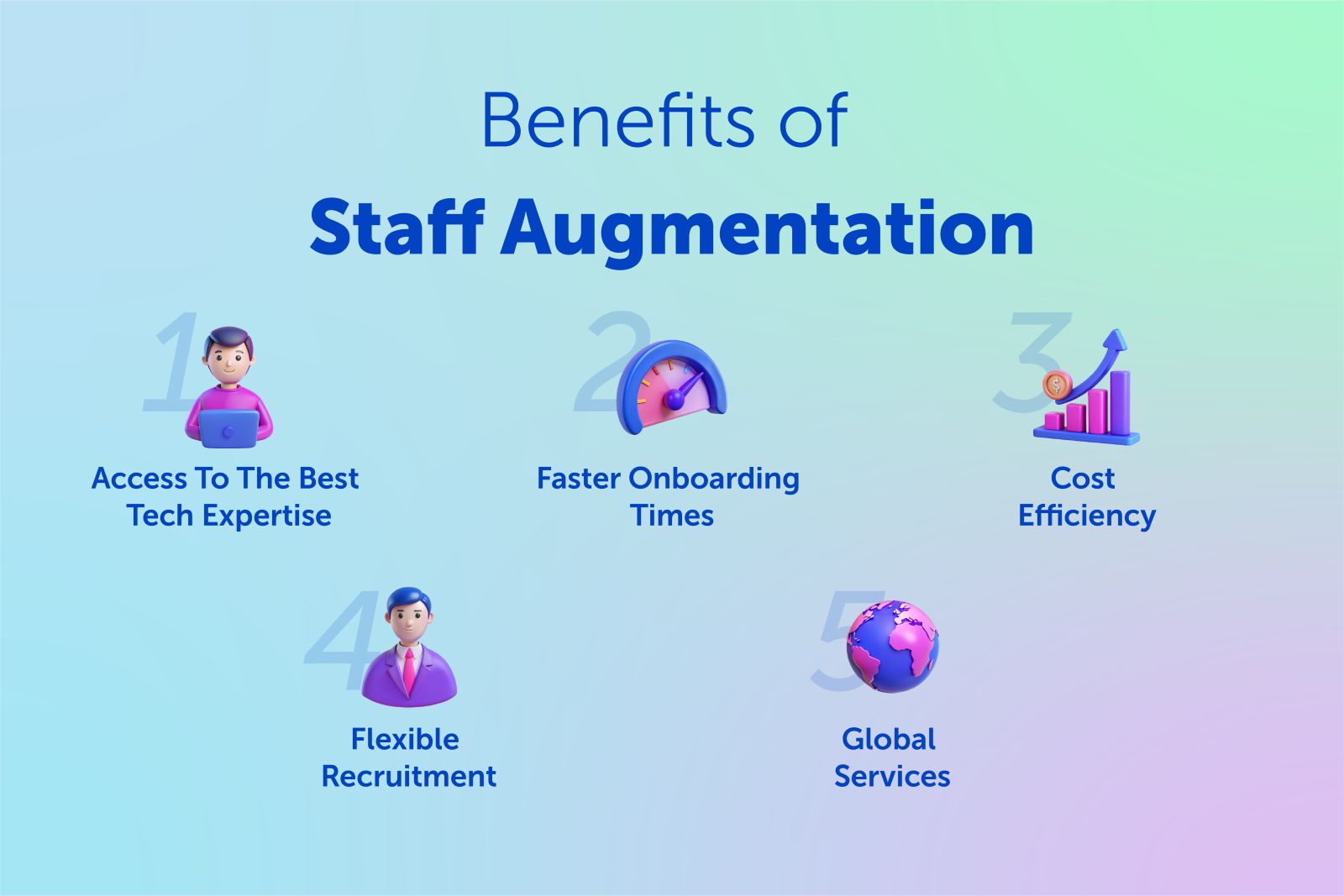
One of the many reasons why staff augmentation services are widely adopted in IT is that the concept lends itself to the very nature of the industry's fluctuating skill requirements and timeline-based projects. Beyond this, staff augmentation also promises a host of financial and operational advantages to IT companies adopting the practice. This includes:
Access to the Best Tech Expertise
Digital products go through multiple phases to become the apps and software we're all familiar with. These development phases all require specific tech expertise that may not be available in-house.
Tech team augmentation assuages any hiccups a lack of expertise could cause in product development by providing external software developers and engineers who can contribute their years of experience to the actualization of project goals.
As an IT company, all you need to do is figure out areas in your software development life cycle requiring extra hands – from backend development to data analytics staff augmentation – and the caliber of personnel you'll like working on these areas. The company providing augmentation services then seeks out these professionals, conducts due diligence in the form of CV reviews and interviews, and recommends the most outstanding individuals.
Faster Onboarding Times
Traditional methods of vetting and hiring developers often reduce the time and resources available for project execution. An IT company looking to staff up would have to draft a job description and upload it on job portals or freelance sites. Then, the HR department would have to sift through thousands of resumes, shortlist the best candidates, and onboard the hired individuals. This recruitment process may take several weeks or months to complete.
In the staff augmentation business model, the same process takes days or a few weeks maximum. The augmentation provider typically already has the experts on call, and they are responsible for onboarding them on the project's scope.
Cost Efficiency
For many IT projects, having a dedicated in-house team is non-negotiable. Without them, organization-wide operations may not function as they're supposed to. However, in some cases, the cost of hiring full-time staff can significantly take away from the resource pool budgeted for a project. Staff augmentation service providers like Softellar help businesses limit personnel and operational costs by giving access to first-rate development talent for a fraction of the investment.
Flexible Recruitment
Flexibility is the strategic imperative behind staff augmentation. In tech environments, business priorities often fluctuate with evolving trends and customer demands. This often means that an organization's demand for skilled workers may vary based on a particular project's technical requirements.
Team augmentations offer a flexible and scalable employment model that is much more prudent and ethical. It negates the complications that come with hiring staff full-time only to lay them off after a project is concluded.
Global Services
On some development projects, it may prove expensive or challenging to source tech professionals with experience in pertinent roles locally. Staff augmentation companies, on the other hand, are not constrained by geographical locations. They can go beyond borders to find qualified IT specialists that integrate seamlessly into your project ideas and organization culture.
Ready to Experience These Benefits?
Discover how staff augmentation can transform your IT projects. Our experts will help you implement this flexible model, from identifying skill gaps to seamless team integration, ensuring faster project delivery and cost efficiency.
Staff Augmentation Models
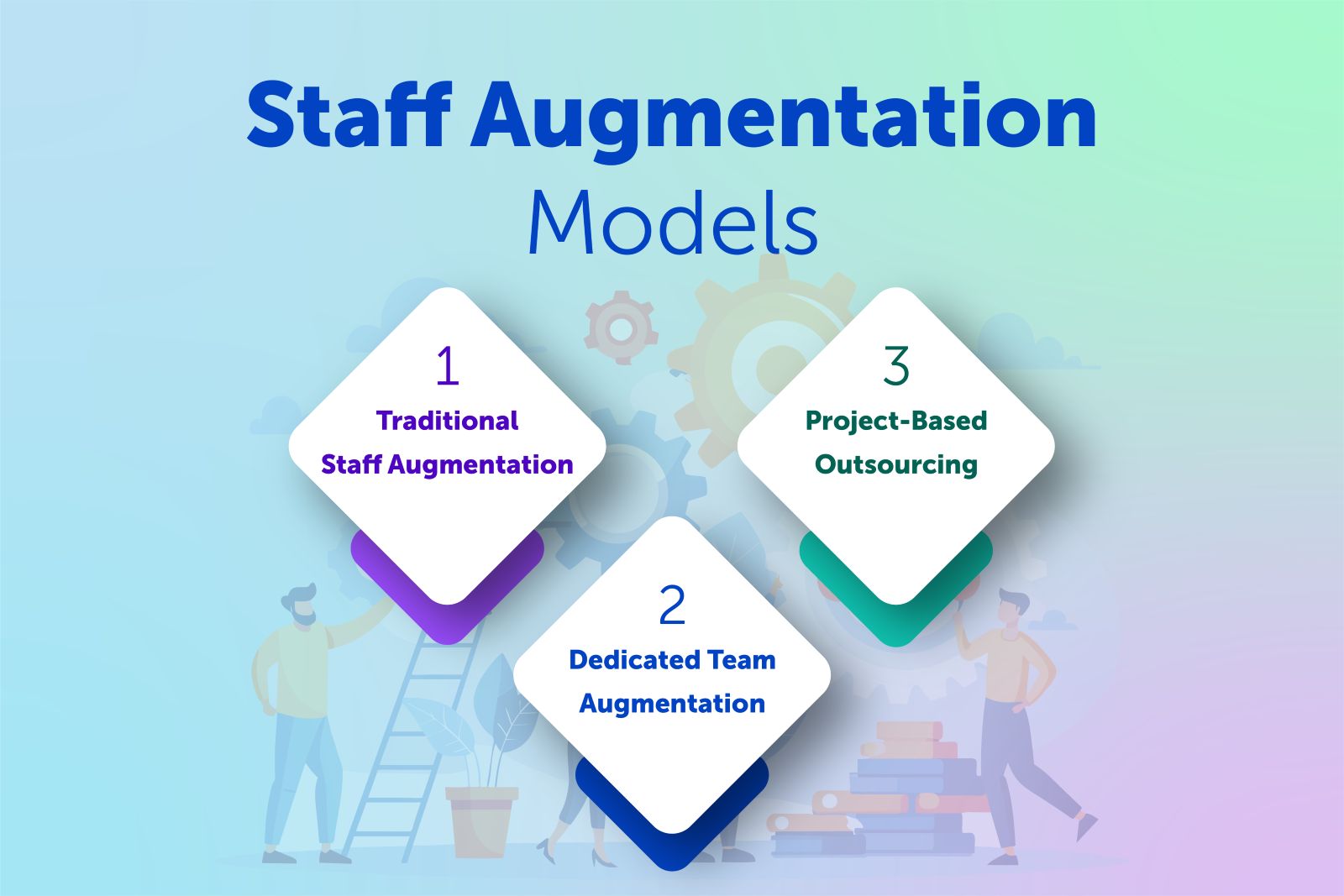
There are different types of staff augmentation models that suit varying project needs and organizational structures. Over the years, staff augmentation meaning has stayed the same. Still, the models of staff augmentation services have differed to cater to the unique tech assignments of organizations in different industries. If there ever was a question of what does a staff augmentation firm do? Here is the answer – they provide flexible staff augmentation models. These models may include:
Traditional Staff Augmentation
This is the most basic employee augmentation model provided by IT solution firms. In this model, businesses hire skilled professionals under the aegis of third-party recruiters to fulfill short-term project demands that in-house staff cannot meet due to knowledge gaps or time limitations.
Dedicated Team Augmentation
The dedicated team augmentation model takes a more nuanced approach to staff augmentation. Here, your staffing agency assembles a comprehensive team of development and operations experts to collaborate with your existing staff on your project throughout the duration of its development and deployment. These teams report to your project managers directly and stay committed to your project objectives till positive outcomes are achieved.
Project-Based Outsourcing
There's a case to be made for project outsourcing not being an augmentation model. This model doesn't fit the staff augmentation definition we discussed earlier because it does not supplement or augment any in-house personnel.
Rather, the entire software development process is handed over to an augmented team put together by a staff augmentation firm.
Project-based outsourcing differs from dedicated team augmentation in the sense that the team is not supervised by company staff, and the responsibility of ensuring timely product delivery falls completely on the augmentation firm.
Reasons to Choose Staff Augmentation
For all the benefits staff augmentation provides, there is a reason why it's still not the de facto employment model used by IT firms. Staff augmentation can provide immense value in the right scenarios, but it also comes with certain tradeoffs. Companies should assess their specific needs and constraints to determine if augmentation makes sense or if alternative staffing strategies may be preferable.
Special Projects
One of the clearest cases for staff augmentation is taking on discrete special projects that fall outside the organization's core competencies. Initiatives like developing custom software, building a mobile app from scratch, overhauling cybersecurity protocols, or leading a machine learning pilot – possibly requiring C++ outsourcing or other niche skills – likely require unique skill sets on a temporary basis.
Seasonal Demands
Companies in industries with significant seasonal fluctuations in workload like retail, tourism, and accounting can benefit immensely from flexible staffing to meet periodic demands. Maintaining a permanently larger team year-round to cope with holidays, tax season or summer travel spikes may not make fiscal sense. Augmented staff can expand capacity when needed.
Testing New Initiatives
In cases where companies are exploring new offerings, entering new markets or taking on considerable business risk, augmentation allows them to test potential growth areas without long-term commitment. If a new product fails or expansion plans fizzle, costly restructuring can be avoided. Augmentation offers more flexibility until initiatives prove viability.
Sudden Vacancies
Rather than hastily hiring replacements when unexpected vacancies arise due to resignation or leave, staff augmentation can fill gaps on an interim basis. This offers breathing room for companies to thoughtfully assess ideal skills fit, avoid recruiting mis-hires, and take time to properly onboard the best permanent team members.
When evaluating engagement models, it's helpful to understand the differences between staff augmentation vs. professional services to make an informed decision.
Factors to Consider When Choosing a Staff Augmentation Model
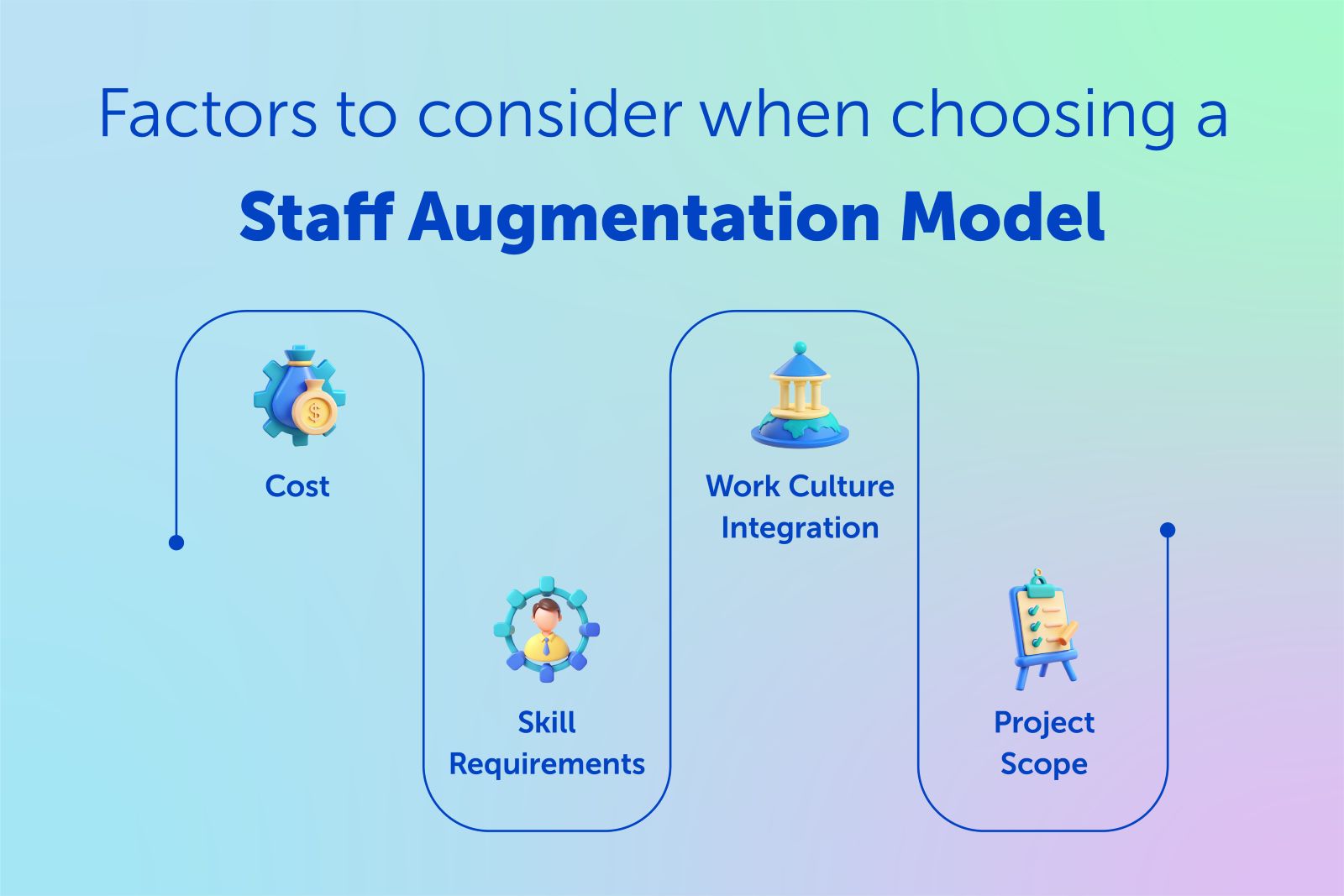
Cost
One of the main determiners of an optimal staff augmentation model is its overhead cost. In terms of both salaries and benefits, the cost of staff augmentation often pales in comparison to the cost of hiring full-time employees. However, there's a wide discrepancy in how staffing agencies price their services. This makes it crucial to compare the total cost of augmentation services to the cost of hiring full-time staff before committing to an augmentation model.
Skill Requirements
What tech skills are needed to fill the staffing positions being augmented? This is an important consideration that determines not just the augmentation model that will be required but also the staffing agency that will be providing it.
Some augmentation agencies specialize in staffing junior tech roles, while others only staff senior developers and engineers – or offer focused services like manual QA augmentation for product testing teams.
Work Culture Integration
A critical aspect of the staff augmentation process is onboarding augmented teams onto organization projects. As such, when choosing an augmentation model, special attention must be paid to the ability of the augmented teams to integrate with staff and collaborate seamlessly. New employees coming aboard a project should be vetted to ensure they possess the necessary skills to thrive in their assigned roles.
Project Scope
When choosing a staff augmentation model, the project scale and timeframe factor into the equation significantly. This is one of the main reasons why various staff augmentation models exist in the first place – to cater to varying business needs across industries.
While short-term projects might benefit from a traditional augmentation model, startups or established entities may get more value from a dedicated team of developers.
Steps of the Staff Augmentation Process
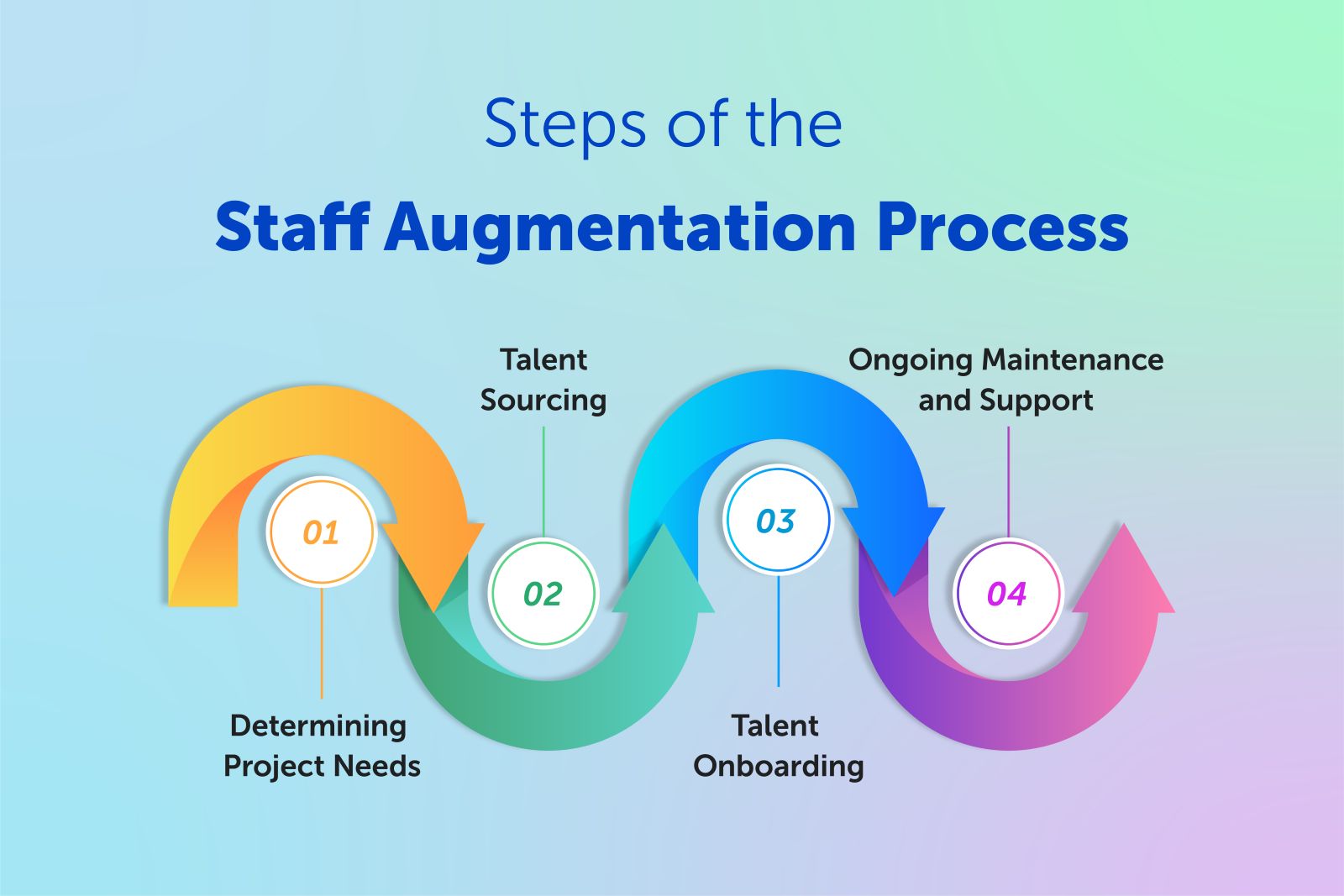
Determining Project Needs
In the initial phase of a staff augmentation project, your staff augmentation provider assesses the current capabilities of your in-house teams to identify project areas with insufficient human resources. This helps the incoming augmented teams get a clearer vision of their role in the development process and the objectives they must achieve to be considered successful.
Talent Sourcing
The next step involves picking the most suitable candidates for the project. Ideally, your augmentation partner organizes vigorous vetting exercises for each candidate to ensure all talents coming on board are well-equipped to tackle challenges that may arise as the job progresses.
Talent Onboarding
Depending on the organizational layout, the staffing agency or in-house managers can handle the job of training and integrating new team members. This onboarding phase is vital because it helps to streamline project progress by ensuring everyone working on the project is on the same page.
Ongoing Maintenance and Support
Staff augmentation firms worth their salt understand the value of providing guidance and support to newly augmented teams throughout the lifecycle of a project. This essential final step helps to keep augmented teams productive and on track with project goals.
Conclusion
A succinct way to define staff augmentation is as a business model IT companies use to supplement their internal teams with external expertise temporarily. With various augmentation models available, this flexible employment model promises faster onboarding times for new hires and cost savings for employees, ultimately bringing down the operational cost of software development projects.
The practice particularly shines when applied to special projects with seasonal demands or when testing novel initiatives. However, getting staff augmentation right hinges on selecting the right augmentation partner. A combination of factors, such as the cost and scope of the project, as well as the cultural compatibility of the work environment, all play a role in this regard.